




Sign In to Your Account
Subscribers have complete access to the archive.
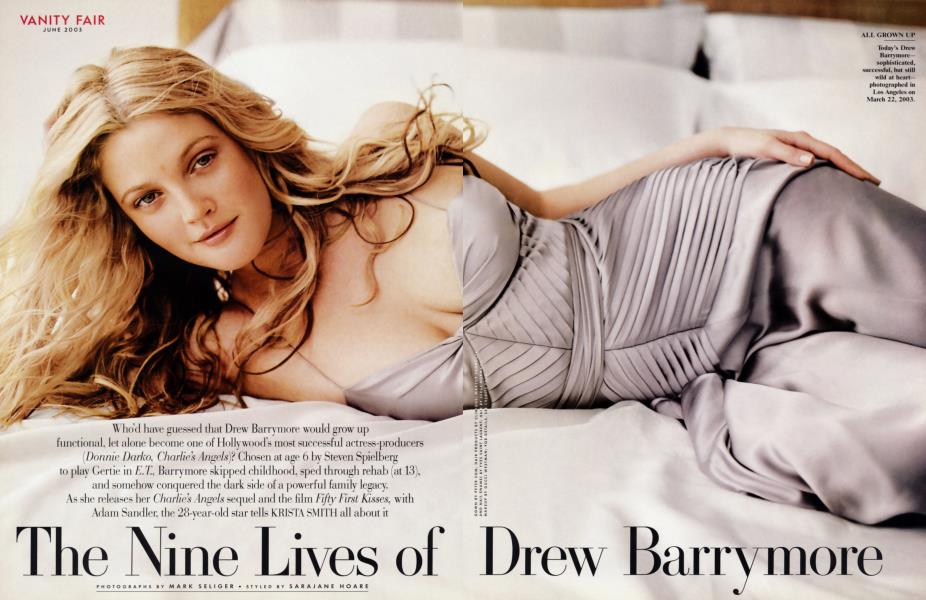
Sign In Not a Subscriber?Join NowWho'd have guessed that Drew Barrymore would grow up functional, let alone become one of Hollywood's most successful actress-producers (Donnie Darko, Charlie's Angels)? Chosen at age 6 by Steven Spielberg to play Gertie in E.T., Barrymore skipped childhood, sped through rehab (at 13), and somehow conquered the dark side of a powerful family legacy. As she releases her Charlie's Angels sequel and the film Fifty First kisses, with Adam Sandler, the 28-year-old star tells KRISTA SMITH all about it
Who'd have guessed that Drew Barrymore would grow up functional, let alone become one of Hollywood's most successful actress-producers (Donnie Darko, Charlie's Angels)? Chosen at age 6 by Steven Spielberg to play Gertie in E.T., Barrymore skipped childhood, sped through rehab (at 13), and somehow conquered the dark side of a powerful family legacy. As she releases her Charlie's Angels sequel and the film Fifty First kisses, with Adam Sandler, the 28-year-old star tells KRISTA SMITH all about it
 ALL CROWN UP Today's Drew Barrymore— sophisticated, successful, but still wild at heartphotographed in Los Angeles on March 22, 2003.
Drew Barrymore has never been one to conceal how she's feeling. "I'm so nervous I could vomit," she tells me as we ride across Los Angeles in the backseat of a hired town car. "Usually I love a crowd—bring on the people—but tonight I am really nervous."
Our destination is a Global Vision for Peace press conference, for which Barrymore has been asked to read an anti-war speech written by the Dalai Lama. It's been 24 hours since war broke out in Iraq, and in that time the number of people expected at the event has doubled to about 500. Barrymore grew up on-screen, appearing in more than 35 movies since her debut at the age of three, but her role in this historic moment is all too real. She's been reading and rereading the speech all day, but she hasn't memorized it, "because they're not my words, they're his." She adds, "I want to do it perfectly and honorably. I feel so lucky because I've been praying and praying for a way to do something productive in the world right now."
Barrymore is dressed simply and elegantly in a chiffon shirt and blazer, her long blond tresses pulled back into a low ponytail. She doesn't want to make any kind of statement with her clothes. However, a pair of flat red Mary Janes, borrowed from her Charlie's Angels co-star Lucy Liu, peek out from under her trousers. She tells me she was going to wear her Chuck Taylors, but thought better of it at the last minute.
We arrive at the former estate of the silent-screen queen Norma Talmadge in Los Feliz, an artsy neighborhood on the east side of L.A., where the conference is being held. Chris Miller, a vice president of Barrymore's production company, Flower Films, greets us. He can tell immediately that Barrymore is anxious, so to distract her he starts quoting lines from the 1981 camp classic Mommie Dearest. "There is a liquor store to the right," he says.
"I should have known you'd know where to find the boys and the booze!," Barrymore fires back, doing a flawless imitation of Faye Dunaway as Joan Crawford.
Then together they cry, "Tear down that bitch of a bearing wall and put a window where it oughta be!"
It works. Instantly, Barrymore is laughing and looking more relaxed. Seeing her like this, I can almost forget that she's Drew Barrymore, the girl who's been famous almost since birth. Moments later, however, the illusion fades as she is escorted to the podium and greeted with a blinding eruption of camera flashes.
"Although everyone wishes to live in peace," she reads, "we are often confused about how it can be achieved. Violence inevitably leads to more violence. It is not the solution—definitely not in the long term.... It has never been more urgent that we seek a genuine determination to achieve global demilitarization_To begin with, we need to embark on the difficult task of developing love and compassion within ourselves."
It's obvious now why Global Vision for Peace chose her. In addition to a natural earnestness and enthusiasm that are rare in anyone, let alone a Hollywood ingenue, Barrymore possesses a commanding presence that belies her diminutive stature (she's five feet four), and there is a surprising gravitas behind her unmistakable Cindy Brady voice. Standing in the crowd and watching her, beautiful and luminescent, calmly read the words of the Dalai Lama, I can't help but be amazed: Who would have thought Drew Barrymore would ever amount to so much?
Why didn't she crash and burn years ago? How did she survive her child-stardom, when so many have failed before her? It occurs to me that had she not landed in rehab as a teenager she might well have ended up cutting hair in Kansas instead of speaking to a crowd of reporters and luminaries about the virtues of peace.
Listen, at some point she'll probably run a studio and pull me out of retirement, says Steven Spielberg.
At the reception immediately following the press conference, Barrymore mingles easily, a drink and cigarette in hand. s, she still drinks and smokes, but only in moderation. These days she's hooked on work, not chemicals. To attend tonight's event, she had to get special permission to leave the set of Fifty First Kisses, her second romantic comedy with Adam Sandler. (The first was The Wedding Singer.) She'll be back there tomorrow before most people at the reception have crawled out of bed.
Meet the new and improved Drew Barrymore, who, without sacrificing her free-spirited persona, has defied countless dire predictions and become a prolific actress and a reliable hit-maker. She is still the same self-described "sunshine junkie" who for years refused to eat meat or wear leather. (She does both now, though she continues to eschew fur.) She still talks like a Valley Girl, professes an unabashed love of beauty products, and freely mixes Marc Jacobs designs with her favorite vintage finds. She does not shy away from burping audibly or discussing how important "regularity" is to her, and she has never bothered to memorize her home phone number. And yet, at just 28, Drew Barrymore has one of the most successful production companies of any actress in Hollywood.
In the nine years since Barrymore founded Flower Films with her partner, Nancy Juvonen, the company has specialized in quirky hits such as Never Been Kissed (1999), in which Barrymore was joined by John C. Reilly, Molly Shannon, and Leelee Sobieski, and Donnie Darko (2001), which starred the Gyllenhaal siblings. The sequel to Charlie's Angels, the company's biggest hit to date, comes out this month. In October, Flower Films will release Duplex, with Ben Stiller, followed by Fifty First Kisses on Valentine's Day weekend.
One person who is not surprised by Barrymore's success as a producer is the man who discovered her. Steven Spielberg, who cast a six-year-old Drew as the lovable little sister, Gertie, in his 1982 mega-hit, E.T. The Extra-Terrestrial, observes, "She was a producer at six years old. She came on board E.T. with a lot of ideas of how the story should be told. Drew did nothing but offer one good idea after another. Now she's a 28-year-old whose ideas are becoming cottage industries like Charlie's Angels and Donnie Darko.
"Listen," Spielberg adds, "at some point she'll probably run a studio and pull me out of retirement and give me a good script to direct."
"I wanted to enable myself to go further than just being an actor," Barrymore says of her decision to branch out into producing. "I've never sat by the phone. I hate waiting around. I like to make it happen. I'm not a control freak—well, I probably am. But why sit around and think, What if ... ? or, If I could just get in there ... You have to get in there." She continues, "Nothing in my life has come from sitting back and watching or thinking that someone else will take care of it. I've just found that I'll always have to get up by myself and do it. And as exhausting as it is, it is invigorating at the same time."
McG (Joseph McGinty Nichol), the director of Charlie's Angels and the upcoming Charlie's Angels: Full Throttle, describes Barrymore as "the secret weapon of all time" and says her combination of business sense and charm is irresistible. "You go up to her mid-century Hollywood lair, where the Beatles used to record and the Rat Pack used to hang out with Angie Dickinson, and you go swimming and you play with her dogs and by the time you're done with that afternoon you've agreed to everything she's ever asked for."
Actor Sam Rockwell puts it another way. "She kind of makes me feel like my cock is 10 feet long," he says. Rockwell starred in George Clooney's directorial debut, Confessions of a Dangerous Mind, in which Barrymore gave what may be the best performance of her career. "She has that bubbly quality in life, and she's able to put that onscreen," Rockwell says, "and that's not easy. The movie works because she is the light in the film. Everybody loves Drew Barrymore, so if she loves this guy Chuck Barris, who does all these horrible things—exploits people on TV, [commits] adultery, kills people off—if she loves him, then he can't be all that bad."
Rockwell had never met Barrymore when she approached him about playing the villain in the first Charlie's Angels. There was no script for him to read, so she sent him a video compilation of scenes from other films which she felt captured the tone she was hoping to achieve. "Her knowledge of film is unbelievable," Rockwell says. "You can look at it and go, 'Well, she's nuts,' but you can also look at it and go, 'Wait a minute—she's a fucking genius.' "
I was able to get a copy of Barrymore's 80minute montage, which included clips from Lost in America, The Jerk, The Red Balloon, and Raging Bull, to name just a few, and featured performances by everyone from Bruce Lee to Peter Sellers. "I always make compilations for a film, because I want everyone to know specifically what page I'm on," says 2 g Barrymore, who worked at a video store as " a teenager. "I can talk until the cows come home, and I do, but I love giving those references out. I love every single detail in a movie. Every shot, every moment, every intricacy."
When I visit Barrymore's trailer on the W set of Fifty First Kisses, she is giving her final approval to the marketing campaign for Charlie's Angels: Full Throttle, which wrapped just three weeks ago. Photographs of Barrymore with her co-stars, Lucy Liu and Cameron Diaz, whom she affectionately calls Pussy and Poo, respectively, are stacked in boxes on the sofa.
I have already been to the editing room and seen some scenes from the film, which, like its predecessor, is a sexy, fast-paced monument to California cool. The formula is simple: hot girls doing guy stuff—wrestling, surfing, driving monster trucks and muscle cars— without losing their girlish identities. "How do you have girls who are that wickedly capable," Barrymore asks, "but who totally laugh at themselves and eat and have fun and enjoy women, and yet love men and want to see them at the end of the day? Those are the things I wanted to incorporate into the film."
For the sequel, Barrymore persuaded Demi Moore, who hadn't made a movie in several years, to play the role of Madison Lee, the "fallen Angel." "They asked if I would just sit down with them, because they didn't have a script to show me," remembers Moore, who, at 40, holds her own standing next to Cameron Diaz in a black bikini. "The feeling from them was that I was the only one they wanted to do this character." Like so many people I speak to, Moore says she was won over by Drew's absolute belief in the project: "The predominant element that was there from the first moment I sat down with them until the last day of shooting was this tremendous, very uplifting passion and enthusiasm."
Barrymore also recruited the stand-up comedian and sitcom star Bernie Mac to replace Bill Murray as the middleman between the elusive Charlie and his Angels. "I was so flattered," Mac tells me. "I wanted to bring some Mac flavor and shit, and Drew allowed me to do that. I was really impressed by the chemistry that she had with the girls. You could see that they had built a relationship around one another, that they respected one another, which is very important in this crazy-ass business."
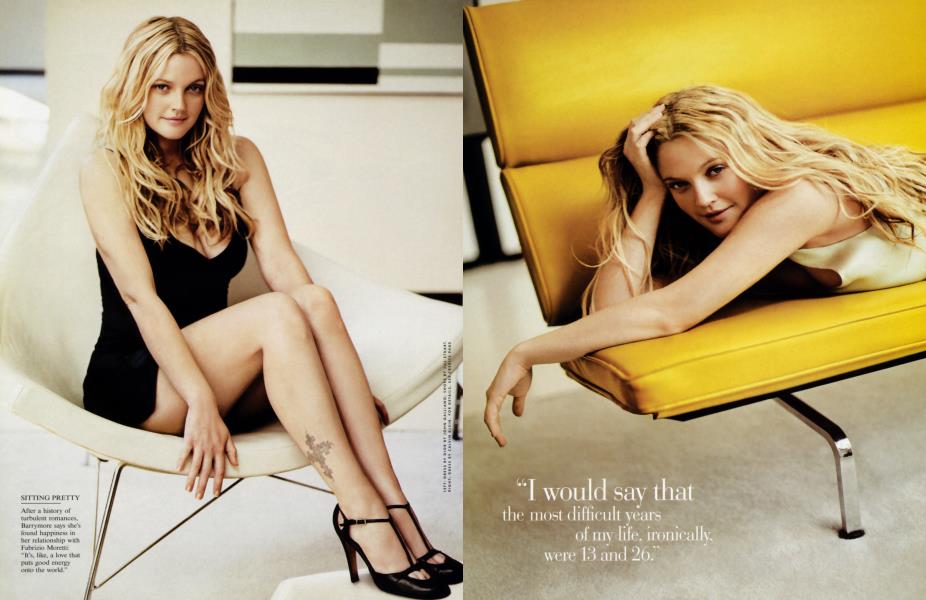
"I would say that the most difficult years of my life, ironically, were 13 and 26.
The closed set of the original Charlie's Angels movie became the subject of endless gossip in the months before its release. There was an infamous altercation between Lucy Liu and Bill Murray, and word leaked out of endless script revisions and budget overruns. Some predicted it would be the biggest flop since Waterworld.
"I was very stressed out," Barrymore remembers, "wondering if we were going to be able to keep our promises, not only to Sony but to every actor. The pressure was enormous, but I just stayed focused on the film that I knew I'd set out to make."
The gamble paid off handsomely. When Charlie's Angels hit theaters in 2000, audiences embraced its fizzy mix of sex appeal, martial-arts action, loud music, and pop culture. It went on to gross $263 million worldwide.
Since making the first film together, Barrymore, Diaz, and Liu have become close friends and spend time together as often as possible. "Drew's just so open," Liu tells me. "She lays it all on the line both personally and professionally, and she lives without guile or ego." But Liu also acknowledges the unique circumstances that set Barrymore apart from other actresses. "Fans have an emotional reaction to her; people feel attached to her. I have never seen that before. She is not aware of all the people she's touched."
From the beginning, Drew Barrymore's -T life was anything but ordinary. John Barrymore Jr., her physically abusive, alcoholic father, and Ildiko Jaid Mako, her eccentric mother, had already parted ways by the time Drew was born on February 22, 1975. A struggling actress, Jaid relied heavily on baby-sitters (including Drew's troubled half-brother, Johnny), who would stay with Drew at the Barrymores' small, one-bedroom apartment while Jaid attended auditions and worked at various waitress jobs. "Drew is a person who had to raise herself, had to parent herself," says John Calley, chairman and C.E.O. of Sony Pictures, which owns Columbia Pictures, the studio that underwrote the Charlie's Angels films. "She has an internal sense of decency and a need to achieve and honor her heritage."
Drew landed her first acting job, a commercial for Puppy Chow, when she was 11 months old. It was a modest beginning to a career that would confirm her as the rightful heir to her family's celebrated theatrical legacy. Drew's great-great-grandfather John Drew was an Irish-born Shakespearean comic actor who, together with his wife, Louisa Lane Drew, became the founding couple of an extraordinary dynasty. Their daughter, Georgiana Drew, and her husband, Maurice Barrymore (bom Herbert Blythe), were accomplished actors in their own right, but their children, Lionel, Ethel, and John (Drew's grandfather), were a phenomenon, known collectively as "the first family of theater." (Drew's godmother is Anna Strasberg, widow of Lee Strasberg.) The Barrymore siblings were as self-destructive as they were successful, with the possible exception of Ethel, who lived to the age of 80 and became so associated with the stage that in the 1952 musical Singin in the Rain Gene Kelly greets Debbie Reynolds, playing an aspiring thespian, with "Well, if it isn't Ethel Barrymore!" Lionel, who was predominantly a character actor, was confined to a wheelchair at age 59 as a result of crippling arthritis and is best known to audiences today for playing the sinister millionaire, Mr. Potter, in It's a Wonderful Life.
Drew's grandfather John Barrymore, known in his lifetime as "the world's greatest actor," moved to Hollywood in the 1920s and married the third of his four wives, the actress Dolores Costello, in 1928. They had two children, Dolores Ethel Mae and John junior (Drew's father), but after seven years Dolores became fed up with Barrymore's drinking and womanizing and left him. Toward the end of his life, John Barrymore, racked by alcoholism, was reduced to reading off cue cards, and he died prematurely, at the age of 60. John's oldest daughter from his first marriage, Diana, died of an overdose at the age of 38, shortly after publishing her autobiography, Too Much, Too Soon. John junior was as handsome as his father and just as self-destructive. He went into acting as a teenager and had some luck making Westerns, but he never hit his stride.
Drew tells me that she often feels her grandfather's presence, and she credits him with guiding her through some of her more difficult times. "I feel him around me," she says. "I have conversations with him in my head."
Drew once told a reporter, "When people talk about my past over and over again, it gets irritating." But it's her triumph over her past that makes her America's perennial "It girl." For the truth is that, while Drew Barrymore may not have always been in fashion, she has always been popular.
With the 1982 release of E.T. The ExtraTerrestrial, Drew became a major movie star, and Jaid became her manager. Steven Spielberg recalls, "She was staying up way past her bedtime, going to places she should have only been hearing about, and living a life at a very tender age that I think robbed her of her childhood. Yet I felt very helpless because I wasn't her dad. I could only kind of be a consigliere to her." In 1982 she became the youngest person ever to host Saturday Night Live (a record she holds to this day). She was invited to the White House by the Reagans in 1984 and '87, and Madonna attended her 12th-birthday party. A year later, Drew entered rehab for alcohol, marijuana, and cocaine. Her best-selling autobiography, Little Girl Lost, was published when she was 15, and later the same year she became legally emancipated from her parents. "The years between 13 and 16 totally changed who I was fundamentally," she says, "which was good, because I'd rather be the person I am now. Even though I kept fucking up along the way and will continue to fuck up, I've tried so hard to work on myself and I'm really aware of everything I've done."
She has always been irrepressible, has always insisted on living her life out loud. In 1995 she achieved the remarkable feat of tongue-tying David Letterman by climbing on top of his desk, gyrating her hips, and flashing her breasts at him. Shortly thereafter, she posed for Playboy. (Jaid Barrymore appeared in the magazine eight months later.) Still, there's been no jail time, no drug busts, no wandering around on a freeway speaking in tongues, and through it all she has worked steadily, starring in Poison Ivy in 1992, 2000 Malibu Road and The Amy Fisher Story in 1993, and Boys on the Side, Batman Forever, and Mad Love, all in 1995. Woody Allen cast her in his 1996 musical, Everyone Says I Love You, and her performance the same year in Wes Craven's meta-thriller Scream quickly became the stuff of teen-movie legend. (It was her idea to have her character die 15 minutes into the film.) It was in 1998, however, that two films, The Wedding Singer and Ever After, established Drew once and for all as an adult actress who can carry a picture.
Barrymore has long been known for her turbulent love life, beginning with her marriage at 19 to a Welsh bar owner named Jeremy Thomas, which lasted two months. She has had public romances with Eric Erlandson, the guitarist for Courtney Love's band, Hole, and Luke Wilson, her co-star in the 1998 comedy Home Fries. "Luke is one of my dearest friends, and I'm very good friends with most of my exes," she says.
Then there was her notorious courtship with and marriage to the Canadian comedian Tom Green, whom she had met in 1999 while working on Charlie's Angels. Their seemingly mismatched relationship was the subject of rampant speculation, which was fueled by stunts such as a fake wedding on Saturday Night Live (the real one followed in 2001) and Green's televised operation for testicular cancer. "I would say that the most difficult years of my life, ironically, were 13 and 26," she says. During the latter year, one of her three dogs came into the bedroom where she and Green were sleeping and woke them up, saving them from a fire that consumed her Hollywood Hills home. She lost everything except the guesthouse, where Ben Affleck now resides. Not long after the fire, the marriage disintegrated.
"It just didn't work," Barrymore says. "Obviously that [relationship] was something I needed to go through in order to make changes that were necessary in my life." She continues, "I always said this business doesn't affect relationships, or you can't let it, but it can and it does and it's difficult. I'm an open person, but at the same time I've learned not to let anyone into my personal life, or to play it out in public, and that feels good."
Since the divorce, Barrymore tells me, she has worked hard at not being a "total people pleaser." "I'm glad I'm not like that anymore," she says. "I've finally broken that pattern."
Today, Barrymore is dating Fabrizio Moretti, the 22-year-old drummer of the stylish and popular New York rock band the Strokes. "Our love is very functional and kind and supportive and communicative," Barrymore says. "It's, like, a love that puts good energy onto the world, yet it's private and sacred. There's nothing gossipy or scandalous about it. It's just a beautiful thing in my life."
During our time together, Barrymore lets me look at her journal, which she writes in every day. It's an ordinary daily planner, but on each page she has attached memorabilia from that day: ticket stubs, boarding passes, inspirational notes to herself, Polaroids of friends or of a dinner she and Fabrizio made together. (She never goes anywhere without her camera.) As she flips through the journal with its many photographs of Fabrizio, Barrymore's face breaks into that famous smile. "He is just my best friend," she says.
The offices of Flower Films are lined from floor to ceiling with shelves filled with photography and reference books, as well as Emily Post's guide to etiquette and a volume of E. E. Cummings's poems. The film library looks like the inside of a Blockbuster video store, its walls decorated with vintage movie posters —Butterfield 8, Stripes, Little Darlings, Foul Play. Like Barrymore, the 35-year-old Nancy Juvonen never wears suits, and she carries a green JanSport backpack instead of a Prada bag. "I try to hire people who really enjoy what they're doing," Juvonen says. "There are going to be ups and downs, but our mantra is 'Happiness is a choice.' "
The partners met in 1993 in Seattle. They were introduced by Nancy's brother, Jim, who was a producer's assistant on the film Mad Love, which starred Barrymore and Chris O'Donnell. At the time, Nancy was working as an assistant to Clarence Clemons, the saxophone player of Bruce Springsteen's E Street Band. A week later, Barrymore called Juvonen and dared her to come to Los Angeles and join her in starting a production company.
"A huge goal for us was to learn the lessons quietly and with our own money," Barrymore says. "I was determined that I would rather invest my own money, because it wasn't about money from a studio, it was about the opportunity."
The partners don't spend much time socializing with the show-business crowd. "We are not scene-sters," says Barrymore. "It is so much more important for us to, like, be hard workers than be friends with everybody. We share a creative vision, which is most important. We started as work associates, and then we became friends."
Barrymore's relationship with Juvonen is perhaps the strongest of her life. No relative or romantic partner has ever offered her as much stability. "For 10 years, Nancy has been this consistent, solid, creative, interesting human being, and I appreciate it so much, and I know how lucky I am," Barrymore says. "I know for a fact I would not have the life that I have, or the career that I have, and the company that I have without her. It is so important to me that she's the woman who inspires me to be the best person I can be."
Today, Drew and Jaid Barrymore speak infrequently, which is an improvement over the decade or so when they rarely spoke at all. "The desire to make that relationship at peace is abundant and ubiquitous in me," Drew says. "The guilt and pain that comes with that relationship is ubiquitous and abundant. It's just amazing how much torture and guilt families can instill in you, and yet you still have this constant need to make them right." Drew sees her father very rarely—he's a bit of a nomad—but she recently had dinner with her mom. "She was really cool, and we kept it light, because for some reason family to me is closely associated with, like, strapping 500-pound bricks to your feet and jumping in the water."
"I don't think there's anything in Drew's life of note that hasn't been in print," Juvonen says, but growing up in public has made Barrymore philosophical, not bitter. "The cool thing is, shit's gonna happen to everyone, and whether it's in public or not, it feels just as heavy to each person, because we all live in our small, contained worlds," Barrymore explains. In fact, she says, she loves gossip and reads all the celebrity magazines. "It just takes some of the joy out of it when you are reading about yourself."
"I always knew that Drew was going to survive whatever life handed her, and learn from it and become deeply spiritual because of it and grow into a fine woman," Steven Spielberg says. "I know I've been through a lot of weird shit in front of everybody," Barrymore tells me, "but I care so much about what I do and I've tried so hard to be professional and to show up and be present. I have this business side of me and this professionalism, and sometimes I feel like my faults or my mistakes on the personal side supersede all that I'm trying to do in my life. I just appreciate every good thing that comes to me."
Drew Barrymore has always possessed an unflinching talent to entertain, which translates into a tremendous confidence onscreen. Now, with age, she appears to be gaining the perspective to match that confidence. "As I am getting older, I'm looking back and thinking, Holy shit, I must have a serious level of fucking confidence to go in there and say, 'I can be a good producer, I can be a good friend, and I can be a great girlfriend,' and not pretend that I am perfect at the same time."
Subscribers have complete access to the archive.
Sign In Not a Subscriber?Join Now


