Sign In to Your Account
Subscribers have complete access to the archive.
Sign In Not a Subscriber?Join NowThe Times's Restoration Drama
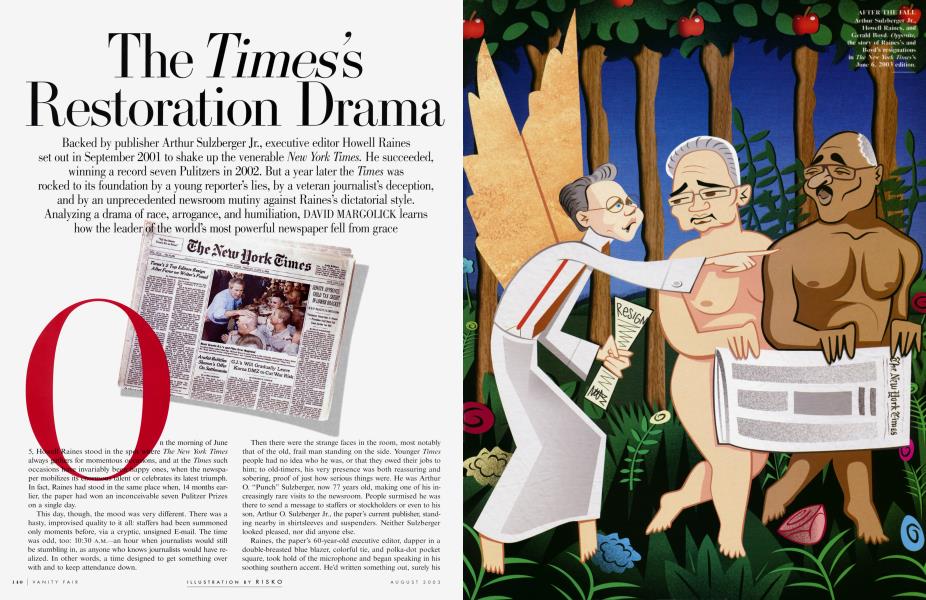
Backed by publisher Arthur Sulzberger Jr., executive editor Howell Raines set out in September 2001 to shake up the venerable New York Times. He succeeded, winning a record seven Pulitzers in 2002. But a year later the Times was rocked to its foundation by a young reporters lies, by a veteran journalist's deception, and by an unprecedented newsroom mutiny against Raines's dictatorial style. Analyzing a drama of race, arrogance, and humiliation, DAVID MARGOLICK learns how the leader of the world's most powerful newspaper fell from grace
DAVID MARGOLICK
On the morning of June stood in the The New York Times for momentous and at the Times such occasionsnkeinvariably ones, when the newspaper mobilizes or celebrates its latest triumph. In fact, Raines had stood in the same place when, 14 months earlier, the paper had won an inconceivable seven Pulitzer Prizes on a single day.
This day, though, the mood was very different. There was a hasty, improvised quality to it all: staffers had been summoned only moments before, via a cryptic, unsigned E-mail. The time was odd, too: 10:30 A.M.—an hour when journalists would still be stumbling in, as anyone who knows journalists would have realized. In other words, a time designed to get something over with and to keep attendance down.
Then there were the strange faces in the room, most notably that of the old, frail man standing on the side. Younger Times people had no idea who he was, or that they owed their jobs to him; to old-timers, his very presence was both reassuring and sobering, proof of just how serious things were. He was Arthur O. "Punch" Sulzberger, now 77 years old, making one of his increasingly rare visits to the newsroom. People surmised he was there to send a message to staffers or stockholders or even to his son, Arthur O. Sulzberger Jr., the paper's current publisher, standing nearby in shirtsleeves and suspenders. Neither Sulzberger looked pleased, nor did anyone else.
Raines, the paper's 60-year-old executive editor, dapper in a double-breasted blue blazer, colorful tie, and polka-dot pocket square, took hold of the microphone and began speaking in his soothing southern accent. He'd written something out, surely his most difficult assignment ever in his 25 years at the paper. "As I'm standing before you for the last time," he began, his hands shaking a bit and with a slight catch in his voice, as a few stray gasps arose around him, "I want to thank you for the honor and privilege of being a member of the best journalistic community in the world." Mercifully, he kept things brief, just like his tenure atop the Times: 21 months, the second shortest in its history. He concluded with something that his hero, the famed Alabama football coach Bear Bryant, might have said had he overseen the city desk of a newsroom. "Remember, when a great story breaks out, go like hell," he declared.
Gerald Boyd, 52, Raines's second-in-command and the paper's highest-ranking black ever, then stepped up to announce that he, too, was stepping down. This brought an even more audible gasp: a bona fide purge was under way. Boyd spoke about his commitment to quality and diversity, but it sounded hollow, defeated. Then he said something about having tried to discuss Raines's managerial problems with him. Some took that to mean that even Boyd, and now of all times, was distancing himself from Raines. But Boyd didn't always make himself clear; maybe he meant to say something else.
Finally, it was Sulzberger's turn. "Young Arthur," he is still called, though he is now 51 years old, and not only because his father is still around. "This is a day that breaks my heart," he said. Raines and Boyd had decided to leave, he continued, and he had gone along with their decision. He announced that Raines's predecessor, Joseph Lelyveld, who'd retired in September 2001, would return until a permanent replacement was named. When Sulzberger finished, the wives of both Raines and Boyd were crying. So little support did the two men enjoy in the newsroom at the end, someone later observed, that Gail Collins was the Times person mourning most conspicuously, and she wasn't a reporter at all, but the person Raines had picked to succeed him as editorial-page editor when he was promoted to the top job.
Had the story been about any other similarly illustrious institution, and had he still been in charge, Raines would have pulled a bunch of reporters off whatever they were doing and put them on it—"flooding the zone," he liked to call it. The world's most powerful newspaper had just undergone its first coup d'etat.
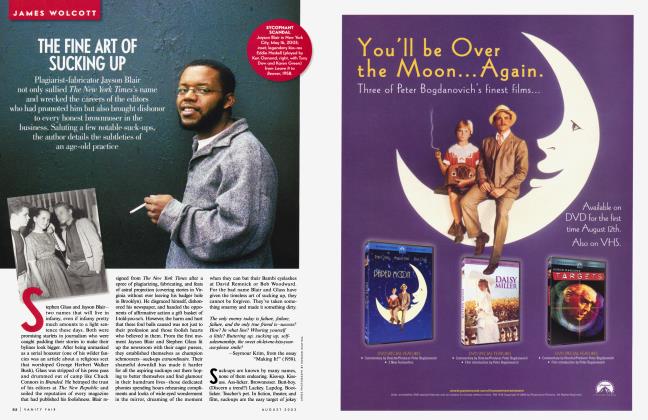
People outside the Times assumed that the recent I scandal of Jayson Blair, a 27-year-old techno-con artist and Times reporter who'd claimed to have ■ seen a bunch of places he'd never visited and interviewed people he'd never met, had done in Raines, and that was how the paper played the story on its front page the next day. TIMES'S 2 TOP EDITORS RESIGN AFTER FUROR ON WRITER'S FRAUD, it stated. But Blair was not really the story. The Blair episode was a freak. In a way, there was nothing to Blair but Blair himself. He had no more caused Raines's demise, a Times reporter tells me, than Gavrilo Princip caused World War I. (As the Times would helpfully explain, Princip was the Serb nationalist who shot Archduke Francis Ferdinand in Sarajevo in 1914.)
The mutiny at the Times was largely a mid-level revolt, with two subeditors—metropolitan editor Jonathan Landman and Washington-bureau chief Jill Abramson—spearheading the charge, not through outright insurrection but simply by standing up for themselves and their reporters. It spread to the upper classes—the Uber-editors whose names appear daily on the masthead, atop the Times editorial page. The proletariat—the people who assign, write, and clean up stories—played a smaller role, except in Washington, but they were generally happy it happened. This revolution's Bastille was a Times Square movie theater, where, at a specially called meeting of staffers three weeks earlier, nearly two years of simmering resentment had boiled over. Sulzberger, Raines, and Boyd had sat on the stage in much the way Romanian strongman Nicolae Ceau§escu and his wife stood on that balcony in Bucharest in 1989, watching with astonishment as the crowd, theretofore reliably submissive, hurled its disrespect at them.
Raines had landed in the third-floor newsroom of the Times a virtual stranger. He'd spent his reporting career elsewhere: in the South, in Washington, in London. Then, for eight years, he'd run the Times editorial board, seven flights higher than and a world away from the newsroom. That meant not working on news stories but supervising the 15 people who pronounce the Times's views on the world. When it came time to pick a successor to Lelyveld, the impetuous young Sulzberger, who liked to differentiate himself from his staid and gentle father, had been drawn—perhaps too drawn—to Raines. He liked his liberal politics, his smarts, his schoolboy humor, his southern swagger, his chutzpah. The Times needed a good goosing, Sulzberger had felt, and Raines, who'd already put backbone and spleen into the Times's oh-so-reasonable editorials, was the man to give it.
Raines was dissatisfied with, even contemptuous of, the Times that had always been—or so he conveyed to his new charges. He wanted to shake off the cobwebs, take off the tweed—or, as he said so often, rev up the newspaper's "competitive metabolism." Long, stodgy, thoughtful, and old were out; snap, buzz, and young were in. Britney Spears landed on page one; Aaliyah mattered more than Beverly Sills. But Raines's personality, and the climate of the place, and the unforgiving spirit of the age, did him in.
Many have started comparing Raines to the man he so relentlessly attacked in his editorials: Bill Clinton. Raines was another prominent southerner of immense promise whose equally immense imperfections were exploited by his enemies. Both had handed their foes bullets and had been brought down in equally improbable ways. "That Jayson Blair would lead to Howell's resignation is as shocking as the blue dress leading to impeachment," says Frank Rich, the Times columnist.
Certain adjectives had clung to Raines like lint—arrogant, autocratic, dictatorial, patronizing, peremptory—even though Sulzberger persuaded himself that his new executive editor had learned to control such tendencies. These traits were hardly foreign to Times editors, but never, it seemed, had they been so pronounced. "The Taliban," Raines and his inner circle were called. The body of the newspaper had rejected him like a foreign organism. This was a revolution, but it was also a restoration.
Times writers—and I was one myself for more than a dozen years, during which I came to know most of the people in this story—quickly learn never to say anything is "unprecedented." It's an invitation to the paper's scrupulously attentive readers to catch you in a mistake—and exact a correction. But the public execution of a Times leader was surely unprecedented. There have been relatively few top men since Adolph Ochs began building the modem Tunes in 1896. With the exception of James Reston, who had a short and unhappy tenure in the 1960s, most—including Edwin James, Turner Catledge, and A. M. Rosenthal—had extended runs. And as Raines disclosed his fate to his stunned staff, flabbergasting people who are paid to stay on top of things, there was another newsroom first. People—many people— began to weep. Part of it was watching two men putting on brave public faces as they faced crushing public humiliation, and so soon after winning all those Pulitzers. "Whatever mistakes he made, his fall from the heights of journalistic glory must be regarded by anyone with a heart as a searing personal tragedy," says Arthur Gelb, the paper's former managing editor. "If Eugene O'Neill or Arthur Miller wrote the play, there wouldn't be a dry eye in the house."
There was a Lord of the Flies quality, inside and outside... in tearing down Howell and Gerald," says Maureen Dowd.
Some cried over what might have been—the sheer waste of it all. Something great about the man had somehow been mislaid. I felt a bit of Raines's greatness myself last year when I had lunch with him at the Times. I was struck by how exciting his vision for the place seemed and how good it was to see him again. Some were surely crying for the newspaper and what it had just endured. There were all those good people Raines had driven out. And the bitter chill that had descended on his newsroom—never a terribly happy place to begin with. And the humiliation to which Blair and Rick Bragg, another Times reporter (and a Raines pal) caught in deception, had subjected the paper. Who'd have thought that the mere mention of the Times would draw laughs from Jay Leno and David Letterman? Or that some mediocre newspaper in a fly-over state would now insist on double-checking anonymous sources in whatever syndicated Times stories it ran? Or that readers could now wonder whether Times writers actually saw what they described, or just made pit stops to pick up exotic datelines? Or that every crackpot who's ever said the Times could never be believed now had fresh fodder for his fantasies?
Some may have cried out of sheer exhaustion, for the past few weeks had been filled with lacerating staff meetings and sneaked peaks to find leaks from Jim Romenesko on his media Web site (poynter.org) or from media mavens such as Sridhar Pappu of The New York Observer. Not to mention the Times's longest-ever story about itself. Then there was Raines's desperate Contrition Tour—his campaign to change his ways and win back his staff. Perhaps a few were crying from remorse—for having gotten what they had wanted, but at a much higher cost than they had anticipated.
What was unclear was how many people cried because they thought Howell Raines was getting a raw deal. But there were some. Raines's sins, they believed, were no worse than those of his predecessors—whose correspondent in Soviet Russia, Walter Duranty, had whitewashed Stalin's crimes; who missed the Holocaust and blew Watergate; who printed the name of the woman who accused William Kennedy Smith of rape; and who made dubious espionage charges against nuclear scientist Wen Ho Lee. At the time, the Times, and the world, had given those people a pass. Only Raines had been jettisoned.
Some of his defenders, using an image of particular resonance to both Raines and Boyd, considered them victims of a journalistic lynch mob—of, as one puts it, "a newsroom full of fucking Judases." Some think that the Times and Arthur Sulzberger himself inadvertently supplied some of the rope, through clumsy public relations and an orgy of conspicuous mea culpas. They believe that, with a little more time and steadfastness from his superiors, Raines might have held on, and the mob would have slithered back to Martha Stewart and Scott Peterson.
"There was a Lord of the Flies quality, inside and outside the paper, in tearing down Howell and Gerald that made me very sad," says Maureen Dowd, the Times COlllITinist. "A lot of the reporters who were so pitiless about giving Howell a second chance were people who had themselves gotten a second chance or strong support from Howell over the years, and a lot of the ones who were so unforgiving had been forgiven by editors when they'd screwed up. Howell is an extraordinarily smart and gifted guy. He knew he had to change and be less Olympian, and I think he could have come out of this stronger."
CONTINUED ON PAGE 195
CONTINUED FROM PAGE 143
Alessandra Stanley, the paper's television critic, agrees. "Howell is a brilliant editor, and I think a lot of us thought that, whatever his crimes, this was not a fitting punishment," she says.
Neither of Raines's principal antagonists— Landman, 50, and Abramson, 49—will likely take his place. The favorites in that race, which may well have been decided by the time this sees print, are Bill Keller, a 54year-old Times columnist who was runnerup last time around, and Dean Baquet, 46, a former Times man now at the Los Angeles Times. Two darker horses—51-yearold John Geddes, an assistant managing editor at the Times, and Marty Baron, 48, editor of The Boston Globe, which is owned by the New York Times Company—are also waiting in the wings. But either Landman or Abramson now seems poised to run the Times someday. Each lacks several of the traditional requirements on the checklist, such as a foreign posting or a Pulitzer. But at this point standing up to Howell Raines could prove just as important a credential.
Great as their power was, Raines's predecessors were dwarfed by the institution, and were content to be. They could have wandered into Times Square and few people would have recognized them, or even have known their names. They were magnified by the Times, but oppressed by it, too. They were ascetic, not indulgent. There was something old-fashioned and monkish and, at times, even slightly ridiculous about them, but also something hugely impressive, even inspiring. The Times mattered above everything; their biggest fear was embarrassing it. They inherited it great, and they made it greater.
Raines, who earned more than $1 million annually, was the first executive editor in memory who tried to live as large as his job. There was nothing reticent or selfeffacing about him. He moved and spoke boldly. Rather than shy away from publicity, he courted it. He hobnobbed with the rich and famous. Tom Brokaw, George Pataki, Charlie Rose, Charles Schumer, Michael Bloomberg, and Dan Rather all came to his wedding reception in March. Abe Rosenthal, who led the Times from 1969 to 1986, also went through his celebrity phase, but it was late, short, sad, and strained. Raines savored his from the beginning, and he had only just begun.
Journalistically and stylistically, Raines and Lelyveld were antipodes. Lelyveld viewed Raines as slick and superficial, lacking the intellectual gravitas to run the paper; Raines considered Lelyveld overly plodding and academic. They "cordially despised" each other, a veteran Times man tells me. (Raines, Boyd, and the Sulzbergers declined to comment for this article.) Perhaps it was not all journalistic; Raines was as silky and gregarious as Lelyveld was awkward and shy. Everyone knew Raines would succeed him, but Lelyveld still pushed for Keller, a cool, cerebral type more in the Lelyveld mold. Some felt that Lelyveld, whether consciously or not, actually set Raines up for a fall by keeping him quarantined in the editorial board's offices on the 10th floor rather than naming him as his deputy—thereby ensuring Raines would be an alien when he migrated downstairs to the newsroom. (Others insist Raines would never have worked for Lelyveld, even if asked.)
In the weeks when Raines's fate hung in the balance and Sulzberger Sr. was looking for advice, it was to Lelyveld that he turned. (The Sulzberger family owns 90 percent of the company's Class B stock, giving them voting control over major corporate decisions.) It would be interesting to know what counsel Lelyveld gave. "Joe saw himself as the keeper of the flame, and Howell is the flame," an editor who'd worked under them both told me just after the denouement—that is, before she'd had time to switch her tenses.
Some say Raines, because of his character flaws, was ordained to fail, without a push from anyone else. Others, particularly those who had enjoyed working with him earlier, were amazed at the metamorphosis—how absolute power absolutely brought out the worst in him. "The Howell Raines that was positive and encouraging and would not criticize after the fact became someone who could do nothing but yell and trash and screech at you," says Katy Roberts, now editor of the "Week in Review" section; as op-ed editor she spent five years working directly under him and was national editor when he assumed the numberone spot. They all fished for explanations.
One was time. Raines was seven years short of mandatory retirement when he took over the paper on September 5, 2001—not much time in Times time to change its direction and make himself its greatest editor ever. He had spent the previous decade preaching from the editorial board, the loftiest perch in journalism, enough to swell any head. So could winning seven Pulitzers after 9/11. "People were saying, 'Now he's really going to be impossible,' " a reporter sympathetic to Raines recalls.
This was so even though Raines's role in collecting all those awards was a bit exaggerated. Several had been awarded for work done before he got there; the much-praised "Portraits of Grief"—those thumbnail profiles of victims that ran in the special "A Nation Challenged" section—had been neither his idea nor something for which he initially had shown any great enthusiasm. And the high level of 9/11 coverage generally was at least as much a tribute to the mighty journalistic machine that his two immediate predecessors, Max Frankel and Lelyveld, had assembled and bequeathed to him as it was to Raines himself.
But the September 11 attacks hurt him, too, as he later conceded. Occurring but six days into his tenure, they put him instantly into overdrive, and he could never downshift afterward. "Howell's forceful leadership style overwhelmed his gentler qualities," says Philip Taubman, the Tunes's deputy editorialpage editor. "The newsroom never had the opportunity to become acquainted with the Howell Raines I know—not just a brilliant journalist, but a man of great heart and warmth, character and compassion. Had that happened, the hostility level might have been a lot lower."
r 11 hen there was his second-in-command. X Traditionally, managing editors at the Times have complemented, counseled, protected their superiors. They have been loyal, but also independent and confident enough to curb their headstrong bosses. Abe Rosenthal, for instance, had Seymour Topping and Arthur Gelb; in one famous story, Gelb literally wrestled Rosenthal to the ground in an argument over why Seymour Glass commits suicide at the end of J. D. Salinger's short story "A Perfect Day for Bananafish." As much as anyone, Raines needed such a forceful figure, and had had them in prior positions. Instead, he'd chosen Gerald Boyd. It is here, rather than with Jayson Blair, that race enters the story.
Race was a key leitmotif in Raines's life. He grew up in Birmingham, Alabama, where Sheriff Bull Connor sicced dogs and fire hoses on civil-rights marchers, and where four young black girls were blown up by Klansmen while attending Sunday school. As a young man during that turbulent time, Raines remained largely on the sidelines, and he was burdened by it afterward in the way good men who do nothing often are. Almost as expiation, he wrote about it. There was his 1977 book, My Soul Is Rested, an oral history of the civil-rights movement, and "Grady's Gift," a 1991 New York Times Magazine story about the black housekeeper in his boyhood home, which won him his own Pulitzer.
In the homestretch of his campaign to take over the Times, Raines had pledged to Sulzberger to make Boyd, then an assistant managing editor, his deputy. Why? It could have been his and Boyd's close personal ties, or his commitment to racial amelioration, or the chance to enhance his own legacy by one day handing the paper over to its first black chief. Or perhaps he wanted someone pliable, or he was pandering to Sulzberger, who had begun a crusade to diversify the newsroom. (Had he been picked as executive editor, Keller later said, he'd have selected Landman.)
Boyd had been a perfectly respectable reporter and editor. But he was clearly not what someone in the position of managing editor had to be—among the best journalists of his generation—at least not yet. Few, besides Raines perhaps, thought that, when the time came in early 2008, Boyd would be elevated. That would have posed a huge publicrelations problem for the Times down the road. Of more immediate concern, Boyd did not stand up to Raines; he ratified him. "In most people's minds, Gerald and Howell were the same person," a Tunes man tells me.
Raines was merely the latest in a series of Times executives who had taken Boyd, a journalist of talent and promise, and pushed him too hard too fast. The sad thing is that had the Times been more patient and astute it would have found a more promising minority candidate in its midst: Dean Baquet, who reportedly says he wants to stay in Los Angeles. As Boyd walked out the door, even people he had abused seemed to realize the sickening unfairness of his fate—and that he had been undone, at least in part, by his friends. He had been applauded far more faintly than Raines had been, but Boyd was better liked and certainly more pitied.
6T f you were to compose this as an opera," one of Raines's oldest friends at the paper tells me, "you'd open with the wedding party." On March 9, 2003, a day after Raines and Krystyna Anna Stachowiak, 39, a Polishborn public-relations executive, had married in a small church in Pennsylvania, hundreds of people descended upon the Bryant Park Hotel in Midtown Manhattan for the "regrets only," celebrity-packed celebration.
Raines wore a white dinner jacket and dark pants that made him look shorter than he really is and, as one attendee from the Times puts it, "rather charming in an awkward way, like someone going to a highschool prom in Birmingham." As he greeted his guests and saluted his bride, "I remember thinking, Good for you, Howell. You're on top of the world, the newspaper's going great, you've married this great woman," Warren Hoge, the Times London-bureau chief, recalls. "If someone had come up and said, 'This man will be deposed in three months,' I'd have given him odds of 10,000 to 1. It just would have seemed the most impossible thing in the world."
Some Times people, though, were disturbed by what they saw that day. One calls it "a media rat fuck." "This was very late-Abelike," he says, referring to Abe Rosenthal. "It disturbed me to see these signs in Howell so early in his regime." Another says, "The general feeling was that Howell was strutting."
There had been trouble from the start. Raines's premise that the paper had grown lazy and lethargic, not surprisingly, offended people, deeply. "Howell was bound and determined to establish the notion that the paper was full of lazy slugs and he had to kick their ass," says Landman. "What was happening was a kind of undifferentiated rage at big parts of the paper." Landman points to the paper's coverage of the Florida election dispute a year before Raines took over. "You tell me what paper covered it better or with a higher 'metabolism,'" he suggests. "There ain't one. This 'metabolism' stuff was phony." Another Times eyewitness puts it more bluntly. "We all felt that our metabolism was pretty fucking high," he says. "And some of us had ex-wives to show for it."
T3 aines cracked the whip over reporters in XV out-of-town bureaus, ordering them to get out more, write more, collect more datelines. Some he tried to order to Washington, presumably to install his own people in their places. One target was Kevin Sack, the bureau chief in Atlanta. Sack, going through a divorce, balked; he did not want to leave his young daughter. Raines wouldn't budge and refused to accept any of Sack's compromises. Soon Sack left for the Atlanta office of the Los Angeles Times, where he won a Pulitzer Prize earlier this year. The episode quickly burnished Raines's reputation for being family-unfriendly and for playing favorites. His friend Rick Bragg, also based in the South, could do whatever he wanted, it seemed—live in New Orleans, where there wasn't even an official Times bureau, write sporadically, and then mostly soft features, which seemed always to land on the front page.
Raines centralized power. Only two editors—Boyd and Andrew Rosenthal (son of Abe), whom Raines had named his number three—seemed to matter. Both had once been well liked, but now they adopted their boss's ways, and much less skillfully. "They had no bedside manner," one editor says. "They were contemptuous, dismissive, sarcastic." Says another, "I never felt so devalued and underappreciated as I did under those two guys." A third editor tried to see Boyd—and was told to come back in four months. The Wall Street Journal reported one instance in which a story was proposed to Boyd, who then insisted a similar piece had appeared in that morning's USA Today. After a meeting in which investigations editor Douglas Frantz handed him a copy of the paper to show that it hadn't, Boyd accused Frantz of publicly humiliating him and handed him a quarter. "Call your friend Dean [Baquet at the Los Angeles Times for a new job]," he said. Frantz did.
Desk heads, at least those dating back to Lelyveld's time, felt ignored or denigrated, since Raines would knock them to one another and to reporters. "It would be nice to have a cultural report," he complained to a correspondent about the Sunday "Arts and Leisure" section, "that would be read by someone living on this planet."
Worse, Raines would not let facts get in the way of a story he had ordered up or a point he decided to make. "Howell wanted a thought inserted high in one of my stories," says a metro reporter. "The only problem was, it wasn't true. Mind you, this was on my beat, a beat he didn't really know about. I said to the editor who was the message-bearer that it wasn't true, and it didn't belong in the story, period. A while later he came back to
me and said, 'Well, you're right, but Howell wants it anyway.' It became clear that the editor had not fully conveyed my arguments to Howell, because he was afraid to. I said, 'Fuck that—I'll tell him myself.' And he literally seized my arm and said, 'You don't want to do that.' And ultimately the editor-intermediary and I compromised on a version of what Howell wanted that was just vague enough not to mean much, but still close enough to a falsehood to make me very uncomfortable."
onditions were worst in the Times's WashV>«ington bureau, historically the paper's version of Chechnya: a fiercely independent enclave, perpetually bridling under foreign rule. One might have expected Raines to like Jill Abramson: both were tough and intelligent, with a great sense of Washington Realpolitik. And speaking of Realpolitik, Abramson was manifestly the most promising woman in the Times pipeline—obviously destined for higher places, with or without Raines. Fighting her was not just foolish but self-destructive.
But, for reasons that still baffle, Raines targeted her. Perhaps her background—New York, Harvard—triggered something in a man from the provinces who had graduated from BirminghamSouthern College. Perhaps she was too strong, which is to say as strong as he. Gender was another possibility; women staffers in New York complained of the "towel snapping" tone Raines had set. Her journalism may not have sizzled to his satisfaction. Then, too, he'd inherited her from Lelyveld. In any case, Raines installed a favorite, Patrick Tyler, as a kind of bureau-chief-in-waiting, making things extremely awkward for everyone and tempting Abramson to consider offers from other newspapers. Sulzberger persuaded her to stay.
So rampantly and heavy-handedly did New York micromanage and monkey around with Washington copy that Steven Weisman, a veteran Times man who'd once shared the White House beat with Raines, offered him a facetious new motto: "We report. You decide." The same thing happened in New York. Raines began killing stories by some of the Times's best journalists. He also went to war with the small team of reporters doing long-term investigative stories, showing little interest in projects which, he felt, took too long and diverted too many resources from more pressing daily stories.
Perhaps most spectacularly, Raines killed a series of stories by Tim Golden, an investigative reporter who had twice shared in Pulitzer Prizes, and David Kocieniewski, now the bureau chief in Trenton, about then senator Robert Torricelli, who was being probed by the Justice Department for taking improper gifts and donations from political supporters. The NBC affiliate in New York eventually broadcast a report based on some of the same materials, and Torricelli quickly decided not to run for re-election. Golden eventually left the paper, as did successive heads of the paper's investigative unit, Stephen Engelberg and Frantz.
"'Flooding the zone' meant that Howell didn't have to decide what was important," one refugee from the Times says. "He seemed to lack the intellectual confidence to ignore stuff. He acted very sure of himself, but he was a deeply insecure man."
The unhappiness was epidemic. "They've lost the confidence of the newsroom, and they're the only ones who don't know it," an assistant managing editor told a metro reporter several months ago. Do they not know it, or do they not care? the reporter asked. "Both, I think," the editor replied. For a time, it was unclear whether word of the unhappiness was reaching Sulzberger, or whether he, like Raines, existed in some kind of bubble, where no one would bring him bad news.
"The Howell Doctrine," a gargantuan article by Ken Auletta in The New Yorker. Times people were floored by the access Raines gave Auletta, something Frankel and Lelyveld would never have dreamed of doing. Times people assumed Raines was banking on a puff piece. Many considered it one, but only because they already knew the plot. To anyone else, there were ample glimpses of Howell the meddler, Howell the martinet, Howell the egomaniac, Howell the brute. No longer could anyone believe the old saw that bad things wouldn't be happening "if only the czar knew." Now Sulzberger had to know; the only question was what, if anything, he planned to do about it.
Leaping out of the article were a series of remarkable on-the-record comments from Landman, suggesting that Raines was dogmatic and dismissive. No one at the Times had ever spoken publicly of an executive editor that way, at least no one who valued his own future at the newspaper. Landman had worked under Raines in Washington, and had admired him greatly there. "I knew he was a bit grandiose sometimes, but I loved working with him," he says. But by now the two had tangled repeatedly and bitterly.
During one particularly poisonous moment, Raines had accused Landman of being "emotionally labile." (It was not the only time he'd diagnosed the alleged psychiatric problems of his subordinates; twice he asked another editor with whom he'd locked horns whether she was depressed.) Reporters working for Landman, who were fiercely devoted to him, worried that Raines would eventually lose patience and shove him somewhere to the side.
When this year's Pulitzer winners were announced in early April, there was glee around the Times that none of Raines's pet projects—especially a long string of stories about sexual discrimination at the Augusta National Golf Club, which had inspired a certain amount of ridicule—had won. People were pleased, too, that the one prize the Times collected went to Clifford Levy, who worked for Landman. Levy had begun a yearlong investigation into state mental hospitals before Raines arrived; many felt that had Raines been paying closer attention Levy would have been pulled off the story to flood some zone. Sack's Pulitzer for the Los Angeles Times also was a victory for the Howell-haters. New York Times staffers high and low inundated Sack with notes and E-mails, many adding sardonic asides on the sorry state of things at his old employer. (Raines, too, offered his congratulations.)
Some Times people began describing their unhappiness to reporters elsewhere, hoping that Sulzberger would at last be moved to intervene. In late April, as war raged in Baghdad, The Village Voice depicted the Times as another "republic of fear." But soon these problems would be dwarfed by the young Times reporter who spent more energy and ingenuity simulating journalism than the real thing would ever have required.
/'"A n April 29, the editor of the San Antonio Express-News notified Raines and Boyd by E-mail that an article by Jayson Blair in the Times the previous Saturday, datelined Los Fresnos, Texas, and describing the family of a soldier missing in Iraq, had been "disturbingly similar" to one that had run in his paper on April 18.
Blair, 27, had begun as an intern at the Times in 1998 and had a checkered history at the paper. He had made lots of mistakes, besides being an oily charmer, a slob, a busybody, and a bad boy. Landman, Blair's editor since late 1999, had opposed his promotion, but a committee, headed by Boyd, gave him one. In a memo written in January 2002, Landman chastised Blair for his carelessness and copied the note to Boyd and a colleague. "There's big trouble I want you both to be aware of," he wrote them.
After three more months of shoddiness, Landman wrote again to newsroom administrators. "We have to stop Jayson from writing for the Times. Right now," he stated. But last October, when a sniper began stalking suburban Washington, Blair was among the eight reporters Raines and, more directly, Boyd tapped for the story. Again, Blair's work was quickly challenged. But Raines praised Blair for his "great shoe-leather reporting" and groomed him for the prestigious Times national staff.
Unable to document his reporting from Los Fresnos, Blair resigned on May 1. The next day Boyd assigned four reporters to review Blair's work and write up what they found. He wanted the story quickly— The Washington Post was working on it, too. Raines and Boyd were each subjected to long, contentious interviews. (Afraid of being scooped, the reporters made Raines promise not to share their findings with anyone else, only to watch him immediately spill some of their beans to PBS newscaster Jim Lehrer. The reporters were furious.)
Both Raines and Boyd recused themselves from any role in editing the story. (They asked to review it, but were told it was inappropriate.) That task fell to others: assistant managing editor Allan Siegal, Glenn Kramon, the business editor, and Lome Manly, the media editor. The project mushroomed beyond the list of corrections Raines had originally requested and ended up taking an extraordinary four full pages—the kind of space normally devoted to the start of a war or the death of a president. The decision to run the story at that length was quickly second-guessed; Lelyveld himself went around saying the story should have been only a fraction as long.
The investigation described "a failure of communication among senior editors," and suggested that Raines and Boyd had missed ample signs of Blair's problems or hadn't wanted to see them or hadn't much cared. What mattered more was that Blair was young and eager—"hungry," as Raines had said in one of his interviews with the Times reporters. It was a hint, though oblique, that if the story was too long, it was also too shortmissing Raines and Boyd's role in creating the culture that allowed a Jayson Blair to happen.
Raines later conceded, as some critics had charged, that race had played a part in Blair's saga; as a "white man from Alabama" who believed in diversity, he'd given Blair "one chance too many." That was succor to foes of racial preferences. But inside the Times, people believed that Raines was guilty of more than overlooking a few memos or having a big heart. What Blair represented to them was not carelessness or affirmative action run amok but a regime that favored youthful enthusiasm and obsequiousness over experience, and that froze out all independent thinkers. And, in a newsroom increasingly hostile to the bosses, Blair was an accomplished suckup, even, according to one reporter, timing his cigarette breaks to coincide with Boyd's. He wasn't black or white so much as he was one of them. Why, Raines later asked the reporters who had written the Blair article, had no one ever shown him Landman's written warnings about the guy? "You want my guess?" one of them replied. "No one wanted to show you a Jon Landman memo."
Staffers upset over the article's omissions were equally irate about Sulzberger's declaration at the end: "Let's not begin to demonize our executives—either the desk editors or the executive editor or, dare I say, the publisher." Case closed, it suggested. "It made whatever came before it seem like a whitewash," one Times reporter says.
The fury persuaded Sulzberger to call the mass meeting at the Loews Astor Plaza on West 44th Street on May 14. The cameramen gathered outside and besieged Raines, Boyd, and Sulzberger as they approached the theater. The siege continued inside. "As soon as people had a weapon to beat Howell up with, they just beat the shit out of him," one Times reporter says. Raines quickly pleaded guilty to a litany of offenses. Then came the questions and comments. A business reporter asked Raines if he would resign; Raines said he would not unless Sulzberger asked him to, and Sulzberger quickly said he would not. "You guys have lost the confidence of much of the newsroom," an editor on the metro desk then declared. "People feel less led than bullied."
To many the session seemed forced and unpersuasive, something out of a playbook for corporate crises. "I feel like I've been slimed," a news clerk complained on the way out. Some of the harshest criticism centered on Sulzberger. Why hold a meeting in so public a setting, where it was certain to become a spectacle? Or say, when asked his opinion of the situation, something as coarse and inarticulate as "it sucks"? Or not put on a necktie?
Or, worst of all, reach into a paper bag and take out a stuffed toy moose—apparently a tool out of some management manual, symbolizing the "moose in the room" that nobody wants to talk about, used to loosen things up—and hand it to a perplexed Raines?
But there was another, more sympathetic way of evaluating Sulzberger's performance. Gradually, he had opened up his father's Times and created an atmosphere in which people could voice their grievances. Things had regressed under Raines, but now, at Sulzberger's prodding, they were opening up again—indeed, opening as they never had before. And, though belatedly, Sulzberger was grappling directly with the situation.
Raines heard another earful the next day, when he met with his angry masthead. Again he took a pummeling; again he pledged to mend his ways. "I have no stake in the Raines method," he said at one point. On May 19, Sulzberger brought Raines and Landman together, and they resolved to bury their differences. "I'm with Jon Landman the way Lincoln was with General Grant: just tell me what kind of whiskey he likes," Raines later said. The next day at yet another meeting, this one with desk heads, Raines again pledged to reform, and this time Landman, having become convinced of his sincerity, backed him. Some of his colleagues, apparently thinking they had Raines on the ropes, accused Landman of selling out. "I'm not with the program," Jill Abramson declared emphatically.
r 11 hen came the unmasking of Rick Bragg, X via a note sent to the complaint line the Times had furnished readers in its article on Jayson Blair. The paper quickly concluded that Bragg, a famously stylish writer whose chicken-fried southern stories had won him his own Pulitzer, had relied almost entirely on a stringer for a June 15, 2002, piece on Florida oystermen, and suspended him, reportedly for two weeks.
Bragg's defense, made to Howard Kurtz of The Washington Post, was essentially that "everyone does it." Times reporters were aghast and indignant at the charge. But Raines—either loyal to his friend or, more likely, preoccupied with his own problems— said nothing, at least initially. His silence helped erode whatever support he still enjoyed or had been laboring to rebuild.
Bragg quit the Times on May 28. The next day, the 2003 Pulitzers were handed out at Columbia University's Low Library. Raines, Boyd, Landman, Kevin Sack—all were there. The air was thick both with the Times scandal—Times columnist William Safire even alluded to it in his speech that day—and with Schadenfreude, and Raines and Boyd looked weary and uncomfortable. "These poor guys," an eyewitness recalls. "They knew that every corner conversation was about them. And it was."
Raines fought to keep his job. To one Times editor who had tangled with him and had little sympathy, it was an ugly, degrading spectacle, recalling the plight of another southerner recently embroiled in controversy. "You could do a good 'Q-hed' about the similarities between Trent Lott and Howell Raines," he says matter-of-factly, using the Times term for a news analysis.
Others disagree. "Howell showed amazing fortitude and class once the story broke, showing up every day, trying to listen, doing his best to keep the ship afloat," says Peter Applebome, a deputy metro editor. "Hanging in there took a lot of guts." In a series of small gatherings with staffers, he made his case, searched for some decisive gesture to stanch the bleeding, asked people for advice, and listened to them in a way he never had before. "He didn't want to have to hear stuff, but in a crazy, sick way, Jayson made him have to hear it," says Soma Golden Behr, an assistant managing editor. "That's the terrible tragedy of this."
'Before the end, he had already lost," says a Raines man, one of the favorites he so conspicuously cultivated. "If he'd stayed on, it would have been as a benign, cooperative, conciliatory peacemaker. And that ain't him." He adds, "Some people never forgave the Times for not letting Joe [Lelyveldj's legacy just continue. Many of those guys who wanted him gone, they would have fallen all over themselves to be in his inner circle."
On May 30, Raines met with Abramson, apologized to her, and said he wanted her to remain in place through the presidential election in 2004— the only presidential election he'd get to enjoy as executive editor. And on June 2 there was another dinner with various Times reporters. But by then his fate was sealed. Or at least it was by the time Sulzberger met for lunch the next day with the Washington bureau.
Precisely when the publisher, or the New York Times board, or the Sulzberger family, decided to pull the plug isn't clear, and in the searing, heartfelt session in Washington that day, Sulzberger didn't let on that the die was already cast—perhaps because he didn't want the secret out, perhaps because he was heartsick and half hoping to be dissuaded. The mood was more cathartic than prosecutorial; people assumed that Raines was staying on, albeit on a kind of probation, and they wanted to make it work.
"He was serious, sober, tough," a reporter who was present recalls. "There was no moose, there was none of the Three Stooges-loving Arthur. It was a very grave and grown-up guy." Afterward, Abramson—who had even read Raines's 1977 novel, Whiskey Man, in order to determine his capacity for redemption-invited staffers into her office. She told them of her recent conversation with Raines, and said that she, like Landman, was giving him another chance. It was inspiring. But it was also irrelevant.
On June 4, around the time Raines was assuring people that the crisis had crested and he had begun drafting a memo describing how various desk editors would be rotated onto the masthead, corporate types upstairs were writing the press release announcing his resignation. (Their story, describing Lelyveld's arrival before explaining that Raines was leaving, would never have gotten by a Times copy editor.) Late that afternoon, Sulzberger met with Raines and Boyd and gave them the word. Lelyveld canceled his dinner with Frank Rich and his wife, Times reporter Alex Witchel, and Sulzberger canceled his with theatrical producer Rocco Landesman and Business Week editor in chief Stephen Shepard and their wives, so they could have dinner together. Raines went home early. His wife was sick, he explained.
Amazingly, at least to the Times publicrelations people, word of the change had still not leaked by the following morning. At 10 o'clock, Sulzberger told masthead editors that Raines and Boyd had concluded theirs was "too high a hill for them to climb." The E-mail notice then went out, people began assembling, and the three men spoke. One Times man listened to Raines from the rear, even though there was ample room up front. "I didn't feel like looking into the guy's eyes," he explains.
After Sulzberger finished, the meeting was apparently abruptly over. People were immobilized—"punch-drunk," someone says. An impromptu receiving line developed, with some staffers queuing up to wish Raines well. Among them was Landman. Raines then took his Panama hat and, arm in arm with his wife, walked out of the New York Times building on West 43rd Street. That's where John Damton, a Times associate editor, learned the news from Bashir, the Afghan coffee vendor. "Come on, Bashir! Don't trade in low-level rumors. You always believe everything you hear," Damton said. He then saw the scrum of television cameras and realized Bashir had it right.
The newspaper, meantime, went back to work. At the noon story meeting, the Washington political editor, Rick Berke, described an article about anxiety and tumult in some federal agency. "We already have a story like that," said A1 Siegal dryly. One page-one offering was "Paper," the "slug" (or shorthand name) an editor had given to the story about the Times itself. After lunch in the Washington bureau, people debated not whether Paper would run on the front page, but above or below the fold. In fact, it landed above the fold, in exactly the same choice spot as the Blair investigation. But it wasn't nearly as long.
In the newsroom, people gathered around televisions whenever CNN went to the Times story, then quickly dispersed. That afternoon Air Force One returned from the Middle East, and on the tarmac at Andrews Air Force Base, Ari Fleischer told the Times White House correspondent David Sanger what had just happened to his newspaper. He smiled as he said it.
The post-Raines era began—or the preX Raines era was resumed—the next morning, when Lelyveld, standing exactly where Raines had stood, made a speech of his own.
Lelyveld is a famously frosty man, but that morning he hit precisely the right notes. He praised Raines and Boyd for their relentless coverage of 9/11, for their selflessness in leaving the paper, for their brave good-byes. He saluted Raines for elevating the importance of photographs in the paper. It was absolutely true—two of those seven Pulitzers had been for them—but it was an odd and poignant tribute to someone who had spent his career painting pictures with his words.
In fact, to anyone listening closely, there was a subtext to Lelyveld's emollient message. With every quality he stressed—civility, dialogue, collegiality, originality, breaking out of the journalistic pack—he was reinstating values which, so many people felt, had vanished or been denigrated under Raines. He even mentioned his predecessor, Frankel. It was a way of saying that an aberrant interregnum had ended, that the line of succession had been restored.
Before long, Raines was at his country J3 home in Pennsylvania, doing something he loved at least as much as putting out a newspaper: fishing. Friends describe him as "chipper," and imagine he'll now write something longer-lasting than any newspaper story: another novel, perhaps. Novels were also on the minds of two Times people, both of whom knew Raines well.
"For someone as driven and talented as Howell to have fallen so far and so fast, there had to be some demon in his psyche that drove him to sabotage his own success," one of them says. "It was terrible to see him selfdestruct, but it might be that, having met his own darkest expectations, it will spur him to write a truly great novel. Either that, or he could completely fall apart."
"It wasn't surprising, but it's unbearably sad," says Steven Weisman. "Howell is so brilliant and capable of such charm and insight and shrewdness, except about himself. It's amazing. It's not even a novel. It's a bad novel."

Subscribers have complete access to the archive.
Sign In Not a Subscriber?Join Now


