Sign In to Your Account
Subscribers have complete access to the archive.
Sign In Not a Subscriber?Join NowEDITOR S LETTER
Quite a Production
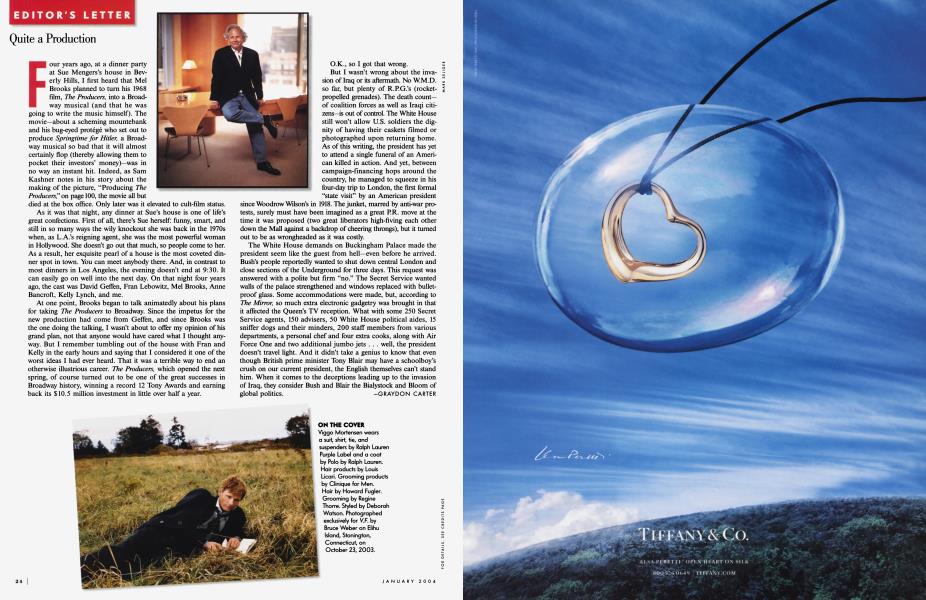
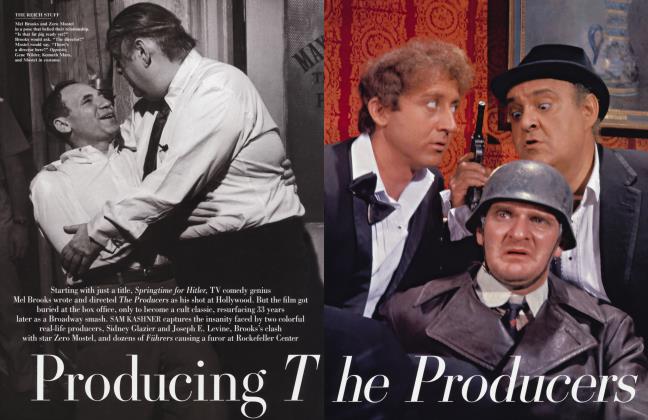
Four years ago, at a dinner party at Sue Mengers's house in Beverly Hills, I first heard that Mel Brooks planned to turn his 1968 film, The Producers, into a Broadway musical (and that he was going to write the music himself). The movie—about a scheming mountebank and his bug-eyed protege who set out to produce Springtime for Hitler, a Broadway musical so bad that it will almost certainly flop (thereby allowing them to pocket their investors' money)—was in no way an instant hit. Indeed, as Sam Kashner notes in his story about the making of the picture, "Producing The Producers," on page 100, the movie all but died at the box office. Only later was it elevated to cult-film status.
As it was that night, any dinner at Sue's house is one of life's great confections. First of all, there's Sue herself: funny, smart, and still in so many ways the wily knockout she was back in the 1970s when, as L.A.'s reigning agent, she was the most powerful woman in Hollywood. She doesn't go out that much, so people come to her. As a result, her exquisite pearl of a house is the most coveted dinner spot in town. You can meet anybody there. And, in contrast to most dinners in Los Angeles, the evening doesn't end at 9:30. It can easily go on well into the next day. On that night four years ago, the cast was David Geffen, Fran Lebowitz, Mel Brooks, Anne Bancroft, Kelly Lynch, and me.
At one point, Brooks began to talk animatedly about his plans for taking The Producers to Broadway. Since the impetus for the new production had come from Geffen, and since Brooks was the one doing the talking, I wasn't about to offer my opinion of his grand plan, not that anyone would have cared what I thought anyway. But I remember tumbling out of the house with Fran and Kelly in the early hours and saying that I considered it one of the worst ideas I had ever heard. That it was a terrible way to end an otherwise illustrious career. The Producers, which opened the next spring, of course turned out to be one of the great successes in Broadway history, winning a record 12 Tony Awards and earning back its $10.5 million investment in little over half a year.
O.K., so I got that wrong.
But I wasn't wrong about the invasion of Iraq or its aftermath. No W.M.D. so far, but plenty of R.P.G.'s (rocketpropelled grenades). The death count— of coalition forces as well as Iraqi citizens—is out of control. The White House still won't allow U.S. soldiers the dignity of having their caskets filmed or photographed upon returning home. As of this writing, the president has yet to attend a single funeral of an American killed in action. And yet, between campaign-financing hops around the country, he managed to squeeze in his four-day trip to London, the first formal "state visit" by an American president since Woodrow Wilson's in 1918. The junket, marred by anti-war protests, surely must have been imagined as a great P.R. move at the time it was proposed (two great liberators high-fiving each other down the Mall against a backdrop of cheering throngs), but it turned out to be as wrongheaded as it was costly.
The White House demands on Buckingham Palace made the president seem like the guest from hell—even before he arrived. Bush's people reportedly wanted to shut down central London and close sections of the Underground for three days. This request was answered with a polite but firm "no." The Secret Service wanted walls of the palace strengthened and windows replaced with bulletproof glass. Some accommodations were made, but, according to The Mirror, so much extra electronic gadgetry was brought in that it affected the Queen's TV reception. What with some 250 Secret Service agents, 150 advisers, 50 White House political aides, 15 sniffer dogs and their minders, 200 staff members from various departments, a personal chef and four extra cooks, along with Air Force One and two additional jumbo jets . . . well, the president doesn't travel light. And it didn't take a genius to know that even though British prime minister Tony Blair may have a schoolboy's crush on our current president, the English themselves can't stand him. When it comes to the deceptions leading up to the invasion of Iraq, they consider Bush and Blair the Bialystock and Bloom of global politics. -GRAYDON CARTER
GRAYDON CARTER
Subscribers have complete access to the archive.
Sign In Not a Subscriber?Join Now