













Sign In to Your Account
Subscribers have complete access to the archive.
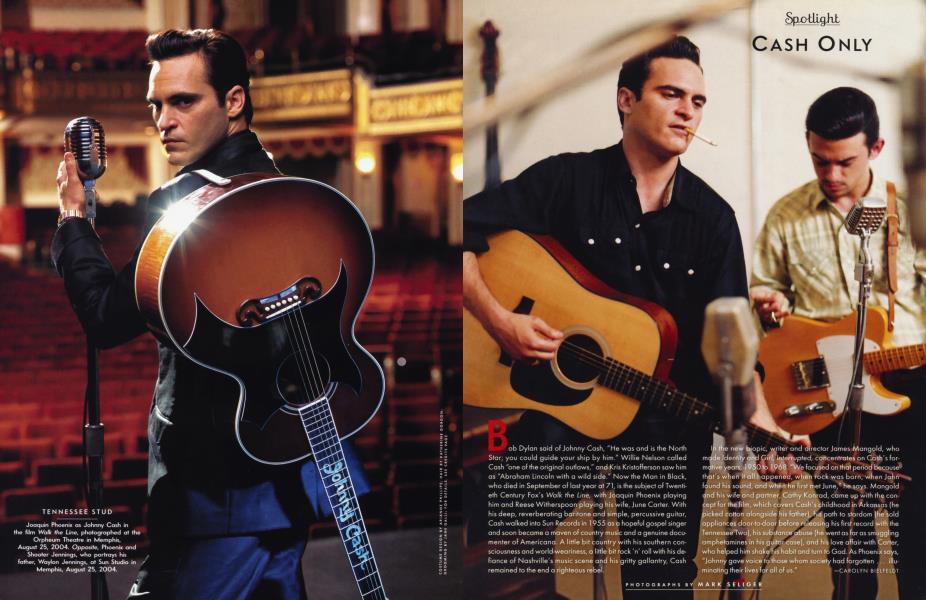
Sign In Not a Subscriber?Join NowBob Dylan said of Johnny Cash, "He was and is the North Star; you could guide your ship by him." Willie Nelson called Cash "one of the original outlaws," and Kris Kristofferson saw him as "Abraham Lincoln with a wild side." Now the Man in Black, who died in September of last year at 71, is the subject of Twentieth Century Fox's Walk the Line, with Joaquin Phoenix playing him and Reese Witherspoon playing his wife, June Carter. With his deep, reverberating baritone and simple, percussive guitar, Cash walked into Sun Records in 1955 as a hopeful gospel singer and soon became a maven of country music and a genuine documentor of Americana. A little bit country with his southern consciousness and world-weariness, a little bit rock 'n' roll with his defiance of Nashville's music scene and his gritty gallantry, Cash remained to the end a righteous rebel.
In the new biopic, writer and director James Mangold, who made Identity and Girl, Interrupted, concentrates on Cash's formative years, 1950 to 1968. "We focused on that period because that's when it all happened, when rock was born, when John found his sound, and when he first met June," he says. Mangold and his wife and partner, Cathy Konrad, came up with the concept for the film, which covers Cash's childhood in Arkansas (he picked cotton alongside his father), his path to stardom (he sold appliances door-to-door before releasing his first record with the Tennessee Two), his substance abuse (he went as far as smuggling amphetamines in his guitar case), and his love affair with Carter, who helped him shake his habit and turn to God. As Phoenix says, "Johnny gave voice to those whom society had forgotten.... illuminating their lives for all of us."
Subscribers have complete access to the archive.
Sign In Not a Subscriber?Join Now
