
Sign In to Your Account
Subscribers have complete access to the archive.
Sign In Not a Subscriber?Join NowCONTRIBUTORS
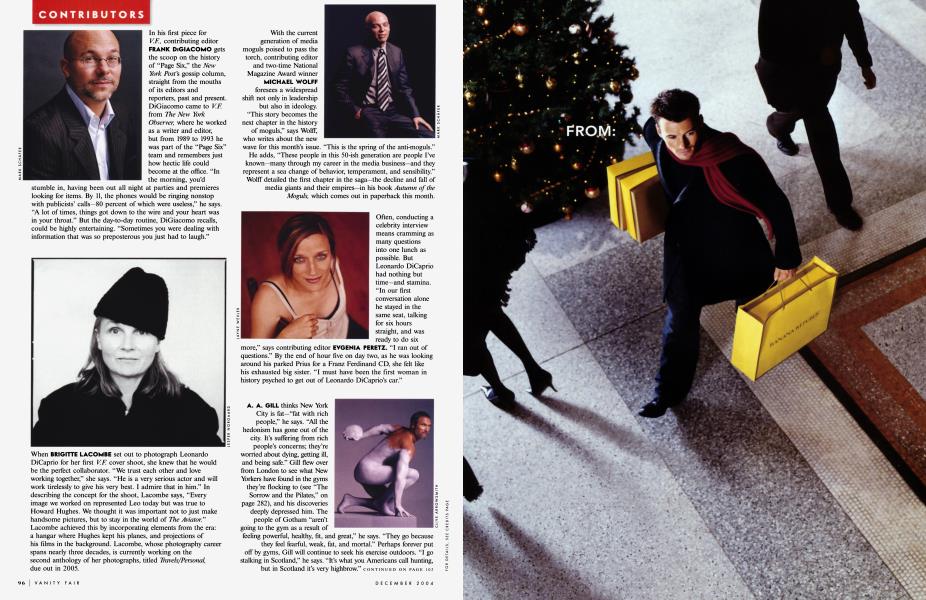
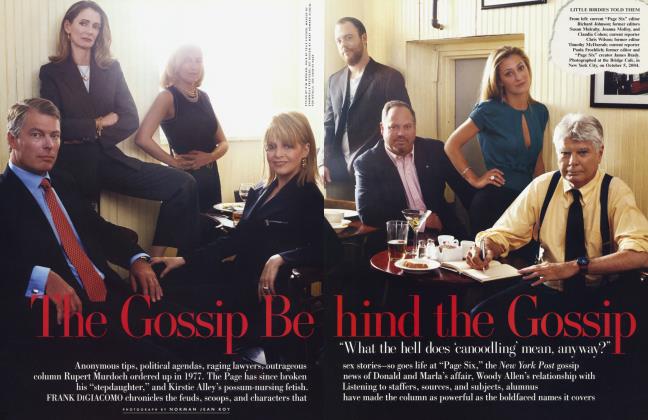
In his first piece for V.F., contributing editor FRANK DiGIACOMO gets the scoop on the history of "Page Six," the New York Post's gossip column, straight from the mouths of its editors and reporters, past and present. DiGiacomo came to V.F. from The New York Observer, where he worked as a writer and editor, but from 1989 to 1993 he was part of the "Page Six" team and remembers just how hectic life could become at the office. "In the morning, you'd stumble in, having been out all night at parties and premieres looking for items. By 11, the phones would be ringing nonstop with publicists' calls—80 percent of which were useless," he says. "A lot of times, things got down to the wire and your heart was in your throat." But the day-to-day routine, DiGiacomo recalls, could be highly entertaining. "Sometimes you were dealing with information that was so preposterous you just had to laugh."
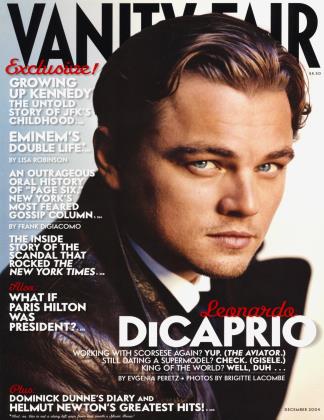
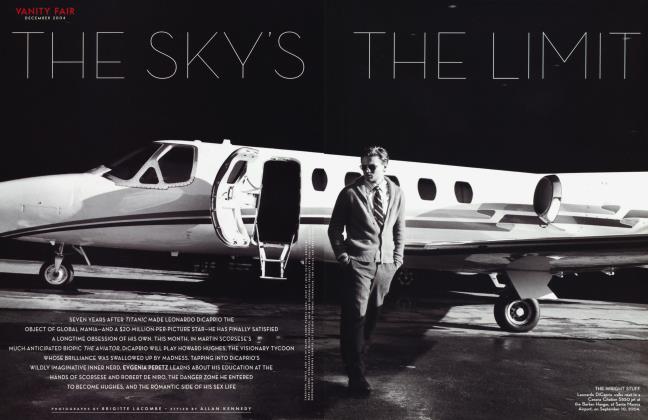
When BRIGITTE LACOMBE set out to photograph Leonardo DiCaprio for her first V.F. cover shoot, she knew that he would be the perfect collaborator. "We trust each other and love working together," she says. "He is a very serious actor and will work tirelessly to give his very best. I admire that in him." In describing the concept for the shoot, Lacombe says, "Every image we worked on represented Leo today but was true to Howard Hughes. We thought it was important not to just make handsome pictures, but to stay in the world of The Aviator. " Lacombe achieved this by incorporating elements from the era: a hangar where Hughes kept his planes, and projections of his films in the background. Lacombe, whose photography career spans nearly three decades, is currently working on the second anthology of her photographs, titled Travels/Personal, due out in 2005.
With the current generation of media moguls poised to pass the torch, contributing editor and two-time National Magazine Award winner MICHAEL WOLFF foresees a widespread shift not only in leadership but also in ideology. "This story becomes the next chapter in the history of moguls," says Wolff, who writes about the new wave for this month's issue. "This is the spring of the anti-moguls." He adds, "These people in this 50-ish generation are people I've known—many through my career in the media business—and they represent a sea change of behavior, temperament, and sensibility." Wolff detailed the first chapter in the saga—the decline and fall of media giants and their empires—in his book Autumn of the Moguls, which comes out in paperback this month.
Often, conducting a celebrity interview means cramming as many questions into one lunch as possible. But Leonardo DiCaprio had nothing but time—and stamina. "In our first conversation alone he stayed in the same seat, talking for six hours straight, and was ready to do six more," says contributing editor EVGENIA PERETZ. "I ran out of questions." By the end of hour five on day two, as he was looking around his parked Prius for a Franz Ferdinand CD, she felt like his exhausted big sister. "I must have been the first woman in history psyched to get out of Leonardo DiCaprio's car."
A. A. GILL thinks New York City is fat—"fat with rich people," he says. "All the hedonism has gone out of the city. It's suffering from rich people's concerns; they're worried about dying, getting ill, and being safe." Gill flew over from London to see what New Yorkers have found in the gyms they're flocking to (see "The Sorrow and the Pilates," on page 282), and his discoveries deeply depressed him. The people of Gotham "aren't going to the gym as a result of feeling powerful, healthy, fit, and great," he says. "They go because they feel fearful, weak, fat, and mortal." Perhaps forever put off by gyms, Gill will continue to seek his exercise outdoors. "I go stalking in Scotland," he says. "It's what you Americans call hunting, but in Scotland it's very highbrow."
CONTINUED ON PAGE 102
CONTINUED FROM PAGE 96
This month, photographer NORMAN JEAN ROY faced the challenging task of photographing the current and former editors of New York's most infamous gossip column, "Page Six." The photo shoot was a first-time gathering, bringing in the old and the new of the section's staff. A Montreal native, Roy began his career just as a pastime, taking pictures of his friends in Nashville, Tennessee. Since then, he has quickly become a pre-eminent photographer in the worlds of fashion and entertainment. He appreciates the diversity of experiences his work grants him. "Photography is a passport to anywhere," he says. "It's all about the access to places and the people you meet."
As contributing editor LAURA JACOBS explored the world of fragrance guru turned entrepreneur Jo Malone, it became clear just how Malone transformed her tiny London shop into an international sensation. "What struck me about her was that she wasn't good at one thing, she was good at everything," says Jacobs, whose research included sampling many of Malone's mysterious, organic fragrances. ("For someone who's always worn Joy, [Malone's] Red Roses is the update.") Yet despite the harmony of notes, it was not the scents but Malone's approach that was most refreshing for the author. "There's a poetry to what she does," says Jacobs. "She's not sitting there in a lab. She's working from her heart and nose, and from inspiration."
According to HOLLY BRUBACH, who this month writes about 18-year-old Italian seductress Melissa Panarello, beginning on page 220, it is hard to imagine a better subject than sex. When Brubach met Panarello in Rome, they discussed men, life, love, and the success of Panarello's scandalous book. "I wasn't sure what to expect," says Brubach. "But Melissa struck me as wise beyond her years—she seemed like somebody who had a very sensible view of the world. I wasn't nearly that sensible at that age, and I don't think most people are." Brubach, who lived in Milan for 5 years and Paris for 12, is currently working on a book of personal essays about living abroad and what we learn about our own culture by living in another.
CONTINUED ON PAGE 104
CONTINUED FROM PAGE 102
For nearly 20 years, contributing artist TIM SHEAFFER has embellished the pages of V.F. with his comical illustrations. "I wanted to work for Vanity Fair because it was an amalgamation of fashion, celebrity, society, and politics," says Sheaffer. "It was the 'it' place to be." Inspired by animation such as the Rocky-andBullwinkle cartoons while growing up, Sheaffer chose to attend the Rhode Island School of Design, followed by Parsons, in New York. He began his career as a fashion illustrator but left that field, after only five years, when he arrived at V.F. Since then, he has been creating caricatures of public figures—from Tom Cruise to George W. Bush—for the magazine and its Web site.
Contributing photographer ANNIE LEIBOVITZ, who has been photographing such iconic musicians as John Lennon, Bob Dylan, and Aretha Franklin since the 70s, traveled to Detroit for this month's piece on Eminem (page 370) and the making of his fourth major album, Encore. Leibovitz had photographed the artist once before, alongside Rakim and Dr. Dre, for VF's November 2002 Music Issue. The picture also appears in her book American Music, which was published last year by Random House. Selections from her book are currently on a two-year tour of American and foreign cities in an exhibition of the same name.
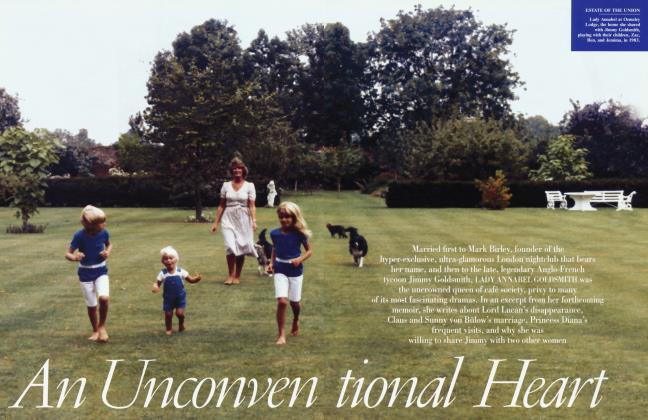
LADY ANNABEL GOLDSMITH considers acquiescing to her publisher's pleas that she write her memoirs, excerpted in this issue beginning on page 376, the best decision she ever made. Composing the majority of the book by hand from her bed, she loved revisiting her childhood school days in Ireland and looking back to those notorious nights at London's private club Annabel's. The process also forced her to write about the death of her son Rupert, a topic she had never before discussed openly. Despite the numerous challenges of committing a life to words, Lady Goldsmith's greatest concern was ensuring that her book did not offend anybody. "Once I started," she says, "I told myself that, if possible, I want it so that I haven't hurt anyone."
CONTINUED ON PAGE 114
CONTINUED FROM PAGE 104
For New rk-based U.K. associate editor KATIE SHARER, her role as the link between VF's London and New York offices is a perfect fit. Having grown up in Los Angeles with her American mother and English father—"on a healthy dose of Monty Python and Chelsea football"— and after living in London for four years, Sharer is a self-proclaimed Anglophile. As for dealing with the New York-London time difference, she hasn't had any problems. "My 16-month-old daughter, Amelia Mullen, gets up very early," she says, "so I can just about start my day when London is starting theirs— which is good for business but not so great for the circles under my eyes." Sharer also contributes to the Fanfair and Vanities sections of this magazine.
Although illustration is what ROSS MACDONALD does principally, it is not his only vocation. When he's not drawing, MacDonald, whose art accompanies this month's "Food Snob's Dictionary, Volume 2," on page 330, supplies historical props— primarily documents—for period movies. "You wouldn't believe how much paper is in a movie," he says. This second career began with an early interest in the printing press, which eventually evolved into consultation for such movies as Seabiscuit, The Alamo, and Van Helsing. He insists, though, that working with Hollywood doesn't always mean celebrity. "Let's face it," he says, "when the credits roll—if I get one—I am next to the honey-wagon driver." Roaring Brook Press will publish MacDonald's third children's book in the fall of 2005.
After such a somber presidential race, contributing editor HENRY ALFORD contemplates a refreshing, if terrifying, alternative when he asks, "What if Paris Hilton were president of the United States?" (page 334). Naturally, Hilton's Simple Life co-star, Nicole Richie, would be her vice president. "I'm envisioning a campaign heavy on the phrase 'bitches in da House!'" says Alford. "I think we're fascinated by Hilton because she's 100 percent id. She's a foxy, delightfully scented id, but she's all id all the same." One of Alford's Vanity Fair pieces—about an embedded fashion journalist in Iraq— appears in the humor anthology May Contain Nuts: A Very Loose Canon of American Humor, published earlier this year by Perennial Currents.
Subscribers have complete access to the archive.
Sign In Not a Subscriber?Join Now


