








Sign In to Your Account
Subscribers have complete access to the archive.
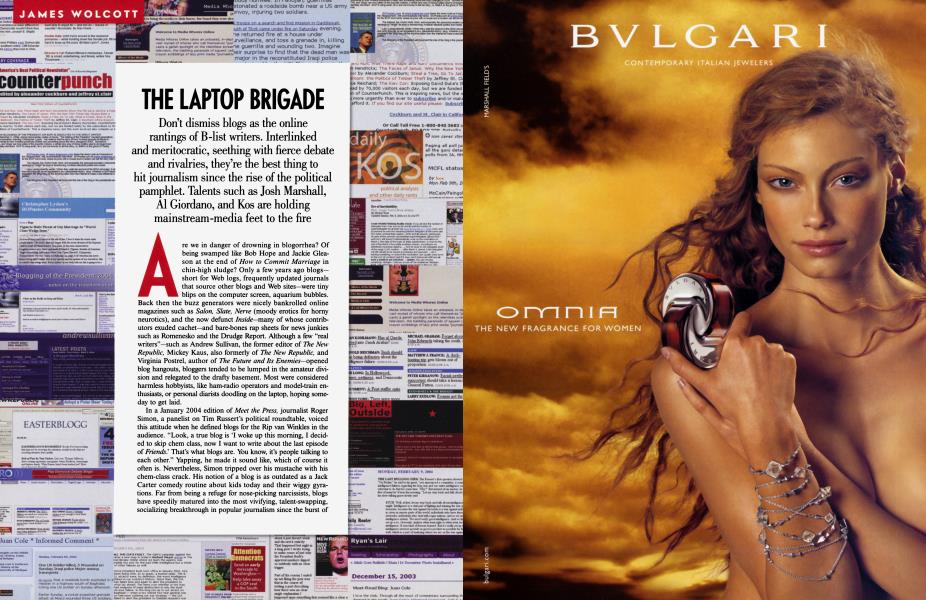
Sign In Not a Subscriber?Join NowDon't dismiss blogs as the online rantings of B-list writers. Interlinked and meritocratic, seething with herce debate and rivalries, they're the best thing to hit journalism since the rise of the political pamphlet. Talents such as Josh Marshall, Al Giordano, and Kos are holding mainstream-media feet to the fire
Don't dismiss blogs as the online rantings of B-list writers. Interlinked and meritocratic, seething with herce debate and rivalries, they're the best thing to hit journalism since the rise of the political pamphlet. Talents such as Josh Marshall, Al Giordano, and Kos are holding mainstream-media feet to the fire
Are we in danger of drowning in blogorrhea? Of being swamped like Bob Hope and Jackie Gleason at the end of How to Commit Marriage in chin-high sludge? Only a few years ago blogs—short for Web logs, frequently updated journals that source other blogs and Web sites—were tiny blips on the computer screen, aquarium bubbles. Back then the buzz generators were nicely bankrolled online magazines such as Salon, Slate, Nerve (moody erotics for horny neurotics), and the now defunct Inside—many of whose contributors exuded cachet—and bare-bones rap sheets for news junkies such as Romenesko and the Drudge Report. Although a few "real writers"—such as Andrew Sullivan, the former editor of The New Republic, Mickey Kaus, also formerly of The New Republic, and Virginia Postrel, author of The Future and Its Enemies—opened blog hangouts, bloggers tended to be lumped in the amateur division and relegated to the drafty basement. Most were considered harmless hobbyists, like ham-radio operators and model-train enthusiasts, or personal diarists doodling on the laptop, hoping someday to get laid.
In a January 2004 edition of Meet the Press, journalist Roger Simon, a panelist on Tim Russert's political roundtable, voiced this attitude when he defined blogs for the Rip van Winkles in the audience. "Look, a true blog is 'I woke up this morning, I decided to skip chem class, now I want to write about the last episode of Friends.' That's what blogs are. You know, it's people talking to each other." Yapping, he made it sound like, which of course it often is. Nevertheless, Simon tripped over his mustache with his chem-class crack. His notion of a blog is as outdated as a Jack Carter comedy routine about kids today and their wiggy gyrations. Far from being a refuge for nose-picking narcissists, blogs have speedily matured into the most vivifying, talent-swapping, socializing breakthrough in popular journalism since the burst of coffeehouse periodicals and political pamphleteering in the 18th century, when The Spectator, The Tatler, and sundry other sheets liberated writing from literary patronage. If Addison and Steele, the editors of The Spectator and The Tatler, were alive and holding court at Starbucks, they'd be WiFi-ing into a joint blog. If Tom Paine were alive and paroled, he'd be blog-jamming against the Patriot Act, whose very name he'd find obscene.
Papers like The Tatler and The Spectator were written to be talked about. The essays enter a cultural debate that was highly oral and social rather than textual and academic, and coffeehouses were the chief sites of this debate.... Coffeehouses were crucial arenas for the formation and expression of public opinion about plays and poetry, politics and finance, dress and manners.
—From Erin Mackie's introduction to The Commerce of Everyday Life: Selections from The Tatler and The Spectator.
Blogs aren't written to be talked about, they're written to be written about. Conversation takes place on the screen, poppy fields of densely packed words issuing as far as the eye can scroll. Every variety and flavor of interest, enthusiasm, furtive itch, and crazed addiction breeds a squalling litter of blogs: nature blogs, fiction blogs, poetry blogs, fashion blogs, media blogs, music blogs, tech blogs, porn blogs, pet blogs, photography blogs, weather blogs, regional blogs, blogs that blog other blogs (such as SullyWatch, which applies a magnifying glass to Andrew Sullivan's performing-flea antics). Off-line magazines have their own online blogs, such as The American Prospect's Tapped (Matthew Yglesias's pithy summaries of weekend op-eds—'George Will. It's almost as if the president isn't very smart or something"—are a must-read), The New Republic's &c. column, and Gregg Easterbrook's Easterblogg, which nearly blew itself up in the cockpit when Easterbrook lambasted Miramax's Harvey Weinstein and Disney's Michael Eisner for behaving like money-hungry Jews in foisting Quentin Tarantino's ultra-violent Kill Bill on the culture—Easterbrook had some splainin' to do for that little outburst.
The poet Philip Larkin envisioned death as a void state of disconnection—nothing to think with, nothing to link with—and in the blogosphere thinking and linking are also co-dependent verbs. No blog can be an island entire unto itself. Visitors vote with their mouse clicks, and the vitality of a blog site derives from the rising number of hits it receives—the return visits. The higher the hit count, the heavier the hit traffic; the heavier the hit traffic, the larger the popularity; the larger the popularity, the greater the love. This is why there is no graver act than to remove a site from one's blog roll, eliminating the link. It can be a haughty kiss-off or a sad rebuke; either way, it's public notice that you no longer wish to be associated with this louse. By thy links they shall know thee, and the fact that neo-liberal blogger Mickey Kaus (Kausfiles at Slate) links to both Lucianne Goldberg, the right-wing Broom-Hilda of Monica Lewinsky infamy, whose comments section teems like a cauldron with racist, homophobic hate speech, and Ann Coulter, the She-Wolf of Sigma Chi, is evidence to his foes not of the Mickster's catholicity but of his scaly lizardry.
Just as 18th-century periodicals were often organs of the Whig and Tory Parties, blog sites cluster according to political outlooks. Internet space may appear to be an expanding universe of uncharted dimensions with no fixed center or hitching post, but a brain scan of the blogosphere would reveal the same hemispheric divide between left and right that prevails in the flesh realm. Not that there isn't some friendly fraternization. The Talking Points Memo blog of Joshua Micah Marshall, a journalist for the Washington Monthly and The Hill, is respected on both sides of the junction. Tacitus, a moderate-conservative blogger (that is, sane), is blog-rolled on some liberal sites. Sharing an opposition to the Sousa march of the American Empire, libertarian bloggers such as Lew Rockwell link to articles by anti-imperialistic lefties at Alexander Cockburn's Counterpunch site. But mostly liberals and conservatives congregate at their own tables in the cafeteria and shoot straw wrappers at each other, dirty looks. Sit them at the same table and huffiness can ensue.
On the January weekend before the New Hampshire primary, the Blogging of the President site—BOP, as it's more familiarly known—hosted a panel discussion about blogging, the Howard Dean phenomenon, and participatory democracy in the Internet Age that was broadcast on public-radio stations across the country. The BOP site is a group blog featuring one of the most cerebral, provocative, history-enriched ongoing symposia to be found on the Web. Its mainstays include Jay Rosen, Stirling Newberry, and Christopher Lydon, who are to political blogdom what Samuel Johnson and his fellow members of the Club were to London, only without the port and cold mutton. To bridge the hemispheric split, BOP invited a number of the leading bloggers from both left and right to join the jawfest, including Josh Marshall, Jeff Jarvis, Andrew Sullivan, and a mystery man who goes by the handle Atrios.
Bad blood simmered between the last two. Atrios once posted an open letter to Salon on his blog, Eschaton, deploring its hiring of Andycakes to whack out a weekly column on liberal idiocy. "I have a hard time believing that people are really going to pay to read essentially the same drivel—'LIBERALS STUPID AND BAD AND TREASONOUS'—that they can read for free over in his own little sandbox." For more than an hour the BOP confab was cordial, civilized, and nonconfrontational; then Sullivan, whom I picture biding his time and biting his lip, struck. He accused Atrios of hiding behind anonymity to lob garbage. "You attack personally but can't be attacked because no one knows who you are!," Sullivan complained. Take off your Phantom of the Opera mask, fiend! "I just choose to keep my personal and professional life separate," Atrios replied.
If Addison and Steele were alive and holding court at Starbucks, they'd be Wi-Fi-ing into a joint blog.
It wasn't exactly a rematch of the Norman Mailer-versus-Gore Vidal clash of titans on The Dick Cavett Show, but the issue percolated, coming to a boil with an article on Salon a week later. The author, Christopher Farah, lit into the whole pirate crew of "anonybloggers"—Josh Freelantzovitzes who get their rude jollies pumping raw sewage into the Internet about professional byliners whose jobs they probably covet. These masked marauders "have made names for themselves by having no names at all and by using the safety and security of their secret identities to spread gossip, make accusations and levy the most vicious of insults with impunity," Farah wrote. He cited Media Whores Online, as a major environmental polluter, and a media-satire blog called the Minor Fall, the Major Lift. But public enemy No. 1 again was Atrios, whose graffiti slurs included calling Nicholas Kristof of The New York Times "human scum," and publishing an e-mail reputedly from a maid named Maria who claimed President Bush had taken cruel sexual advantage of her. Farah failed to register that the maid's woeful tale of seduction and betrayal was a parody of the National Review Online's house blog, which had been running anonymous e-mails from readers accusing John Kerry of unsubstantiated assaults on human decency, such as trying to cut into line. (Punk'd, Salon quickly edited that goof from the text, sparing Farah further embarrassment.) Feeling vindicated, Andrew Sullivan gave the article a hearty Cornfield County salute: "Anonyblogger Atrios recently called the New York Times' Nick Kristof 'human scum.' Welcome to the pond, Nick! Of course, Atrios is immune from personal attacks because he's anonymous."
The Farah article really got the I frogs hopping in Bloggyville. I Jonah Goldberg of N.R.O. sympathized with the anti-anonybloggers. He, too, had been taunted by strange kids on the playground. Pro-Atrios posters pointed out that Atrios isn't anonymous, but pseudonymous, a crucial distinction. There are practical reasons to deploy the secret identity of a pseud. Bloggers risk losing their jobs by posting under their real names, even if the blog isn't work-related. Adopting a pseud can also open up unexplored sides of a writer's persona, much as online role-playing does on game sites and in sex chat rooms. Online, reputation accrues much as it does in print. The blogger has blog cred to preserve and protect, and an inaccurate or bogus-arguing blogger faces backlash however faceless the blogger himself/herself may be. Most important, pseudonyms have a long, respectable history in pamphleteering, journalism, and fiction. The Federalist Papers were authored under the name Publius. Janet Flanner covered Paris for The New Yorker under the name Genet. The New Republic's TRB column was written for decades by Richard L. Strout of The Christian Science Monitor. Philip Larkin wrote schoolgirl porn under the lesbian disguise of Brunette Coleman. (O.K., maybe not the best example.) And I would add, based on my own subjective impressions, the reason Andrew Sullivan attracts so many personal attacks isn't that he's recognizable and his attackers aren't, but that he makes it so easy and fun. He's like a bad tenor begging to be pelted with fresh produce.
On the surface the battle between Andy and Atrios is a minor spat between a drama queen and a shrinking violet, but it has deeper ripples. That Sullivan, a wellknown byliner, television pundit, and former Gap model, felt impelled to pick a fight with a lesser-known blogger was a sign of insecurity—shaky status. It signifies the shift of influence and punch-power in the blogosphere from the right to the left. It is Atrios, not Andrew Sullivan, who is in ascendance in the blogosphere. Only a few years ago the energy and passion were largely the property of the right hemisphere, where Sullivan, Glenn "Instapundit" Reynolds, and N.R.O.'s Victor Davis Hanson fired up the neurons against the defeatism, anti-Americanism, and death's-head specter of Islamic terrorism billowing from the ruins of Ground Zero. Each morning, after subjecting myself to the depresso news in the daily papers and wishing I had a rabbit hole to dive into, I'd frequent these blogs for morale uplift, mentally applauding their jeers at matchstick figures on the left such as Susan Sontag, Noam Chomsky, and Edward Said (sentiments I'm ashamed of now), and saluting their bugle calls as the U.S. geared up to topple the Taliban. (Like millions of Americans, I lead a very active vicarious life—I get around a lot inside my head.) But I parted sympathies with the bugle boys when they repositioned their bombsights for Iraq. Honest, confused souls could disagree over the case for overthrowing Saddam Hussein. It was the ugly rhetoric, fathead hubris, and might-makes-right triumphalism that repulsed. Warbloggers hunkered into B-grade versions of the ideological buccaneers in the neoconservative camp. Punk-ass laptop Richard Perles, they excoriated dissenters as wimps, appeasers, and traitors, peddled every xenophobic stereotype (the French as "cheese-eating surrender monkeys," etc.), and brushed aside the plight of the Palestinians with brusque indifference or outright contempt. And the warbloggers behaved like they owned the legacy and sorrow of September 11, as if only they understood How Everything Changed and those who disagreed had goldfish bowls on their heads. "For the Clintonites, 9/11 didn't really happen," Sullivan preposterously claimed as recently as January 2004. When I stray into these sites now, it's like entering the visitors' center of a historical landmark. The rhododendrons need dusting, and the tour guide isn't listening to himself, having done his spiel endless times before.
Liberal blogs are now where the bonfires blaze. They set the tempo, push the debate, and crack the best jokes. TBogg, for example, with his continuing saga about America's Worst Mother and her four children, Leona, Hibiscus, Mandalay, and Grunion (the brats' names change with each installment). Atrios's Eschaton is a major stomping ground for anti-Bush information and anti-warblog humor. Josh Marshall's Talking Points Memo has always been essential, but over the last year he has surpassed himself with brilliant running analyses of the Valerie Plame scandal, lengthy Q&As with Wesley Clark and George Soros, and detective work on Bush's sketchy National Guard service (about which Kevin Drum at Calpundit has also done superb Sherlock Holmes sleuthing). Middle East scholar Juan Cole's blog has established itself as the go-to site for informed, incisive interpretations and info on what's unraveling in Iraq and the rest of the region. Economist Brad DeLong, when not defending Paul Krugman against his nitpickers, is the Harold Bloom of data crunching, finding secret harmonies hidden in the numbers. Bob Somerby blows his tiny ration of cool regularly at the Daily Howler, documenting the lies, flip exaggerations, and smarmy chumminess of the dominant media—their cackling incompetence. During the early Democratic primary contests, Al Giordano, who blogs out of South America for BOP and his own site, Big, Left, Outside, enjoyed the hottest streak of almost any handicapper, the first to hear John Kerry's hulking footsteps about to overtake Howard Dean.
Gracious in victory, Giordano gave a nod to Daily Kos, the blog site that had been a powerful transmitter of the Dean message. "My olive branch, and authentic praise, to a guy who dressed himself in glory," began Giordano's tribute to the namesake host of the Daily Kos. After Dean lost New Hampshire, Kos conceded that the Dean cause itself was probably lost. "I doubt that all my friends and readers here can understand how painful and hard that it was for Kos to admit. But, in the end, he chose truth over illusion. And I predict... that the Daily Kos will continue as the top blog on the Internet, as we pull on the Court Appointed President's arms and legs and quarter him in the months to come." Kos, the newly crowned king of Blogistan!
Sullivan attracts so many personal attacks because he makes it so easy... like a bad tenor begging to be pelted with fresh produce.
Who he?, as Harold Ross might ask. Kos is the army nickname of Markos Moulitsas Zuniga, who was born in Chicago in 1971 and raised in El Salvador, returning to the U.S. when his family fled that country's civil war. After high school, he enlisted in the army and was stationed in Germany, an artillery guy. After earning two bachelor's degrees, he moved to San Francisco and started Daily Kos in 2002. In those days of misty watercolor memories it took Daily Kos a month to get the number of hits that it now racks up in a day. The blog quickly differentiated itself from the gaggle. "I pounded my niche," he says, covering politics as an archipelago of anthills with his readers filing ant reports from the various colonies. It was political coverage from a bustling bottom-up perspective rather than a pundit's Olympian perch. Daily Kos's first spike in hitsville came during the summer of the 2002 midterm elections, when it provided exhaustive state-by-state breakdowns of each race. It was inside baseball with outsiders' enthusiasm—electoral sabermetrics. The second "huge spike," according to Kos, came during the buildup to the Iraq war, which Kos opposed. A military veteran, he couldn't be accused of being a weenie peacenik, and Daily Kos, along with antiwar.com and others, magnetized the Web opposition. The number of hits jumped from 20,000 a day to 100,000 plus. Kos and his partner, Jerome Armstrong, mapped out the online strategy of the Howard Dean campaign, which, whatever the spinout of Dean's candidacy, demonstrated blogging's efficacy as a fund-raising and enlistment tool. Kos's latest brainstorm is to use the blogosphere as a "farm system" to fund and groom the next wave of liberal writers and pundits, a counterforce to the conservative-think-tank infrastructure and its modeling academies, where juicy novices master the Ann Coulter Hair Toss and special tanning secrets.
From the outset Daily Kos was devised as a choral suite rather than a solitary squawk box. "Without the community, I wouldn't be anything," Kos says. He opened up the main column to some of the best posters from the comments section, and set up a diaries section for posters—blogs within his blog. Some of the most talented Daily Kossacks splintered off to start blogs of their own, listed on the Kos's blog roll under "Alumni." "The meritocracy of the blogosphere appeals to me," Kos says. Age, race, sexual persuasion, wardrobe choices —none of these signify online, where no one knows what you look like unless you post pictures of yourself with your cats. One Daily Kos grad is Steve Gilliard, a dynamo blogger whose posts about the insurgency in Iraq were more scarily prophetic than anything blathered by the military experts on cable news. It was Gilliard who threw down the dueling glove at the mainstream press which, he said, holds people accountable but freaks all over the car lot when accountability is expected of them. "I think it would be a really, really good idea to track reporters word for word, broadcast for broadcast, and print the results online," Gilliard proposed. "Keeping score of who's right and wrong, how many times they repeat cannards [sic] like Al Gore invented the internet and make obvious errors. Not accusations of ideology, but actual data and facts." It'll buggeth the journalists mightily, but it's also doing the press a favor. "If someone had actually checked Jayson Blair's work, the Times might have fired his ass years earlier." Gilliard's proposal has become more popularly known as the Adopt a Journalist program, debated and discussed on BOP, NPR's On the Media, and elsewhere. Al Giordano sees it as a stealthy insurrection: "The Internet, like Kerry, sneaks up on the frontrunner, Commercial Media, without letting its footsteps be heard, while it gets written off and underestimated by the very forces that seem to be in charge."
What the Adopt a Journalist program symptomizes is how fed up so many smart, informed, impassioned Internet newshounds are, how unwilling they are to play bystander and watch the media make another monster mash of the presidential election, as they did in 2000, or help stampede us into another misguided war. "Why Oh Why Can't We Have a Better Press Corps?" wails Brad DeLong on a regular basis on his site, and it's a question that resonates across the blogosphere. Because the press seems incorrigible. Paul Krugman writes a Times column urging political reporters not to repeat the gauche frivolity of 2000, driveling on about earth tones and alpha males, and what's happened so far? Bright chatter about Wesley Clark's sweaters and long eyelashes (really!—Jacob Weisberg of Slate found them a fetching detail), maunderings about Howard Dean's wife by such happy homemakers as Sally Quinn and Maureen Dowd, and much speculation about Botox deposits in craggy visages. Patti Smith's war cry about rock 'n' roll was "We created it—let's take it over." Journalism can't and shouldn't be taken over by bloggers, but they can take away some of the toys, and pull down the thrones.
Subscribers have complete access to the archive.
Sign In Not a Subscriber?Join Now


