Sign In to Your Account
Subscribers have complete access to the archive.
Sign In Not a Subscriber?Join NowEDITOR'S LETTER
The Shots Seen Round the World
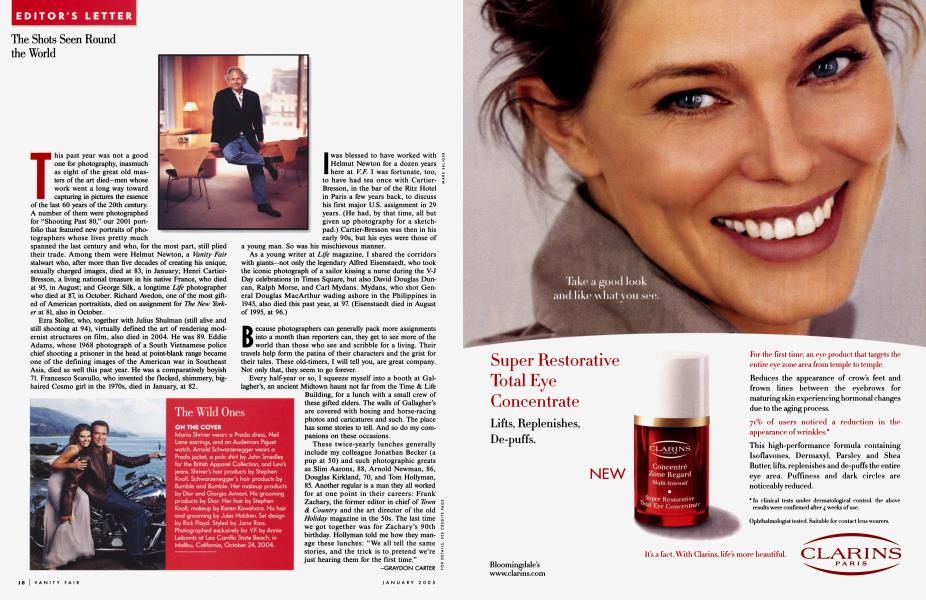
This past year was not a good one for photography, inasmuch as eight of the great old masters of the art died—men whose work went a long way toward capturing in pictures the essence of the last 60 years of the 20th century. A number of them were photographed for "Shooting Past 80," our 2001 portfolio that featured new portraits of photographers whose lives pretty much spanned the last century and who, for the most part, still plied their trade. Among them were Helmut Newton, a Vanity Fair stalwart who, after more than five decades of creating his unique, sexually charged images, died at 83, in January; Henri CartierBresson, a living national treasure in his native France, who died at 95, in August; and George Silk, a longtime Life photographer who died at 87, in October. Richard Avedon, one of the most gifted of American portraitists, died on assignment for The New Yorker at 81, also in October.
Ezra Stoller, who, together with Julius Shulman (still alive and still shooting at 94), virtually defined the art of rendering modernist structures on film, also died in 2004. He was 89. Eddie Adams, whose 1968 photograph of a South Vietnamese police chief shooting a prisoner in the head at point-blank range became one of the defining images of the American war in Southeast Asia, died as well this past year. He was a comparatively boyish 71. Francesco Scavullo, who invented the flecked, shimmery, bighaired Cosmo girl in the 1970s, died in January, at 82.
I was blessed to have worked with Helmut Newton for a dozen years here at VF I was fortunate, too, to have had tea once with Cartier Bresson, in the bar of the Ritz Hotel in Paris a few years back, to discuss his first major U.S. assignment in 29 years. (He had, by that time, all but given up photography for a sketch pad.) Cartier-Bresson was then in his early 90s, but his eyes were those of a young man. So was his mischievous manner.
As a young writer at Life magazine, I shared the corridors with giants—not only the legendary Alfred Eisenstaedt, who took the iconic photograph of a sailor kissing a nurse during the V-J Day celebrations in Times Square, but also David Douglas Duncan, Ralph Morse, and Carl Mydans. Mydans, who shot General Douglas MacArthur wading ashore in the Philippines in 1945, also died this past year, at 97. (Eisenstaedt died in August of 1995, at 96.)
Because photographers can generally pack more assignments 1C into a month than reporters can, they get to see more of the world than those who see and scribble for a living. Their travels help form the patina of their characters and the grist for their tales. These old-timers, I will tell you, are great company. Not only that, they seem to go forever.
Every half-year or so, I squeeze myself into a booth at Gallagher's, an ancient Midtown haunt not far from the Time & Life Building, for a lunch with a small crew of these gifted elders. The walls of Gallagher's are covered with boxing and horse-racing photos and caricatures and such. The place has some stories to tell. And so do my companions on these occasions.
These twice-yearly lunches generally include my colleague Jonathan Becker (a pup at 50) and such photographic greats as Slim Aarons, 88, Arnold Newman, 86, Douglas Kirkland, 70, and Tom Hollyman, 85. Another regular is a man they all worked for at one point in their careers; Frank Zachary, the former editor in chief of Town & Country and the art director of the old Holiday magazine in the 50s. The last time we got together was for Zachary's 90th birthday. Hollyman told me how they manage these lunches: "We all tell the same stories, and the trick is to pretend we're just hearing them for the first time."
GRAYDON CARTER
Subscribers have complete access to the archive.
Sign In Not a Subscriber?Join Now