
Sign In to Your Account
Subscribers have complete access to the archive.
Sign In Not a Subscriber?Join NowHONORING SEIDNER
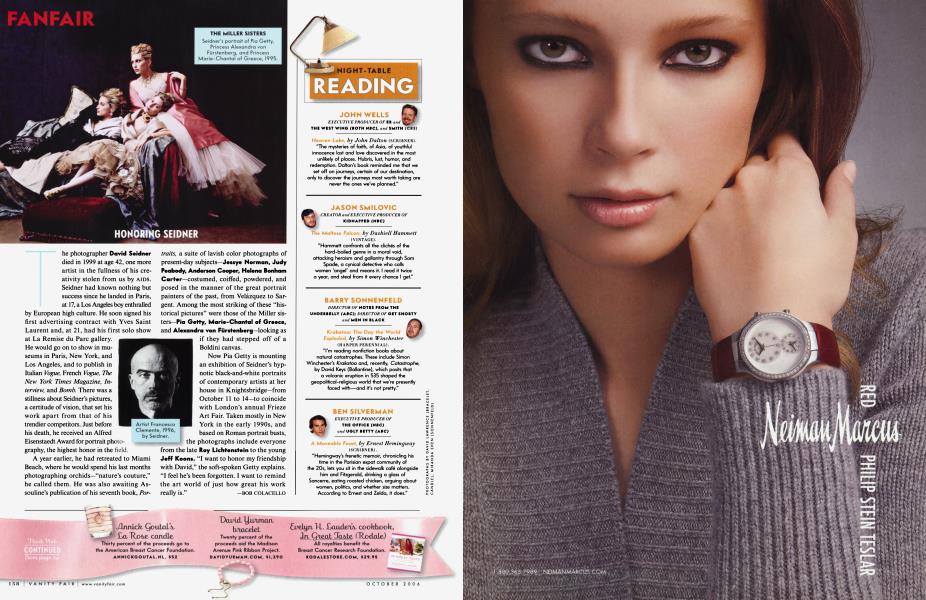
The photographer David Seidner died in 1999 at age 42, one more artist in the fullness of his creativity stolen from us by AIDS. Seidner had known nothing but success since he landed in Paris, at 17, a Los Angeles boy enthralled by European high culture. He soon signed his first advertising contract with Yves Saint Laurent and, at 21, had his first solo show at La Remise du Parc gallery. He would go on to show in museums in Paris, New York, and Los Angeles, and to publish in Italian Vogue, French Vogue, The New York Times Magazine, Interview, and Bomb. There was a stillness about Seidner's pictures, a certitude of vision, that set his work apart from that of his trendier competitors. Just before his death, he received an Alfred Eisenstaedt Award for portrait photography, the highest honor in the field.
A year earlier, he had retreated to Miami Beach, where he would spend his last months photographing orchids—"nature's couture," he called them. He was also awaiting Assouline's publication of his seventh book, Por- traits, a suite of lavish color photographs of present-day subjects—Jessye Norman, Judy Peabody, Anderson Cooper, Helena Bonham Carter—costumed, coiffed, powdered, and posed in the manner of the great portrait painters of the past, from Velazquez to Sargent. Among the most striking of these "historical pictures" were those of the Miller sisters—Pia Getty, Marie-Chantal of Greece, and Alexandra von Fiirstenberg—looking as if they had stepped off of a Boldini canvas.
Now Pia Getty is mounting an exhibition of Seidner's hypnotic black-and-white portraits of contemporary artists at her house in Knightsbridge—from October 11 to 14—to coincide with London's annual Frieze Art Fair. Taken mostly in New York in the early 1990s, and based on Roman portrait busts, the photographs include everyone from the late Roy Lichtenstein to the young Jeff Koons. "I want to honor my friendship with David," the soft-spoken Getty explains. "I feel he's been forgotten. I want to remind the art world of just how great his work really is."
BOB COLACELLO
Subscribers have complete access to the archive.
Sign In Not a Subscriber?Join Now