
Sign In to Your Account
Subscribers have complete access to the archive.
Sign In Not a Subscriber?Join NowTHE AGENT ORANGE AFFAIR
LETTERS
A Vietnam veteran feels Agent Orange's effects; saluting the little people; William Shawcross goes after Craig Unger; behind the boos; and more
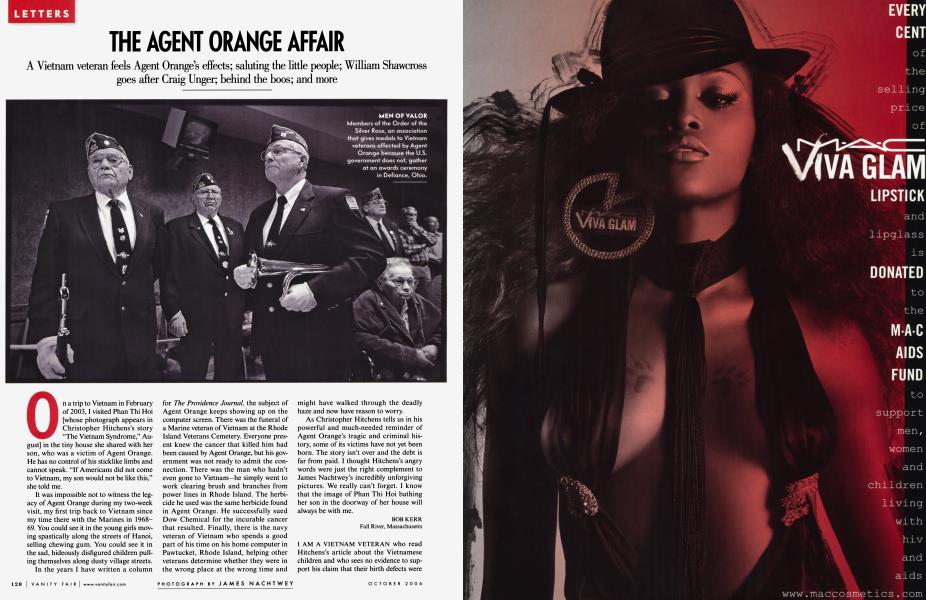
On a trip to Vietnam in February of 2003,1 visited Phan Thi Hoi [whose photograph appears in Christopher Hitchens's story "The Vietnam Syndrome," August] in the tiny house she shared with her son, who was a victim of Agent Orange. He has no control of his sticklike limbs and cannot speak. "If Americans did not come to Vietnam, my son would not be like this," she told me.
It was impossible not to witness the legacy of Agent Orange during my two-week visit, my first trip back to Vietnam since my time there with the Marines in 1968— 69. You could see it in the young girls moving spastically along the streets of Hanoi, selling chewing gum. You could see it in the sad, hideously disfigured children pulling themselves along dusty village streets.
In the years I have written a column for The Providence Journal, the subject of Agent Orange keeps showing up on the computer screen. There was the funeral of a Marine veteran of Vietnam at the Rhode Island Veterans Cemetery. Everyone present knew the cancer that killed him had been caused by Agent Orange, but his government was not ready to admit the connection. There was the man who hadn't even gone to Vietnam—he simply went to work clearing brush and branches from power lines in Rhode Island. The herbicide he used was the same herbicide found in Agent Orange. He successfully sued Dow Chemical for the incurable cancer that resulted. Finally, there is the navy veteran of Vietnam who spends a good part of his time on his home computer in Pawtucket, Rhode Island, helping other veterans determine whether they were in the wrong place at the wrong time and might have walked through the deadly haze and now have reason to worry.
As Christopher Hitchens tells us in his powerful and much-needed reminder of Agent Orange's tragic and criminal history, some of its victims have not yet been born. The story isn't over and the debt is far from paid. I thought Hitchens's angry words were just the right complement to James Nachtwey's incredibly unforgiving pictures. We really can't forget. I know that the image of Phan Thi Hoi bathing her son in the doorway of her house will always be with me.
BOB KERR
Fall River, Massachusetts
I AM A VIETNAM VETERAN who read Hitchens's article about the Vietnamese children and who sees no evidence to support his claim that their birth defects were caused by Agent Orange. I don't doubt that there are victims in Vietnam, but not to the extent which Hitchens describes or leads us to believe. Presenting his undocumented views puts our country in a bad light, particularly when it comes to world opinion. I don't think we need more unsubstantiated, biased journalism. That being said, I speak with firsthand information on birth defects caused by Agent Orange, since my two children were born with malformations, one of which was spina bifida, which, it has been proved, can be caused by Agent Orange. I also have diabetes from Agent Orange.
I have never seen victims with the defects Hitchens describes as being caused by Agent Orange; therefore, I question the validity of his claims.
So what is his point? If Hitchens wants to bring the tragedy of Agent Orange to the attention of the American people, I think he should start by reporting that the U.S. is not taking care of its own veterans and their family members who have birth defects. We have been fighting since the 80s for medical coverage for our children and only recently has the Veterans Administration begun covering certain things. Yet many more of our claims continue to be denied. Does anyone care, or are we just a product of our society's mistakes left to be forgotten?
MICHAEL ENGI
Bordentown, New Jersey
CHRISTOPHER HITCHENS and James Nachtwey's look at the consequences of exposure to Agent Orange was haunting. The millions of gallons dumped on Vietnam, Laos, and Cambodia is one of the forgotten tragedies of the Vietnam War. It is hard to believe that more than three decades later the Vietnamese and our own Vietnam veterans still suffer from our misguided decision to wage chemical warfare of a magnitude never witnessed in the history of mankind. While the war may be over, the toll continues.
GLEN LOVELAND
Albuquerque, New Mexico
EVERY COUNTRY in the world has a population of children with birth defects. Since no study has ever determined that the incidence of birth defects in Vietnam is any different from what it is anywhere else, and since Ranch Hand, the detailed study of the 1,900-plus soldiers from the group that transported, handled, and sprayed the defoliants (including Orange and Blue), found no particular effects on the men or their children, it is impossible to demonstrate that the condition of all the poor children in the photo-essay has anything to do with the war. To make the blind assumption that any child with a birth defect in Vietnam must be a victim of chemicals sprayed by the U.S. in various limited areas of the country is totally irresponsible. It makes for a nice, dramatic article and plays on the seemingly eternal guilt trip about Vietnam that some people are on, but it is invalid, misleading, and the antithesis of real journalism.
R. J. DEL VECCHIO
Fuqway-Varina, North Carolina
LOOSE TALK
THANK YOU for having the courage to publish the article "Click Here for Conspiracy" [by Nancy Jo Sales, August]. In our increasingly Orwellian society, it is reassuring to know that your magazine still has the strength to air a voice that does not pledge blind allegiance to the administration.
HARLAN TUFFORD
St. Catharines, Ontario
I AM A 24-YEAR-OLD disillusioned political-science graduate from the University of South Carolina, Beaufort. Disillusioned with politics, government, this country, I believe only in the people. The little people. The little people, such as Dylan Avery and the thousands like him and his friends, who refuse to accept the direction in which this country is heading.
XAVIER RAMIREZ
Santa Barbara, California
POSTSCRIPT
In July 1998, contributing editor Robert Sam Anson interviewed Jeffrey MacDonald, the Green Beret doctor who had been convicted of brutally murdering his pregnant wife and their two young daughters ("The Devil and Jeffrey MacDonald"). During his trial, in 1979, MacDonald claimed that a band of drug-crazed hippies had broken into his North Carolina home on February 16, 1970, and killed his family. The intruders, MacDonald said, included three men and a stringy-haired blonde woman who was wearing a floppy hat and chanting, "Acid is groovy, kill the pigs." (The woman was later suspected to be Helena Stoeckley, a notorious drug addict living in the area; she testified, but no evidence linked her to the killing spree.) The jury didn't buy MacDonald's story, and a judge gave him three life sentences. MacDonald appealed three times. All three appeals failed.
Flash forward to 1997, when a court decided to allow DNA testing on hairs and other samples found at the crime scene. Anson's article raised the question: If tests showed that the DNA didn't come from anyone in the household, would the incarcerated MacDonald get a shot at a new trial?
This is still debatable. In March 2006—practically 10 years later—MacDonald's camp received the test results. "It's the longest set of DNA tests I've ever been involved with," says Barry Scheck, a lawyer from O. J. Simpson's "Dream Team" and co-founder of the Innocence Project, who drew up MacDonald's exam procedures. "It's not normal for it to take that long." To top it off, the outcome wasn't a home run for either side: one hair belonged to MacDonald; one hair was that of an unknown outsider; none of the evidence connected Stoeckley.
In the meantime, there's been another twist. In December 2005, five months after MacDonald, now 62, was denied his first-ever parole request (and three years after he married longtime friend Kathryn Kurichh), retired federal marshal Jimmy Britt came forward claiming that the lead prosecutor in MacDonald's trial, 27 years ago, lied to the judge and intimidated none other than the now deceased Stoeckley into changing her testimony. "That alone could very well be a basis for vacating [MacDonald's] conviction," Scheck says.
In January 2006, MacDonald's lawyers were granted a motion to present Britt's information in federal court, which could result in a new trial. The court is currently reviewing the defense's filings, and we're still left with more questions than answers.
To read the original story, please visit VANITYFAIR.COM.
I HAVE NEVER BEEN COMFORTABLE with the official version of what happened on 9/11 and have always felt that this administration was somehow complicit, whether it was by passive negligence or actual participation. I'm not sure the truth will ever come out, but I salute Vanity Fair for having the balls to examine this issue rather than play stupid like the rest of the lapdog mainstream media. I encourage everyone with access to a computer to take the time to watch Loose Change. I believe you will never look at the 9/11 tragedy the same way again.
BRUCE G. KREIDLER
Cincinnati, Ohio
I WOULD SAY THAT THE MAJORITY of people influenced by this "documentary" are the same ones following the Bermuda Triangle and Area 51 conspiracies closely. It's entertaining and believable—if you are the type that gets confused about voting ballots. In another film about Flight 93 (yes, there's a cable version, too), the passengers were using credit cards and talking on the Airfones on the backs of the seats— remember those? As for the picture showing the damage to the Pentagon, roll the superimposed plane sideways and it matches perfectly where the wing and engine would have hit. And the cause of the horizontal plumes of smoke coming out of the W.T.C., who knows? Not much research has been done on crashing planes into buildings. I do believe that lies have been told, but not to this Wizard of Oz level, and Loose Change does not pass the follow-the-evidence test. The only things we know for sure: planes hit the buildings, it took years of planning, and the passengers on the manifests will never come home again.
CHARLES WESTMORELAND
Houston, Texas
LOOSE CHANGE would have been more appropriately titled Loose Screws. It's incomprehensible to think that anyone in this government could be capable of planning, enacting, and covering up a complex operation such as 9/11. Why didn't Nancy Jo Sales ask these paranoid slackers why members of our government can't find Osama bin Laden, conquer insurgencies in Afghanistan or Iraq? Or why they've made such a mess of the Department of Homeland Security, our intelligence organizations, health-care and Social Security reforms, and illegal immigration? In fact, this government can't do anything right, except political manipulation to divide and confuse us. Cynicism, not competence, defines the Bush administration.
DEAN FOX
Foster City, California
THE YELLOWCAKE MYSTERY
I TAKE ISSUE with some of the points raised by Craig Unger in "The War They Wanted, the Lies They Needed" (July 2006):
1. The article dealt at some length with Wissam al-Zahawie, Iraq's ambassador to the Vatican, and quoted Joseph Wilson minimizing al-Zahawie's importance, saying, "He went to the Vatican as his last post so he could be near the great European opera houses in Rome.... The idea that he would be entrusted with this supersecret mission to buy 500 tons of uranium from Niger is out of the question." But Unger failed to mention that al-Zahawie was a frequent Iraqi delegate to the International Atomic Energy Agency and nuclear-nonproliferation talks. Surely that is more relevant than any love of opera he may have had.
2. More important, there is no direct reference in Unger's article to the Butler Report, commissioned by the British government in 2004. This, together with the Duelfer Report, is widely regarded as one of the most authoritative investigations of the issues surrounding Iraq and W.M.D. Two key excerpts:
Paragraph 499 states:
We conclude that, on the basis of the intelligence assessments at the time, covering both Niger and the Democratic Republic of Congo, the statements on Iraqi attempts to buy uranium from Africa in the Government's dossier, and by the Prime Minister in the House of Commons, were well-founded. By extension, we conclude also that the statement in President Bush's State of the Union Address of 28 January 2003 that: 'The British Government has learned that Saddam Hussein recently sought significant quantities of uranium from Africa' was well-founded.
Paragraph 503 states:
From our examination of the intelligence and other material on Iraqi attempts to buy uranium from Africa, we have concluded that:
a. It is accepted by all parties that Iraqi officials visited Niger in 1999.
b. The British Government had intelligence from several different sources indicating that this visit was for the purpose of acquiring uranium. Since uranium constitutes almost three-quarters of Niger's exports, the intelligence was credible.
c. The evidence was not conclusive that Iraq actually purchased, as opposed to having sought, uranium and the British Government did not claim this.
d. The forged documents were not available to the British Government at the time its assessment was made, and so the fact of the forgery does not undermine it.
Lord Butler's conclusions seem pretty important to me and absolutely relevant to Unger's investigation. I wonder why no reference was made to them in this article.
WILLIAM SHAWCROSS London, England
CRAIG UNGER REPLIES: First, as Mr. Shawcross says, al-Zahawie's past certainly was suspicious—which is precisely why he was investigated by both the French and the Americans. However, the resulting investigations found nothing to support charges that Iraq had sought a uranium deal with Niger.
The Butler Report merely repeats the British government's assertion that there were other sources—without naming them or offering evidence to support the claims. We do know that Rocco Martino says he was one of Britain's sources—and that his material was fraudulent. We also know that the C.I.A. did notfind the British evidence compelling. Even before Bush cited the Niger documents in his State of the Union address, the C.I.A. told the White House that "the Brits have exaggerated this issue."
If the British had other sources, it's hard to believe they would not have named them by now. Their excuse for not doing so has been that the information comes from a third-country source. However, as Joe Wilson noted in my article, that third country is presumably a member of the U.N and "should comply with Article 10 of United Nations Resolution 1441," stipulating that member states must share with the International Atomic Energy Agency all information they have on prohibited nuclear programs in Iraq. I'm surprised that Mr. Shawcross, whose 1979 book, Sideshow, was an excellent investigation into the U.S. invasion of Cambodia, would accept on faith the assertions of the Butler Report, which has been widely described in the British press as a whitewash.
CANNES BEHAVING BADLY
CAN I VENTURE the suggestion that the audience in Cannes didn't boo The Da Vinci Code because it is "foreign," as Dominick Dunne proposes, but rather because they didn't like it ["A Riviera Row," August]? So he enjoyed it. Good for him. I enjoyed it, too, but I can see why a group of film critics might feel that it is not exactly a classic. As for Marie Antoinette, it's just possible that the same reasoning holds true and that the critics were expressing their opinion about the quality of the film, rather than their dislike of foreigners. It's offensive and somewhat dangerous for Dunne to automatically ascribe people's actions to a fabricated dislike of foreignness.
MORE FROM THE V.F. MAILBAG
"No doubt you'll receive tons of mail calling the author a traitor, or denouncing Vanity Fair as a liberal. Bush-bashing rag"—actually, that was the previous 57 Mailbags—"however, this article proves you are doing the work that the first patriots of this nation envisioned for a free press." So says Mike Kress, of Spokane, Washington, about V.F.'s report on the homemade documentary Loose Change. On the contrary—curiously, some might say—the floorboards are buckling under the weight of appreciative letters regarding that piece. "It is imperative to remember that the truth is not a Republican or Democratic agenda, but an American one" is how, for instance, Cricket Kovatch, of South Bend, Indiana, puts it. In these letters, the same words come up repeatedly: courage, bravo, guts, applaud, integrity (and its I'm-running-late variant, intrgrty), kudos, salute, and balls. It's almost as if... well, we don't want to call it a conspiracy, but certainly there is strong circumstantial evidence that the article— and the movie—struck a chord.
More resonating emotions courtesy of the August issue: "Christopher Hitchens's devastating piece on the remnants of Agent Orange in succeeding generations moved me to tears—not just because of its subject and the sad, startling photographs by James Nachtwey, but because of the absolute beauty of the writing itself," says Mindy Berry Hanson, of Heath, Ohio. And Marion Donnan Mahoney, from Kettering, Ohio, says that "only recently my [Vietnam veteran] brother told me about one of his officers, who drank a glass of Agent Orange in front of the men—so they would realize 'how harmless the stuff was.' I think that speaks volumes, not only about Vietnam and the military but about war in general."
But on to more urgent matters. "I love the white purse Jennifer Aniston wears in the movie The Break-Up," writes a fan, from Sylmar, California. "I'd like to get one. Can you help?" No, we can't, but we do know a woman in Baltimore ("I believe myself to be an Angel of God, sent to help the people of Earth to deal with global warming and basically to remember how to love instead of hate!") who might be able to pull a few strings, after she takes care of those other things. Why don't you—and how we hate this expression—reach out to her? We're too busy; we have another 130 words of the Mailbag to write. But not too busy to track down the designer of Aniston's bag: Helmut Lang.
"Dominick Dunne's column is always gripping reading, even though his subjects have no relation to my life in Australia," writes Lou Ebsary, of Victoria, Down Under. "Could you please devote more of the available space to his written words, and keep his photo size to a minimum? I do not wish to offend Mr. Dunne in this request." (It was the shorts, wasn't it? In the August issue? Yeah, it had to be the shorts.) Anyway, what you're saying is reduce the D.D. pix by a hectare or two and use the net gain for some nicely turned D.D. phrase or inside D.D. scoop? Hmmm ... we like your thinking, Lou Ebsary. Thanks for, ah, reaching out to us.
JACQUI LEWIS
London, England
JACK "MOONDOGGY" LONDON
MOST PEOPLE would be surprised to learn that Jack London (of Call of the Wild fame) saved the royal sport of surfing when it was close to extinction ["Malibu's Lost Boys," by Sheila Weller, August]. London was one of the very first American wave catchers, learning to surf in Hawaii in 1907. He began a one-man campaign to create public interest in surfing and wrote "A Royal Sport," a chapter in his book The Cruise of the Snark (1911), to spark enthusiasm. Without London, it's likely that Miki Dora and the other lost boys and girls of Malibu would have had to engage in another sport to escape their adolescent angst. London's great-grandson Bruce Knight can still be seen catching waves north of San Diego.
ROBERTA WIRTH
Centerville, Minnesota
AFTER LENDING Vanity Fair my How to Stuff a Wild Bikini poster for "Malibu's Lost Boys," like, cowabunga, I wasn't even identified. I'm the fourth lime-green headband to the right, and that's the only time I have been on the "right." It was great fun at the V.F. shoot, and the story was an even greater read!
SALLI SACHSE
La Jolla, California
POLITICS OF CORRUPTION
I WANT TO COMPLIMENT Vanity Fair and Judy Bachrach on a superbly written expose on the Representative Randall "Duke" Cunningham corruption scandal ["Washington Babylon," August]. I was particularly impressed with the journalistic integrity of the piece. Unlike other prominent periodicals, you avoided indicting the Republican Party for the sins of the few who were clearly corrupted by power. Our form of government, with its system of checks and balances, is strengthened by responsible reporting.
SAL PALMA
Alpharetta, Georgia
TOPIC OF CANCER
WHILE I ENJOYED READING the interview with Sheryl Crow ["A Rock of Her Own," by Frank DiGiacomo, August], I would like to make one clarification. Upon her diagnosis, Crow stated, her friends gathered around to offer support and held "hospice" at her house. While the support of friends at a time like that is instrumental, both Crow and the reader need to know that hospice is a program utilized throughout the United States when treatments for a terminal illness are no longer an option and the patients have come to terms with their death, which usually occurs within months of being placed in hospice. God willing, Ms. Crow will never need the help of hospice, just the help and support of friends.
DANA VIGILANTE
Hospice-patient liaison, Atlantic Hospice
Nutley, New Jersey
MURDER IN PARADISE
"A FLOWERING EVIL," by Mark Seal [August], about the murder of African conservationist Joan Root, concludes by saying that the real crime in Africa today is that the Chinese are raping what remains of the continent's primary virgin rainforests. I must ask, are allegations such as this really true? One tends to think the worst of the Chinese, with their dismal environmental record, but they are certainly trying to improve themselves, and they have the eminent green architect William McDonough in their corner; he is the founding U.S. chair of the China-U.S. Center for Sustainable Development. Such allegations are worthy of a separate article in their own right, assuming they are true.
CLIFTON WELLMAN
Elmhurst, New York
EDITOR'S NOTE: Some copies of the September issue contain two errors on page 246 ("Baghdad Is Burning," by William Langewiesche). Iraq was awarded its sovereignty on June 28, 2004, and the new government held its first election in January of2005.
Letters to the editor should be sent electronically with the writer's name, address, and daytime phone number to letters @vf.com. Letters to the editor will also be accepted via fax at 212-2864324. All requests for back issues should be sent to subscriptions@vf.com. All other queries should be sent to vfmail@vf.com. The magazine reserves the right to edit submissions, which may be published or otherwise used in any medium. All submissions become the property of Vanity Fair.
Subscribers have complete access to the archive.
Sign In Not a Subscriber?Join Now


