




Sign In to Your Account
Subscribers have complete access to the archive.
Sign In Not a Subscriber?Join NowMAPPING MANHATTAN'S FUTURE
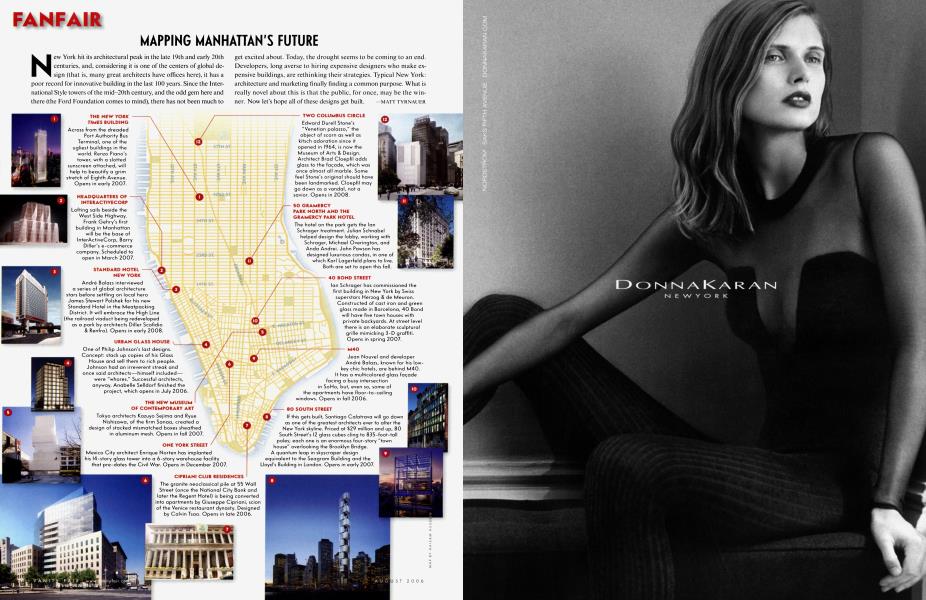
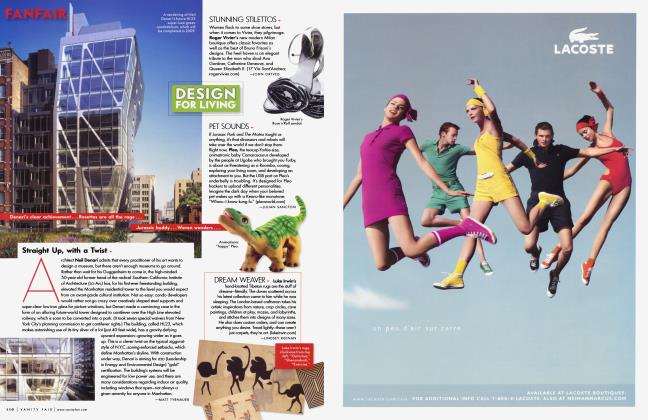
Few York hit its architectural peak in the late 19th and early 20th centuries, and, considering it is one of the centers of global design (that is, many great architects have offices here), it has a poor record for innovative building in the last 100 years. Since the International Style towers of the mid-20th century, and the odd gem here and there (the Ford Foundation comes to mind), there has not been much to get excited about. Today, the drought seems to be coming to an end. Developers, long averse to hiring expensive designers who make expensive buildings, are rethinking their strategies. Typical New York: architecture and marketing finally finding a common purpose. What is really novel about this is that the public, for once, may be the winner. Now let's hope all of these designs get built.
MATT TYRNAUER
THE NEW YORK TIMES BUILDING
Across from the dreaded Port Authority Bus Terminal, one of the ugliest buildings in the world. Renzo Piano's tower, with a slotted sunscreen attached, will help to beautify a grim stretch of Eighth Avenue. Opens in early 2007.
HEADQUARTERS OF INTERACTIVECORP
Lofting sails beside the West Side Highway. Frank Gehry's first building in Manhattan will be the base of InterActiveCorp, Barry Diller's e-commerce company. Scheduled to open in March 2007.
STANDARD HOTEL NEW YORK
Andre Balazs interviewed a series of global architecture stars before settling on local hero James Stewart Polshek for his new Standard Hotel in the Meatpacking District. It will embrace the High Line (the railroad viaduct being redeveloped as a park by architects Diller Scofidio & Renfro). Opens in early 2008.
URBAN GLASS HOUSE \
One of Philip Johnson's last designs. Concept: stack up copies of his Glass House and sell them to rich people. Johnson had an irreverent streak and once said architects—himself included — were "whores." Successful architects, anyway. Anabelle Selldorf finished the project, which opens in July 2006.
THE NEW MUSEUM OF CONTEMPORARY ART
Tokyo architects Kazuyo Sejima and Ryue Nishizawa, of the firm Sanaa, created a design of stacked mismatched boxes sheathed in aluminum mesh. Opens in fall 2007.
ONE YORK STREET
Mexico City architect Enrique Norten has implanted his 14-story glass tower into a 6-story warehouse facility that pre-dates the Civil War. Opens in December 2007.
CIPRIANI CLUB RESIDENCES
The granite neoclassical pile at 55 Wall Street (once the National City Bank and later the Regent Hotel) is being converted into apartments by Giuseppe Cipriani, scion of the Venice restaurant dynasty. Designed by Calvin Tsao. Opens in late 2006.
80 SOUTH STREET
If this gets built, Santiago Calatrava will go down as one of the greatest architects ever to alter the New York skyline. Priced at $29 million and up, 80 South Street's 12 glass cubes cling to 835-foot-tall poles; each one is an enormous four-story "town house" overlooking the Brooklyn Bridge. A quantum leap in skyscraper design equivalent to the Seagram Building and the Lloyd's Building in London. Opens in early 2007.
M40
Jean Nouvel and developer Andre Balazs, known for his lowkey chic hotels, are behind M40. It has a multicolored glass fapade facing a busy intersection in SoHo, but, even so, some of the apartments have floor-to-ceiling windows. Opens in fall 2006.
40 BOND STREET
Ian Schrager has commissioned the first building in New York by Swiss superstars Herzog & de Meuron. Constructed of cast iron and green glass made in Barcelona, 40 Bond will have five town houses with private backyards. At street level there is an elaborate sculptural grille mimicking 3-D graffiti. Opens in spring 2007.
50 GRAMERCY PARK NORTH AND THE GRAMERCY PARK HOTEL
The hotel on the park gets the Ian Schrager treatment. Julian Schnabel helped design the lobby, working with Schrager, Michael Overington, and Anda Andrei. John Pawson has designed luxurious condos, in one of which Karl Lagerfeld plans to live. Both are set to open this fall.
TWO COLUMBUS CIRCLE
Edward Durell Stone's "Venetian palazzo," the object of scorn as well as kitsch adoration since it opened in 1964, is now the Museum of Arts & Design. Architect Brad Cloepfil adds glass to the fapade, which was once almost all marble. Some feel Stone's original should have been landmarked. Cloepfil may go down as a vandal, not a savior. Opens in 2008.
Subscribers have complete access to the archive.
Sign In Not a Subscriber?Join Now