
Sign In to Your Account
Subscribers have complete access to the archive.
Sign In Not a Subscriber?Join NowCONTRIBUTORS
Eric Clapton
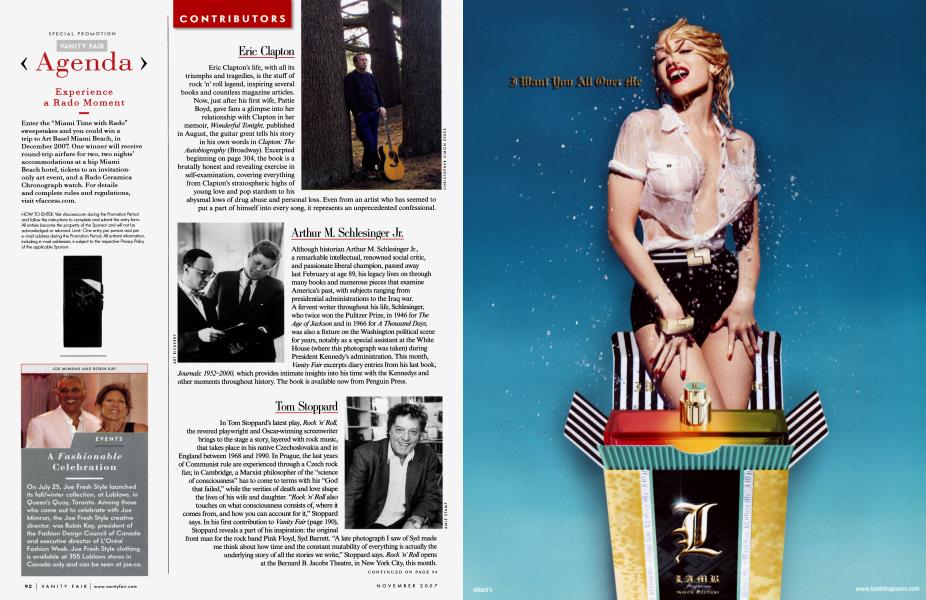
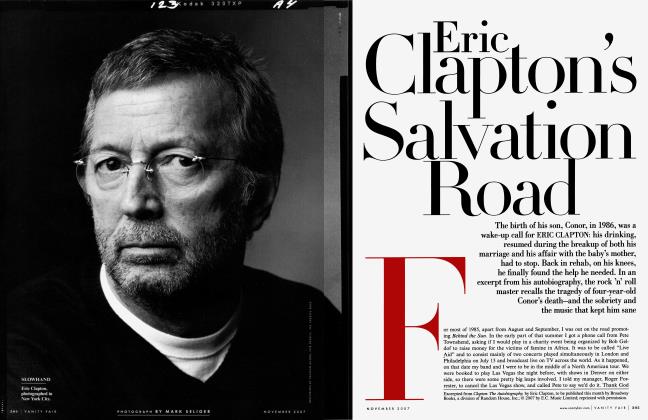
Eric Clapton’s life, with all its triumphs and tragedies, is the stuff of rock ’n’ roll legend, inspiring several books and countless magazine articles. Now, just after his first wife, Pattie Boyd, gave fans a glimpse into her relationship with Clapton in her memoir, Wonderful Tonight, published in August, the guitar great tells his story in his own words in Clapton: The Autobiography (Broadway). Excerpted beginning on page 304, the book is a brutally honest and revealing exercise in self-examination, covering everything from Clapton’s stratospheric highs of young love and pop stardom to his abysmal lows of drug abuse and personal loss. Even from an artist who has seemed to put a part of himself into every song, it represents an unprecedented confessional.
Arthur M. Schlesinger Jr.
Although historian Arthur M. Schlesinger Jr., a remarkable intellectual, renowned social critic, and passionate liberal champion, passed away last February at age 89, his legacy lives on through many books and numerous pieces that examine America’s past, with subjects ranging from presidential administrations to the Iraq war. A fervent writer throughout his life, Schlesinger, who twice won the Pulitzer Prize, in 1946 for The Age of Jackson and in 1966 for A Thousand Days, was also a fixture on the Washington political scene for years, notably as a special assistant at the White House (where this photograph was taken) during President Kennedy’s administration. This month, Vanity Fair excerpts diary entries from his last book, Journals: 1952-2000, which provides intimate insights into his time with the Kennedys and other moments throughout history. The book is available now from Penguin Press.
Tom Stoppard
In Tom Stoppard’s latest play, Rock W Roll, the revered playwright and Oscar-winning screenwriter brings to the stage a story, layered with rock music, that takes place in his native Czechoslovakia and in England between 1968 and 1990. In Prague, the last years of Communist rule are experienced through a Czech rock fan; in Cambridge, a Marxist philosopher of the “science of consciousness” has to come to terms with his “God that failed,” while the verities of death and love shape the lives of his wife and daughter. “Rock n Roll also touches on what consciousness consists of, where it comes from, and how you can account for it,” Stoppard says. In his first contribution to Vanity Fair (page 190), Stoppard reveals a part of his inspiration: the original front man for the rock band Pink Floyd, Syd Barrett. “A late photograph I saw of Syd made me think about how time and the constant mutability of everything is actually the underlying story of all the stories we write,” Stoppard says. Rock ’n’Roll opens at the Bernard B. Jacobs Theatre, in New York City, this month.
CONTINUED ON PAGE 94
CONTINUED FROM PAGE 92
Annie Leibovitz
From Africa to Hollywood to the New Establishment, contributing photographer Annie Leibovitz has compiled an unforgettable array of portfolios for Vanity Fair. This month, she turns her lens toward folk music’s classic stalwarts and newest sensations. “Since Annie was a teenager, she’s been a huge fan of folk music, and now she’s introducing it to her children,” says Kathryn MacLeod, her Vanity Fair producer. “The portfolio was a reunion for Annie with many of these artists, like Joan Baez and Joni Mitchell, but she was also excited to meet the new musicians carrying on the strong songwriting traditions of the older legends.” Leibovitz (seen here at far left, with Mary and Paul, of Peter, Paul and Mary, at the Carter Barron Amphitheatre, in Washington, D.C., circa 1966) lives in New York City with her three children.
Sally Bedell Smith
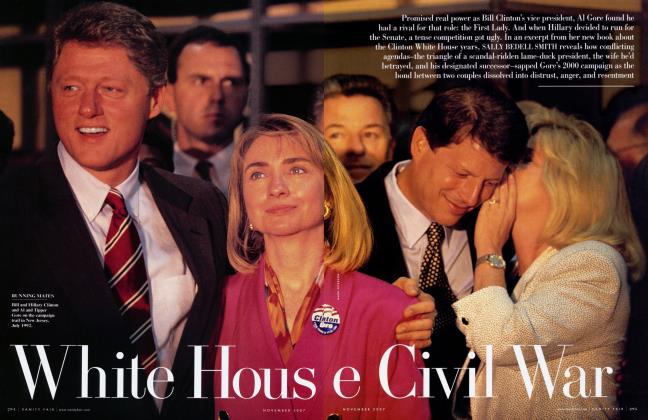
The author of 2004’s Grace and Power: The Private World of the Kennedy White House, Vanity Fair contributing editor Sally Bedell Smith is no stranger to the political struggles inside the White House. “I hoped to apply my knowledge of presidential relationships to another, very different White House couple,” she says. In an excerpt from her new book, For Love of Politics-Bill and Hillary Clinton: The White House Years (page 294), Smith explores the Clintons’ shared political ambitions, which drove a wedge between Bill and his other political partner, A1 Gore. Smith believes her research into the Clintons’ past could shed light on their future: “Both Clintons are deeply invested in their political sequel.”
Robert Dallek
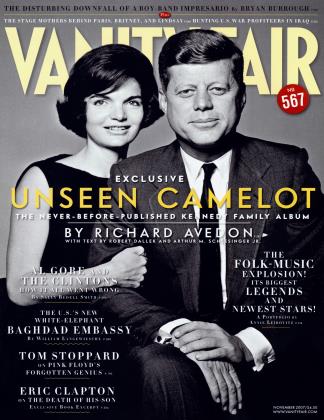
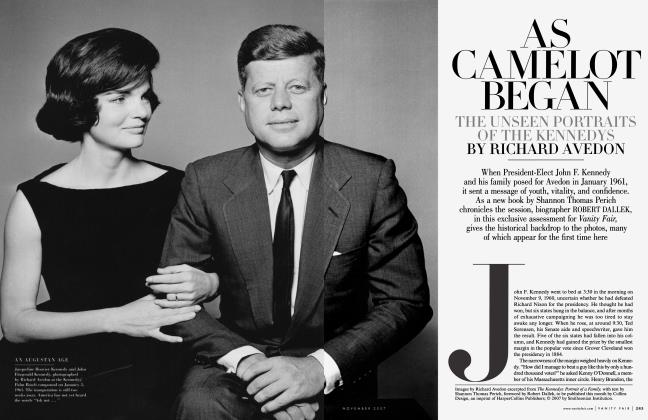
For decades, a clan of family friends refused researchers access to John F. Kennedy’s medical records. But five years ago, historian and presidential biographer Robert Dallek persuaded the protective committee to make him privy to the information—and discovered that J.F.K. had been far sicker than was previously believed. Dallek was recently given the opportunity to see another set of long-hidden artifacts: Richard Avedon’s photographs of J.F.K. alongside Jacqueline, Caroline, and John junior. This time he saw evidence not of an ailing prince but of a shrewd politician about to become the youngest elected president in history. “The photos are an expression of the political wisdom J.F.K. had. He knew he needed to persuade the country that he would be an authoritative presence in the White House; he also knew that his family’s appearance would be a great boon to him.” The photos, set to be released this month in The KennedysPortrait of a Family—for which Dallek has written the foreword—make clear the Kennedys’ singular status as America’s royal family. “No other president since has come close to J.F.K. in this regard—none of the successor families have enjoyed the appeal his has.”
CONTINUED ON PAGE 96
CONTINUED FROM PAGE 94
William Langewiesche
As the extravagant, sprawling, 104-acre U.S. Embassy in Baghdad prepared to commence operations this month, V.F. turned to international correspondent William Langewiesche, who chronicles the rise of U.S. diplomacy through the use of embassies in “The Mega-Bunker of Baghdad” (page 200). “At $600 million to build and another $1.2 billion to operate yearly, the embassy is obviously a questionable addition to America’s diplomatic presence in Iraq,” Langewiesche says. “But more to the point, it stands as a monument to American embassy construction worldwide, and it raises some simple questions: What are we doing with these facilities today? And what are we hoping to gain other than safety for safety’s sake? ” Langewiesche’s most recent book, The Atomic Bazaar: The Rise of the Nuclear Poor, was published in May by Farrar, Straus and Giroux.
David Rose
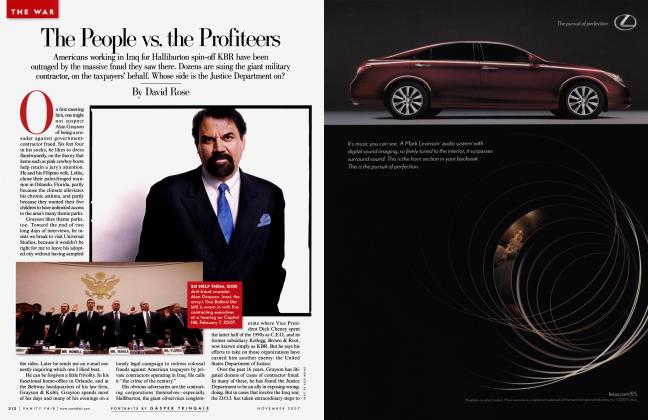
Contributing editor David Rose’s articles in Vanity Fair have exposed some of the more disgraceful actions of the U.S. government—the silencing of whistle-blowers, the abuses at Guantanamo Bay, the use of depleted-uranium munitions that may sicken and even kill the soldiers who deploy them.
Still, he says, “I remain fundamentally optimistic about America.” That is partly because of people such as Alan Grayson, an attorney and retired telecom entrepreneur, who, as Rose reports in “The People vs. the Profiteers” (page 212), is on a one-man crusade against Iraq-war profiteering. “One of the most impressive things about Grayson,” says Rose, “is the extent to which he is prepared to risk very large sums of his own money”—$10 million, Grayson estimates—“in support of a cause he believes is right.”
Bryan Burrough
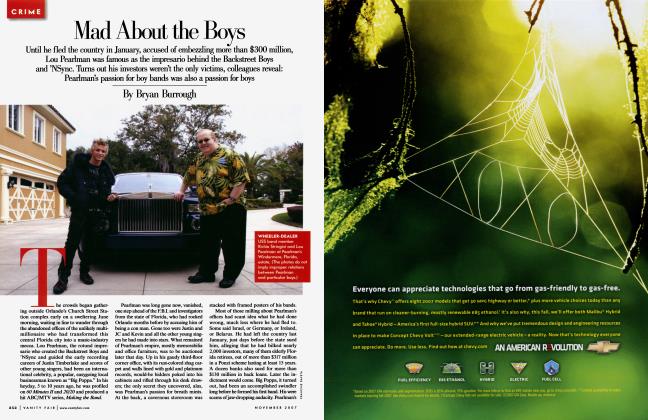
In this month’s issue, special correspondent Bryan Burrough delves into the hidden world of boy-band super-producer Lou Pearlman. Pearlman, creator of ’NSync and the Backstreet Boys, was recently arrested on fraud charges, but Burrough discovers an even more perverse side to him. “I started out researching a fairly typical case of business fraud and soon realized it was a far more interesting story.” Burrough details “an untold story of a man who, at the very least, made many of his young singers uncomfortable with his odd backrubs, a man who many around him felt was a sexual predator.” Burrough’s next book, The Big Rich, which tells the stories of the wealthiest Texas oil families, is due out next year from Penguin Press.
CONTINUED ON PAGE 106
CONTINUED FROM PAGE 96
Lisa Robinson
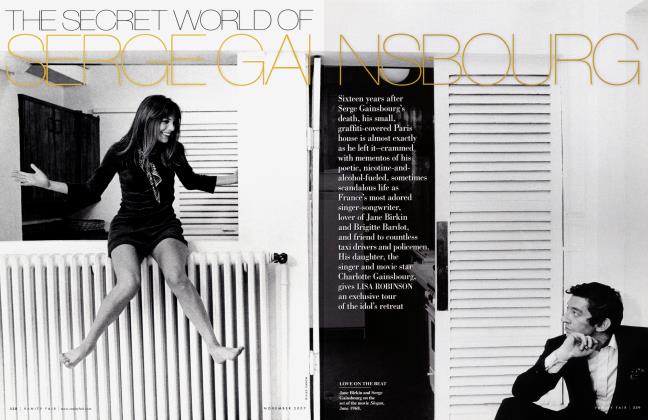
“I became fascinated with Serge Gainsbourg after seeing the outside of his house,” says contributing editor Lisa Robinson (pictured at Gainsbourg’s house at 5 bis ^ Rue de Verneuil, in Paris). “No one except family had been allowed inside since his death, in 1991, and I wanted to see it. But more than that, I wanted to talk to the women who had figured so dramatically in the life of this extraordinarily innovative and complex singer-songwriter.” Robinson’s story on Gainsbourg revisits a glamorous, hedonistic time and reveals a talented, provocative man who continues to influence contemporary musicians, including Beck, Sean Lennon, Michael Stipe, Regina Spektor, and Air. This month, Robinson also writes about new music in her Hot Tracks column and worked with Annie Leibovitz to organize the Folk-Music Portfolio. “There is a resurgence of folk music right now,” says Robinson, “and we’ve come full circle, with a portfolio that showcases some younger singers with some of folk’s greatest influences. Given the times, this is the perfect year to celebrate those who sing about love and peace.”
James Wolcott
V.F. contributing editor James Wolcott’s wistful memorial to the Twist in this month’s column is as much a paean to the dance itself as it is a recommendation for dance as diplomacy. “To me, the fact that Chubby Checker is still out there Twisting, at the age of 66, is proof of its rejuvenation powers! This would clearly be a happier, healthier nation if we could set aside our petty differences and Twist,” says Wolcott. To the hipper among writhing Americans, the Kennedys’ embrace of the Twist sent the dance packing from pop culture. One wonders how the Bushes would fare on the dance floor, but Wolcott doesn’t see it. “Jackie Kennedy may have enjoyed the Twist and the Frug, but it’s hard to picture Laura Bush—who’s suffered from a pinched nerve in her neck—getting a major groove on.”
Jean-Baptiste Mondino
Photographer Jean-Baptiste Mondino has always been inspired by music, which often comes across in his work. Well known for shooting musicians such as Keith Richards and Mick Jagger with their guitars, Mondino has made an impact on both the rock and pop worlds throughout the past 20 years with his bold and dynamic images. This month, the Paris-based lensman fuses music and photography again by capturing Serge Gainsbourg’s house and the pivotal women in his life, Jane Birkin and Charlotte Gainsbourg, for Lisa Robinson’s article about the late French singer. “I was very honored to be invited to shoot Jane and Charlotte,” Mondino says. “We were all very happy that Vanity Fair decided to show Serge’s talent to the world.” Mondino, whose book Guitar Eros was published last year by Schirmer/Mosel, is also an award-winning music-video director who has worked with Madonna, David Bowie, and Sting, among others.
Subscribers have complete access to the archive.
Sign In Not a Subscriber?Join Now


