

Sign In to Your Account
Subscribers have complete access to the archive.
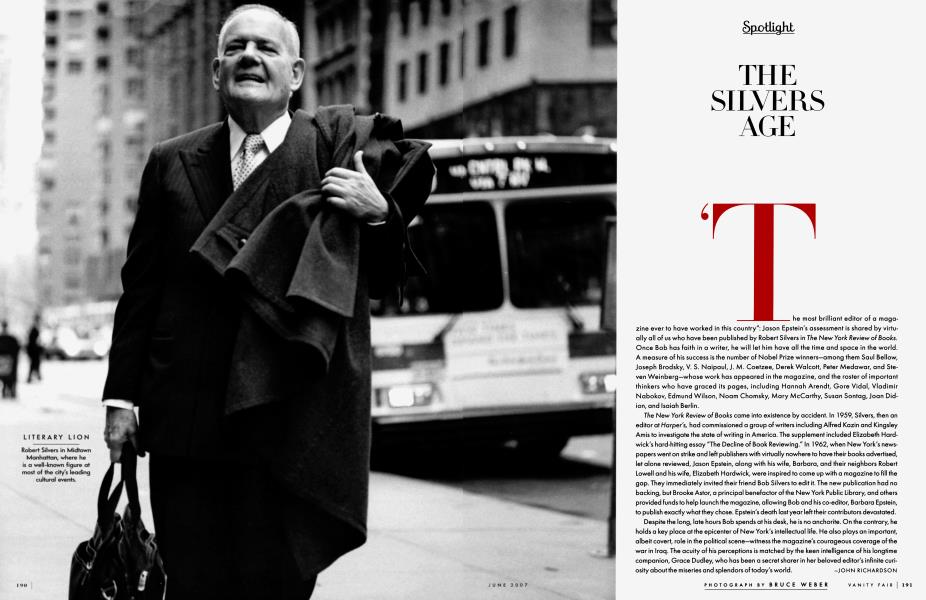
Sign In Not a Subscriber?Join Now'The most brilliant editor of a magazine ever to have worked in this country": Jason Epstein's assessment is shared by virtually all of us who have been published by Robert Silvers in The New York Review of Books. Once Bob has faith in a writer, he will let him have all the time and space in the world. A measure of his success is the number of Nobel Prize winners—among them Saul Bellow, Joseph Brodsky, V. S. Naipaul, J. M. Coetzee, Derek Walcott, Peter Medawar, and Steven Weinberg—whose work has appeared in the magazine, and the roster of important thinkers who have graced its pages, including Hannah Arendt, Gore Vidal, Vladimir Nabokov, Edmund Wilson, Noam Chomsky, Mary McCarthy, Susan Sontag, Joan Didion, and Isaiah Berlin.
The New York Review of Books came into existence by accident. In 1959, Silvers, then an editor at Harper's, had commissioned a group of writers including Alfred Kazin and Kingsley Amis to investigate the state of writing in America. The supplement included Elizabeth Hardwick's hard-hitting essay "The Decline of Book Reviewing." In 1962, when New York's newspapers went on strike and left publishers with virtually nowhere to have their books advertised, let alone reviewed, Jason Epstein, along with his wife, Barbara, and their neighbors Robert Lowell and his wife, Elizabeth Hardwick, were inspired to come up with a magazine to fill the gap. They immediately invited their friend Bob Silvers to edit it. The new publication had no backing, but Brooke Astor, a principal benefactor of the New York Public Library, and others provided funds to help launch the magazine, allowing Bob and his co-editor, Barbara Epstein, to publish exactly what they chose. Epstein's death last year left their contributors devastated.
Despite the long, late hours Bob spends at his desk, he is no anchorite. On the contrary, he holds a key place at the epicenter of New York's intellectual life. He also plays an important, albeit covert, role in the political scene—witness the magazine's courageous coverage of the war in Iraq. The acuity of his perceptions is matched by the keen intelligence of his longtime companion, Grace Dudley, who has been a secret sharer in her beloved editor's infinite curiosity about the miseries and splendors of today's world.
Subscribers have complete access to the archive.
Sign In Not a Subscriber?Join Now
