Sign In to Your Account
Subscribers have complete access to the archive.
Sign In Not a Subscriber?Join NowPimping Mao's Ride
CHINESE CARS: NO LONGER A JOKE
Isn't there something, well, oxymoronic about the phrase "Chinese cars"? O.K., gunpowder; but technology and China haven't exactly been synonymous since around Confucius's time. They called it the Long March and not the Long Drive for a reason.
But consider: from the early post-Mao era, when it was still barely able to eke out a few bad copies of Soviet copies of 1937 Packards for the Party elite—and a trickle of rackety little motorized pedicabs for everybody else—China has blended the Communist lash and the capitalist carrot to become the third-largest automobile-maker in the world.
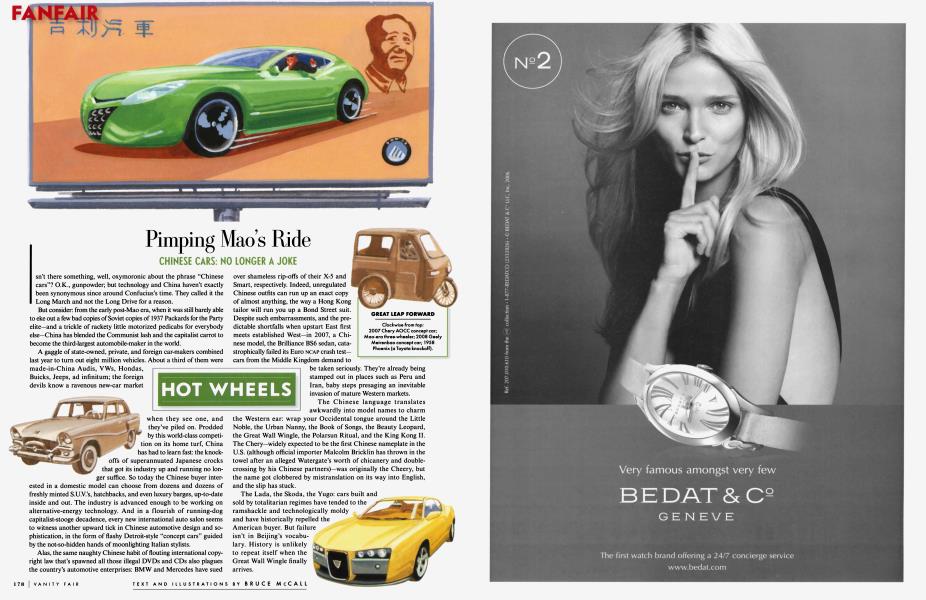
A gaggle of state-owned, private, and foreign car-makers combined last year to turn out eight million vehicles. About a third of them were made-in-China Audis, VWs, Hondas, Buicks, Jeeps, ad infinitum; the foreign devils know a ravenous new-car market when they see one, and they've piled on. Prodded by this world-class competition on its home turf, China has had to learn fast: the knockoffs of superannuated Japanese crocks that got its industry up and running no longer suffice. So today the Chinese buyer interested in a domestic model can choose from dozens and dozens of freshly minted S.U.V.'s, hatchbacks, and even luxury barges, up-to-date inside and out. The industry is advanced enough to be working on alternative-energy technology. And in a flourish of running-dog capitalist-stooge decadence, every new international auto salon seems to witness another upward tick in Chinese automotive design and sophistication, in the form of flashy Detroit-style "concept cars" guided by the not-so-hidden hands of moonlighting Italian stylists.
HOT WHEELS
Alas, the same naughty Chinese habit of flouting international copyright law that's spawned all those illegal DVDs and CDs also plagues the country's automotive enterprises: BMW and Mercedes have sued over shameless rip-offs of their X-5 and Smart, respectively. Indeed, unregulated Chinese outfits can run up an exact copy of almost anything, the way a Hong Kong tailor will run you up a Bond Street suit. Despite such embarrassments, and the predictable shortfalls when upstart East first meets established West—in 2007, a Chinese model, the Brilliance BS6 sedan, catastrophically failed its Euro NCAP crash testcars from the Middle Kingdom demand to be taken seriously. They're already being stamped out in places such as Peru and Iran, baby steps presaging an inevitable invasion of mature Western markets.
GREAT LEAP FORWARD I
Clockwise from top: 2007 Chery AOCC concept car; Mao-era three-wheeler; 2008 Geely Meirenbao concept car; 1958 Phoenix (a Toyota knockoff).
The Chinese language translates awkwardly into model names to charm the Western ear: wrap your Occidental tongue around the Little Noble, the Urban Nanny, the Book of Songs, the Beauty Leopard, the Great Wall Wingle, the Polarsun Ritual, and the King Kong II. The Chery—widely expected to be the first Chinese nameplate in the U.S. (although official importer Malcolm Bricklin has thrown in the towel after an alleged Watergate's worth of chicanery and doublecrossing by his Chinese partners)—was originally the Cheery, but the name got clobbered by mistranslation on its way into English, and the slip has stuck.
The Lada, the Skoda, the Yugo: cars built and sold by totalitarian regimes have tended to the ramshackle and technologically moldy and have historically repelled the American buyer. But failure isn't in Beijing's vocabulary. History is unlikely to repeat itself when the Great Wall Wingle finally arrives.
Subscribers have complete access to the archive.
Sign In Not a Subscriber?Join Now