Sign In to Your Account
Subscribers have complete access to the archive.
Sign In Not a Subscriber?Join NowTHE BILL CLINTON SHOW
Readers cry foul; Nancy Dowd's letter sparks outrage; busting the man crush; R.F.K. memories; Saint Angelina; and a lopsided history
LETTERS
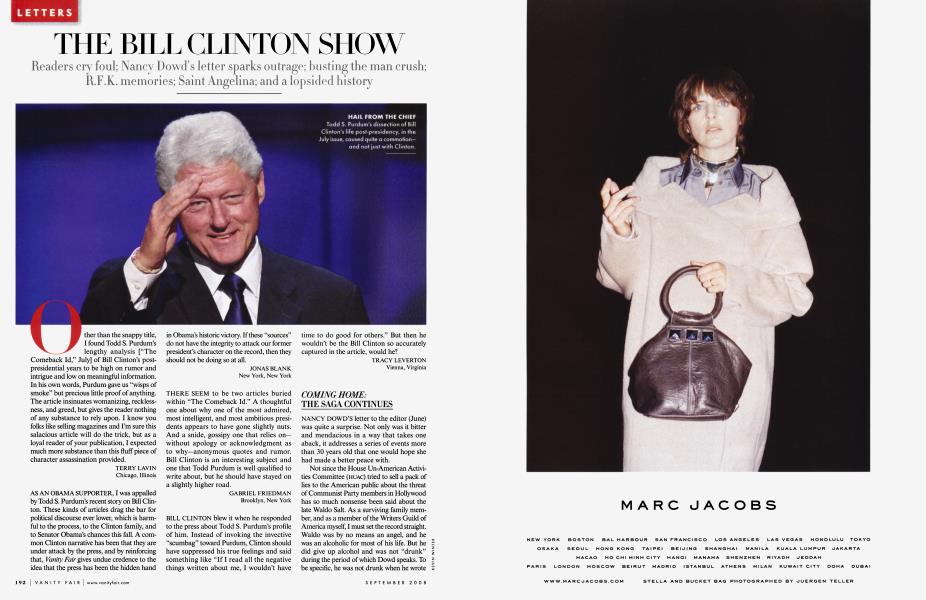
Other than the snappy title, I found Todd S. Purdum's lengthy analysis ["The Comeback Id," July] of Bill Clinton's postpresidential years to be high on rumor and intrigue and low on meaningful information. In his own words, Purdum gave us "wisps of smoke" but precious little proof of anything. The article insinuates womanizing, recklessness, and greed, but gives the reader nothing of any substance to rely upon. I know you folks like selling magazines and I'm sure this salacious article will do the trick, but as a loyal reader of your publication, I expected much more substance than this fluff piece of character assassination provided.
TERRY LAVIN Chicago, Illinois
AS AN OBAMA SUPPORTER, I was appalled by Todd S. Purdum's recent story on Bill Clinton. These kinds of articles drag the bar for political discourse ever lower, which is harmful to the process, to the Clinton family, and to Senator Obama's chances this fall. A common Clinton narrative has been that they are under attack by the press, and by reinforcing that, Vanity Fair gives undue credence to the idea that the press has been the hidden hand in Obama's historic victory. If these "sources" do not have the integrity to attack our former president's character on the record, then they should not be doing so at all.
JONAS BLANK New York, New York
THERE SEEM to be two articles buried within "The Comeback Id." A thoughtful one about why one of the most admired, most intelligent, and most ambitious presidents appears to have gone slightly nuts. And a snide, gossipy one that relies on— without apology or acknowledgment as to why—anonymous quotes and rumor. Bill Clinton is an interesting subject and one that Todd Purdum is well qualified to write about, but he should have stayed on a slightly higher road.
GABRIEL FRIEDMAN Brooklyn, New York
BILL CLINTON blew it when he responded to the press about Todd S. Purdum's profile of him. Instead of invoking the invective "scumbag" toward Purdum, Clinton should have suppressed his true feelings and said something like "If I read all the negative things written about me, I wouldn't have time to do good for others." But then he wouldn't be the Bill Clinton so accurately captured in the article, would he?
TRACY LEVERTON Vienna, Virginia
COMING HOME: THE SAGA CONTINUES
NANCY DOWD'S letter to the editor (June) was quite a surprise. Not only was it bitter and mendacious in a way that takes one aback, it addresses a series of events more than 30 years old that one would hope she had made a better peace with.
Not since the House Un-American Activities Committee (HUAC) tried to sell a pack of lies to the American public about the threat of Communist Party members in Hollywood has so much nonsense been said about the late Waldo Salt. As a surviving family member, and as a member of the Writers Guild of America myself, I must set the record straight. Waldo was by no means an angel, and he was an alcoholic for most of his life. But he did give up alcohol and was not "drunk" during the period of which Dowd speaks. To be specific, he was not drunk when he wrote the outline or screenplay of Coming Home; he was not drunk when he accepted the W.G.A. Laurel Award for lifetime achievement. He spent many hours composing the acceptance speech, and I was present at the event, along with other family members. And his sobriety aside, he was certainly not incomprehensible at the Academy Awards when he received his Oscar for Coming Home.
In addition—contrary to Dowd's insistence that in fact he was fired from the project not because of his heart attack but because he was "drunk"—if Dowd would care to visit the U.C.L.A. film-library special collections, where his papers are, she can read the letter Jerome Heilman wrote to him, in which he fired Waldo because he was too ill to do the re-write and the picture was weeks away from shooting. But the larger point is, whether or not there were problems with the draft, whether or not he was late with pages, these are writerly issues that I cannot believe Dowd herself has not faced, her undeniable talent notwithstanding.
Her most disturbing accusation is that Waldo was "an embittered, gilded rewriter." I won't grace the "gilded rewriter" phrase with an argument, because it is so hollow, and his work is out there to dispute the point. But anyone who knew him knows that "embittered" is the last word one would use. This is a man who stood up to HUAC, survived the blacklist with enormous grace, and over the years spewed less poison about the intimates and colleagues who named him than the dose of poison spewed by Dowd in a single letter.
As a writer who lost a project she cared about, who saw a script arbitration deny her a credit she felt she deserved, and who endured having to share her Oscar moment with the other writers, Dowd is in damn good company. Many had been there before her, and there have been many since. And to drag a fellow writer—much less one with such a distinguished legacy and body of work, who was a well-known, tireless mentor to hundreds of writers, and for whom Robert Redford named the Waldo Salt Screenwriting Award, at Sundance—through a series of falsehoods simply to assuage her own disappointments, shortcomings, frustrations, and heartbreaks (the daily diet of any working Hollywood screenwriter) is unacceptable, unprofessional, pitiable, and profoundly unworthy of whatever status she maintains in this industry.
JENNIFER SALT Sherman Oaks, California
1 HAVE just finished reading Nancy Dowd's scurrilous and rabid attack on Jane Fonda, Bruce Gilbert, and Waldo Salt. Her personal assaults are clearly beneath contempt, and I will not dignify them with a response. The facts of the case, however, are a different matter and cannot go unchallenged.
It was Waldo Salt who involved me in the project that would become Coming Home. (We had previously worked together on Midnight Cowboy and The Day of the Loeust and had formed a deep and lasting friendship, as well as a trusting professional relationship.) I was struck by Waldo's passion for the subject matter and Jane Fonda's and Bruce Gilbert's selfless and unrelenting efforts to get the film off'the ground.
I understood Waldo's insistence that he start from scratch, research the Vietnam War, and develop his own ideas for the movie. This he did with a major assist from Bruce, Jane's intelligent and articulate partner, and the cooperation of many of the wounded veterans and their families. Out of this effort Waldo fashioned an approximately 37-page outline, which I presented to United Artists. Based on that outline, U.A. agreed to pay Waldo's voluntarily reduced fee and provide him with a secretary so that he could write a first-draft script, which I submitted to U.A. upon completion.
To suggest that Fonda was "unbankable" at that time is absurd. It was specifically Jane's willingness to commit to that original screenplay that persuaded U.A. to agree to finance the film—with no other actors cast! After director John Schlesinger dropped out and I replaced him with Hal Ashby, we began a re-write based on Hal's personal take on the material. Soon after, Waldo suffered a massive (and well-documented) heart attack. By now we had accumulated a great deal of material, both written and recorded, and it was to Waldo's first draft and this research that we all turned in our effort to fashion a shooting script.
I have met Nancy Dowd only once—at the Writers Guild arbitration meeting she described in her letter. It is utter nonsense to suggest that Dowd's story credit was a "blip on the screen" or that Jane and Bruce had anything to do with it. Hal, our editor Don Zimmerman, our graphic designer, and I worked on the titles. Jane didn't see them until the release prints, to which there was no objection by the Writers Guild until Dowd filed her complaint. It is particularly significant to note that the Guild never ordered us to recall and alter the prints already in distribution, which they most certainly would have done had they felt there was anything inappropriate or demeaning in Dowd's credit. They simply asked us to change them as new prints were made, and we did so with no objection. To the very best of my recollection there was never an "apology" made by Jane or myself. If there was, I invite Dowd to send me a copy and I will gladly correct this statement.
To suggest that Waldo Salt was a drunkard and an incompetent is nothing less than slander. During all the years he and I worked together, I never observed Waldo drink as much as a beer or a glass of wine. I knew that Waldo had been an alcoholic as a younger man and a victim of the McCarthy anti-Communist purge. By the time we met, however, he had been clean and sober for years.
Dowd's vicious slander should not be permitted to stand, smearing the memory of this marvelous human being and champion of the Writers Guild and the dignity of writers everywhere.
JEROME HELLMAN Producer, Coming Home New York, New York
IRONICALLY, Nancy Dowd (a.k.a. Rob Morton, Ernest Morton, or "uncredited" on most projects she has been associated with) makes the strongest case for her removal from the film Coming Home. Her reduction of the love scene between Sally and the paraplegic Luke to "Dad's Army invents the clitoral orgasm" is the most appalling example of her insensitivity.
That scene was not about clitoral orgasms; rather, it was a desperately needed and deeply appreciated testament to the fact that men in wheelchairs are still men—real lovers in real beds with real women—men who CONTINUED FROM PAGE 194
FIND ALL THE STORIES DISCUSSED HERE, TOGETHER WITH LOTS MORE READER LETTERS, ON VF.COM.
CONTINUED ON PAGE 200
V.F. CLASSIC
In 1965, Bob Guccione launched Penthouse magazine, a glossy mix of tabloid headlines, muckraking journalism. and dirty pictures that turned into one of the world's most successful erotic empires. But by February 2005, when Vanity Fair dispatched contributing editor Patricia Bosworth to reconnect with Guccione. whom she had worked for as the executive editor of Penthouse's sister publication. Viva, three decades before, the soft-core king was a broken man. His multi-million-dollar fortune had evaporated. His health was fading. And his great love. Kathy Keeton, had died, in 1997, after battling breast cancer. Yet Guccione, as Bosworth revealed, was determined to keep fighting for his life—and emerge a survivor. To read Bosworth's "The X-Rated Emperor," please visit VANITYFAIR.COM/ARCHIVE.
are relaxed and unashamed, thoroughly undaunted despite the assumptions made about them, and potent in the truest sense of the word. Failure to understand that challenges Dowd's ability to handle such material at all.
TRACY HODSON Alameda. California
IT'S NOT A GUY THING
IN "Mad About the Guy" [July], a simplistic and poorly reasoned piece, James Wolcott, ironically enough, betrays the very same cultural discomfort with male affection that the Bush campaign exploited in the 2004 election, with those pious warnings about gay marriage to energize some conservatives and to distract other voters from the horrendous failures of policies in Iraq and elsewhere. Wolcott surely does not advance our political understanding with remarks that are not insightful; if they reveal anything at all, it may be Wolcott's own insecurities, as when he snidely invokes Brokeback Mountain to deal with the reporters who "still can't quit" McCain.
Like the short-lived chatter about the "metrosexual" a while back, the current talk about the "man crush" merely attests to how uptight so many Americans are, male and female, in responding to males who don't always abide by the culture's homophobic injunctions to be inhibited in expressions of same-sex affection. Insecurity rarely fosters insight, and it fatally flawed Wolcott's article. Such insecurity gave an edge to the Seinfeld episode from which Wolcott quotes, but it shouldn't have been the basis for a serious appraisal of the horror of the Bush years.
ONTINUED ON PAGE 212
MORE FROM THE V.F. MAILBAG
1 i I hen you're in this particular line yw of work mailbagging you soon Y T come to cherish letters that are genuinely, unself-consciously out of deep left field. And so it is with this verdict rendered by Jeff Turbin (no address given, but presumably writing from somewhere in the vicinity of the Iron Curtain): "A true Communist magazine." For us. such comments are the definition of pure pleasure. (Come to think of it, we suppose this one actually came out of deep right field.)
All kinds of impassioned mail (some 400 letters), pro and con, greeted Todd S. Purdum's article on Bill Clinton, some of it even printable. We will mention two that caught our eye. Dennis Christensen writes from Chicago to say. succinctly, "The article about Bill Clinton was very good, even if he didn't like it." And another reader, whose name we didn't catch, says,
"I am writing in response to the despicable piece of journalism you call 'The Comeback Id' that is due out in this week's issue." Wait, don't responses generally follow, not precede, what's being responded to?
"I do not believe you understand Americans at all," writes Karen Enders Leicht of Albertville, Alabama, to V.F. editor (and Canadian native) Graydon Carter. "The whole point of this country is a rebel stance." O.K. ... "In other words, we are dedicated to the idea that we are made up of individuals." And? "We have never been interested in being like everyone else." Fine, but where is this going? *7 do not care that we do not use the metric system..."
Grabbing hold of the other end of July's Editor's Letter ["What Ever Happened to the Future?"], Candace Westlund of Corvallis. Oregon, takes Graydon (and his "low ethical standards") to task for writing approvingly of his S10 knockoff wristwatch. "Condoning the purchasing of fake designer items has just inspired me to never purchase your magazine ever again," she says. We guess that means you're not interested in this fine, fine V.F. knockoff issue we have here? Come on, just compare -you can't tell them apart! (Well, ours does say "Proost Questionnaire," but otherwise they're identical.)
This month we reopen the voting on Graydon s hair. The most recent tally stood at 14-11 in favor of keeping the current style. The hitherto uncounted: "Yummy! Don't change a thing!" (Julie Herr, Warwick. New York); "Lose the wings. Graydon" (Diana Jenkins. Sydney. Australia);
, "Seriously. Graydon. cut the hair" (Charmaine Conaghan, Glenview, Illinois); "Graydon should not see a barber" (Cheta Ott. Ocala, Florida); "As long as you like it" (Jeanne M. Madison, Banning,
California); "I'm sure that something else can be done" (Carole Del Monte, the Villages. Florida); "I do not like them Sam I Am" (Helen Bolstad, Estero, Florida); "Stop polling, it's over, it's time to move on.... Go to the number-two or numberthree clip" (Shari Tagliabue. Townsville, Australia); "I think he's fouffing it up as a ploy to take our minds off the troubles of the day! Very nice of him" (Diane Heller, Los Angeles); and "Why don't you generate some computer-imaging alternatives that we can vote on?" (Carol J. Lundgaard. Oakland, California).
We make that 18-16, plus one request for more information and one intriguing suggestion. To be continued.
CONTINUED FROM PAGE 200
JOHN IBSON Author, Picturing Men: A Century of Male Relationships in Everyday American Photography Fullerton, California
THE SPIRIT OF R.F.K.
I THOROUGHLY enjoyed "The Last Good Campaign," by Thurston Clarke [June], I vividly remember Robert F. Kennedy's 1968 presidential campaign. I was a student at the University of Southern California, and I managed to get a full-time volunteer position with his campaign. It was a wonderful, inspiring, and unforgettable experience up until the tragic night of June 4. I was with the campaign at the Ambassador Hotel the evening of his assassination. I was absolutely shattered by it. Even today, I can still remember clearly the very moment it happened and the chaos and utter grief that ensued.
Thank you for reminiscing about 1968. I was not only deeply touched but also reminded about the very reasons why I was so committed to Bobby's campaign. His passion has inspired me, like many others he touched, to continue my commitment to the political and social process throughout my life.
JIM WIATT Beverly Hills, California
UNDER HER SPELL
"A WOMAN IN FULL" [by Rich Cohen, July] was inspiring. Angelina Jolie's dedication to world issues and her love of children are so wonderful. Aside from being gorgeous and intelligent, she possesses a level of goodness that is encouraging. Thank you for an insightful look at an individual whose gentleness is both admired and appreciated.
KIM MITTLEMAN Pasadena. California
WHEN ASKED if nepotism plays a role in actors' children becoming actors, Angelina Jolie denied that was the case. Instead, she claims it is because artists "raise their kids differently"—by reading to them, having art in the house, and taking them to the theater. How out of touch is she? I hate to break it to her, but those activities and exposures are what a great number of parents do with their children. Artists are not unique in that regard. Interestingly, the article also mentioned that Angelina got her first movie role in one of her actor father's movies, but I'm sure nepotism had nothing to do with it. It was all those books Jon Voight read to her.
SHELLEY JARVIS Pleasanton, California
REWIRING THE WORLD
I WOULD expect an article quoting innovators of the digital age ["How the Web Was Won," by Keenan Mayo and Peter Newcomb, July] to include at least one critic, one voice of concern, one naysayer. But Henry Ford never anticipated global warming when he and his enablers perfected the assembly line. And the builders of the Titanic thumbed their noses at ice floating in the path of their "unsinkable" passenger steamship. So it's not surprising that these techno-gurus don't see, or refuse to point out, the icebergs.
MICHAEL MINER Screenwriter, RoboCop Studio City, California
Letters to the editor should be sent electronically with the writer's name, address, and daytime phone number to letters@vf.com. Letters to the editor will also be accepted via fax at 212-286-4324. All requests for back issues should be sent to subscriptions@vf.com. All other queries should be sent to vfmail@vf.com. The magazine reserves the right to edit submissions, which may be published or otherwise used in any medium. All submissions become the property of Vanity Fair.
POST SCRIPT
In December 1999, I wrote about the four top photojournalists Ikilled in the February 10, 1971, shootdown of a South Vietnamese I helicopter over the Ho Chi Minh Trail, in Laos ("Saigon Quartet"). The article described how a U.S. M.I.A. search team, 27 years later, excavated the crash site and recovered traces of their remains, along with personal items belonging to the newsmen, including lenses and other camera parts. From that article came a book. Lost over Laos, which I co-authored with my Vietnam War-era colleague at the Associated Press, the photographer Horst Faas.
Since the V.F. article was published, the story has continued, with one stunning twist after another. The climax came on April 3, 2008, with the ceremonial interment of those remains at the Journalists Memorial, inside the Newseum, in Washington, D.C. Set into the floor is a plaque inscribed with the names of that long-lost "quartet": Larry Burrows. British, of Life magazine; Henri Huet, French-Vietnamese, of the Associated Press; Kent Potter, American, of United Press International; and Keisaburo Shimamoto, Japanese, of Newsweek.
As the A.P.'s bureau chief in Saigon in 1971, I had written the first bulletin about the ambush of the group's helicopter, typing, for the first time in my professional life, through my tears. The Vietnam War cost more than 70 media lives—the most of any 20thcentury conflict—but losing four journalists at once was a staggering blow. The crash site, in wild, hostile territory, was out of reach.
I promised myself that if a chance ever came to find that place I wanted to be the first one there. Persistence, coincidence, and sheer luck led to the re-discovery of the crash site, in 1996. and two years later, in March 1998, Faas and I, on assignment for V.F.. stood on that hillside as the M.I.A. search team dug telltale artifacts out of the dirt. With only trace remains for lab experts to examine, those artifacts would be proof enough that our friends had died there. The case ultimately was closed on the basis of "circumstantial group identification," but various obstacles thwarted burial plans for another five years, until Newseum officials agreed to make the as-yet-unbuilt museum a resting-place for the four—as well as the seven South Vietnamese who died with them.
More than 100 guests attended the dedication, including relatives of three of the four men. dozens of former Saigon press-corps colleagues, and retired military and diplomats. Speaking for the families, Larry Burrows's son, Russell, said the Newseum's memorial gallery would be, for them, a permanent chapel.
would go on to imagine a thousand times over those years, before it finally, and incredibly, came true. —RICHARD PYII To read the original story, please visit VF.COM. ROGER MATTINGLY
Subscribers have complete access to the archive.
Sign In Not a Subscriber?Join Now


