Sign In to Your Account
Subscribers have complete access to the archive.
Sign In Not a Subscriber?Join NowTimeless Beauty
THE ICONIC CARTIER TANK
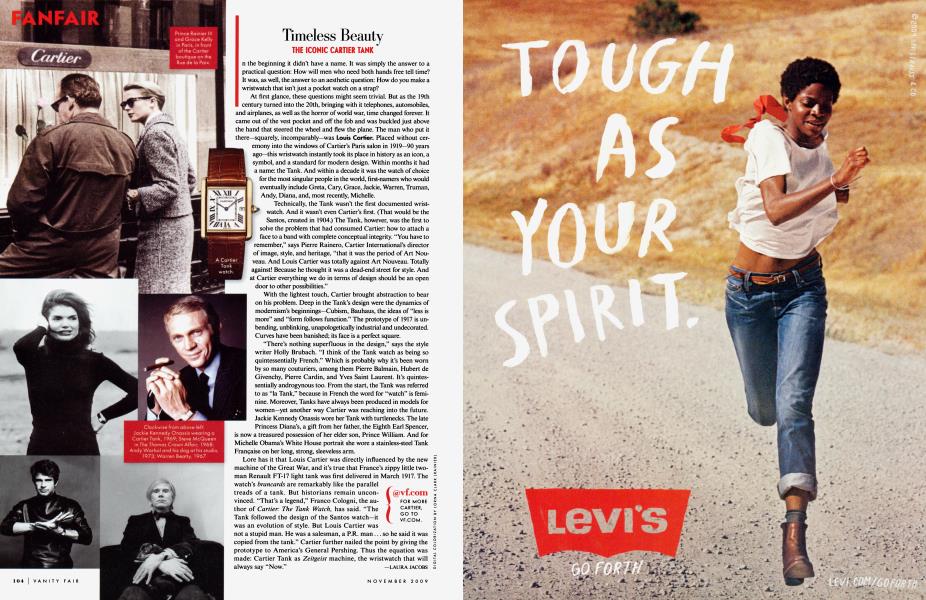
n the beginning it didn’t have a name. It was simply the answer to a practical question: How will men who need both hands free tell time? It was, as well, the answer to an aesthetic question: How do you make a wristwatch that isn’t just a pocket watch on a strap?
At first glance, these questions might seem trivial. But as the 19th century turned into the 20th, bringing with it telephones, automobiles, and airplanes, as well as the horror of world war, time changed forever. It came out of the vest pocket and off the fob and was buckled just above the hand that steered the wheel and flew the plane. The man who put it there—squarely, incomparably—was Louis Cartier. Placed without ceremony into the windows of Cartier’s Paris salon in 1919—90 years ago—this wristwatch instantly took its place in history as an icon, a symbol, and a standard for modern design. Within months it had a name: the Tank. And within a decade it was the watch of choice for the most singular people in the world, first-namers who would eventually include Greta, Cary, Grace, Jackie, Warren, Truman, Andy, Diana, and, most recently, Michelle.
Technically, the Tank wasn’t the first documented wristwatch. And it wasn’t even Cartier’s first. (That would be the Santos, created in 1904.) The Tank, however, was the first to solve the problem that had consumed Cartier: how to attach a face to a band with complete conceptual integrity. “You have to remember,” says Pierre Rainero, Cartier International’s director of image, style, and heritage, “that it was the period of Art Nouveau. And Louis Cartier was totally against Art Nouveau. Totally against! Because he thought it was a dead-end street for style. And at Cartier everything we do in terms of design should be an open door to other possibilities.”
With the lightest touch, Cartier brought abstraction to bear on his problem. Deep in the Tank’s design were the dynamics of modernism’s beginnings—Cubism, Bauhaus, the ideas of “less is more” and “form follows function.” The prototype of 1917 is unbending, unblinking, unapologetically industrial and undecorated. Curves have been banished; its face is a perfect square.
“There’s nothing superfluous in the design,” says the style writer Holly Brubach. “I think of the Tank watch as being so quintessential^ French.” Which is probably why it’s been worn by so many couturiers, among them Pierre Balmain, Hubert de Givenchy, Pierre Cardin, and Yves Saint Laurent. It’s quintessential^ androgynous too. From the start, the Tank was referred to as “la Tank,” because in French the word for “watch” is feminine. Moreover, Tanks have always been produced in models for women—yet another way Cartier was reaching into the future. Jackie Kennedy Onassis wore her Tank with turtlenecks. The late Princess Diana’s, a gift from her father, the Eighth Earl Spencer, is now a treasured possession of her elder son, Prince William. And for Michelle Obama’s White House portrait she wore a stainless-steel Tank Frangaise on her long, strong, sleeveless arm.
Lore has it that Louis Cartier was directly influenced by the new machine of the Great War, and it’s true that France’s zippy little twoman Renault FT-17 light tank was first delivered in March 1917. The watch’s brancards are remarkably like the parallel treads of a tank. But historians remain unconvinced. “That’s a legend,” Franco Cologni, the author of Cartier: The Tank Watch, has said. “The Tank followed the design of the Santos watch—it was an evolution of style. But Louis Cartier was not a stupid man. He was a salesman, a P.R. man... so he said it was copied from the tank.” Cartier further nailed the point by giving the prototype to America’s General Pershing. Thus the equation was made: Cartier Tank as Zeitgeist machine, the wristwatch that will always say “Now.” -LAURA JACOBS
Subscribers have complete access to the archive.
Sign In Not a Subscriber?Join Now