







Sign In to Your Account
Subscribers have complete access to the archive.
Sign In Not a Subscriber?Join NowRussia's Tiny Treasures
FANFAIR
A CHARMING HOLIDAY TRADITION
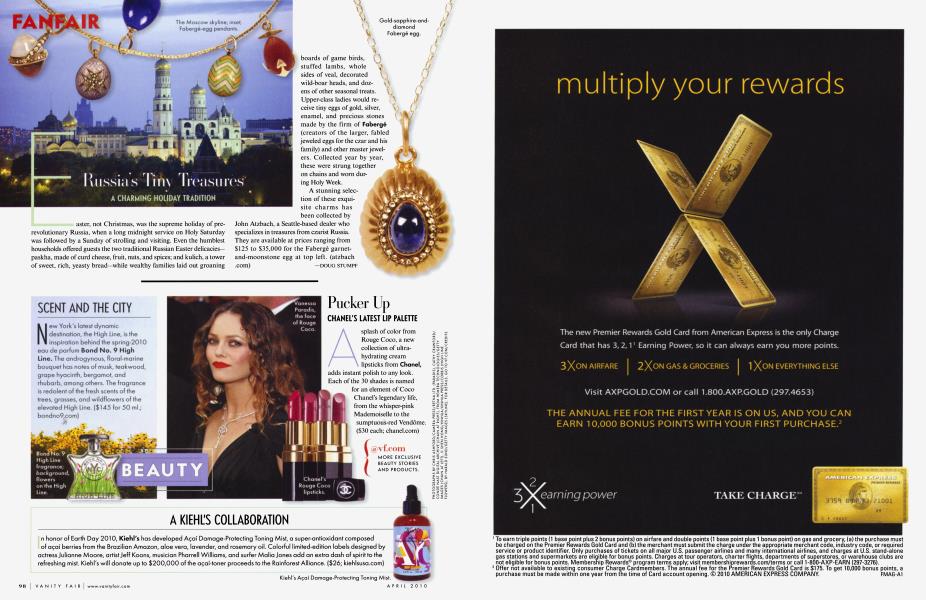
Easter, not Christmas, was the supreme holiday of prerevolutionary Russia, when a long midnight service on Holy Saturday was followed by a Sunday of strolling and visiting. Even the humblest households offered guests the two traditional Russian Easter delicacies— paskha, made of curd cheese, fruit, nuts, and spices; and kulich, a tower of sweet, rich, yeasty bread—while wealthy families laid out groaning boards of game birds, stuffed lambs, whole sides of veal, decorated wild-boar heads, and doz\ ens of other seasonal treats. Upper-class ladies would receive tiny eggs of gold, silver, enamel, and precious stones made by the firm of Faberge (creators of the larger, fabled jeweled eggs for the czar and his family) and other master jewelers. Collected year by year, these were strung together on chains and worn during Holy Week.
A stunning selection of these exquisite charms has been collected by John Atzbach, a Seattle-based dealer who specializes in treasures from czarist Russia, They are available at prices ranging from $125 to $35,000 for the Faberge garnetand-moonstone egg at top left, (atzbach .com)
DOUG STUMPF
Subscribers have complete access to the archive.
Sign In Not a Subscriber?Join Now