








Sign In to Your Account
Subscribers have complete access to the archive.
Sign In Not a Subscriber?Join NowOh, Behave!
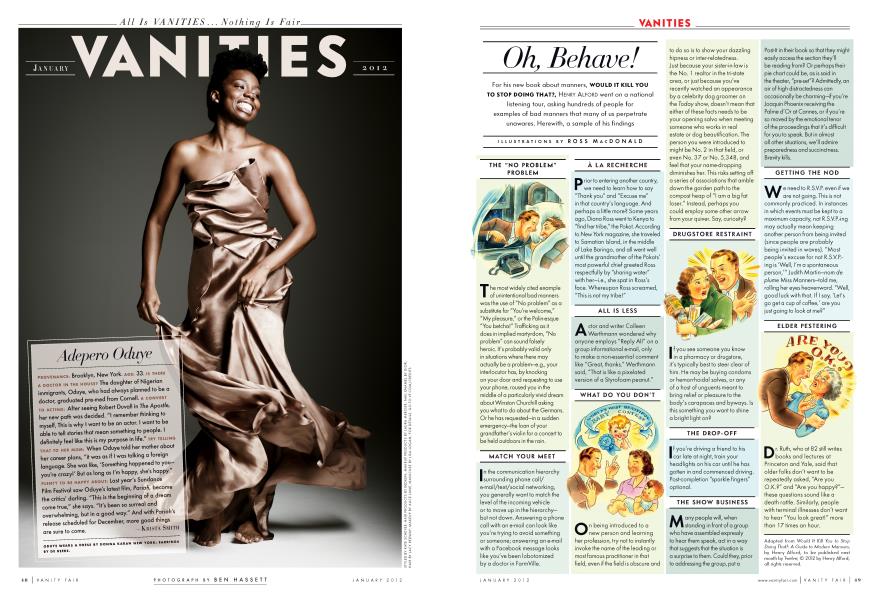
For his new book about manners, WOULD IT KILL YOU TO STOP DOING THAT?, HENRY ALFORD went on a national listening tour, asking hundreds of people for examples of bad manners that many of us perpetrate unawares. Herewith, a sample of his findings
THE "NO PROBLEM' PROBLEM
The most widely cited example of unintentional bad manners was the use of "No problem" as a substitute for "You're welcome," "My pleasure," or the Palin-esque "You betcha!" Trafficking as it does in implied martyrdom, "No problem" can sound falsely heroic. It's probably valid only in situations where there may actually be a problem—e.g., your interlocutor has, by knocking on your door and requesting to use your phone, roused you in the middle of a particularly vivid dream about Winston Churchill asking you what to do about the Germans. Or he has requested—in a sudden emergency—the loan of your grandfather's violin for a concert to be held outdoors in the rain.
MATCH YOUR MEET
In the communication hierarchy Isurrounding phone call/ e-mail/text/social networking, you generally want to match the level of the incoming vehicle or to move up in the hierarchy— but not down. Answering a phone call with an e-mail can look like you're trying to avoid something or someone; answering an e-mail with a Facebook message looks like you've been lobotomized by a doctor in FarmVille.
A LA RECHERCHE
Prior to entering another country, we need to learn how to say "Thank you" and "Excuse me" in that country's language. And perhaps a little more? Some years ago, Diana Ross went to Kenya to "find her tribe," the Pokot. According to New York magazine, she traveled to Samatian Island, in the middle of Lake Baringo, and all went well until the grandmother of the Pokots' most powerful chief greeted Ross respectfully by "sharing water" with her—i.e., she spat in Ross's face. Whereupon Ross screamed, "This is not my tribe!"
ALL IS LESS
Actor and writer Colleen Werthmann wondered why anyone employs "Reply All" on a group informational e-mail, only to make a non-essential comment like "Great, thanks." Werthmann said, "That is like a pixelated version of a Styrofoam peanut."
WHAT DO YOU DON'T
On being introduced to a new person and learning her profession, try not to instantly invoke the name of the leading or most famous practitioner in that field, even if the field is obscure and to do so is to show your dazzling hipness or inter-relatedness.
Just because your sister-in-law is the No. 1 realtor in the tri-state area, or just because you've recently watched an appearance by a celebrity dog groomer on the Today show, doesn't mean that either of these facts needs to be your opening salvo when meeting someone who works in real estate or dog beautification. The person you were introduced to might be No. 2 in that field, or even No. 37or No. 5,348, and feel that your name-dropping diminishes her. This risks setting off a series of associations that amble down the garden path to the compost heap of "I am a big fat loser." Instead, perhaps you could employ some other arrow from your quiver. Say, curiosity?
DRUGSTORE RESTRAINT
If you see someone you know in a pharmacy or drugstore, it's typically best to steer clear of him. He may be buying condoms or hemorrhoidal salves, or any of a host of unguents meant to bring relief or pleasure to the body's carapaces and byways. Is this something you want to shine a bright light on?
THE DROP-OFF
If you're driving a friend to his car late at night, train your headlights on his car until he has gotten in and commenced driving. Post-completion "sparkle fingers" optional.
THE SHOW BUSINESS
Many people will, when standing in front of a group who have assembled expressly to hear them speak, act in a way that suggests that the situation is a surprise to them. Could they, prior to addressing the group, put a Post-It in their book so that they might easily access the section they'll be reading from? Or perhaps their pie chart could be, as is said in the theater, "pre-set"? Admittedly, an air of high distractedness can occasionally be charming—if you're Joaquin Phoenix receiving the Palme d'Or at Cannes, or if you're so moved by the emotional tenor of the proceedings that it's difficult for you to speak. But in almost all other situations, we'll admire preparedness and succinctness. Brevity kills.
GETTING THE NOD
We need to R.S.V.P. even if we are not going. This is not commonly practiced. In instances in which events must be kept to a maximum capacity, not R.S.V.P.-ing may actually mean keeping another person from being invited (since people are probably being invited in waves). "Most people's excuse for not R.S.V.P.ing is 'Well, I'm a spontaneous person,"'Judith Martin—nom de plume Miss Manners—told me, rolling her eyes heavenward. "Well, good luck with that. If I say, 'Let's go get a cup of coffee,' are you just going to look at me?"
ELDER PESTERING
Dr. Ruth, who at 82 still writes books and lectures at Princeton and Yale, said that older folks don't want to be repeatedly asked, "Are you O.K.?" and "Are you happy?"— these questions sound like a death rattle. Similarly, people with terminal illnesses don't want to hear "You look great!" more than 17 times an hour.
Adapted from Would It Kill You to Stop Doing That?: A Guide to Modern Manners, by Henry Alford, to be published next month by Twelve; © 2012 by Henry Alford; all rights reserved.
Subscribers have complete access to the archive.
Sign In Not a Subscriber?Join Now