Sign In to Your Account
Subscribers have complete access to the archive.
Sign In Not a Subscriber?Join NowTITANS OF STYLE
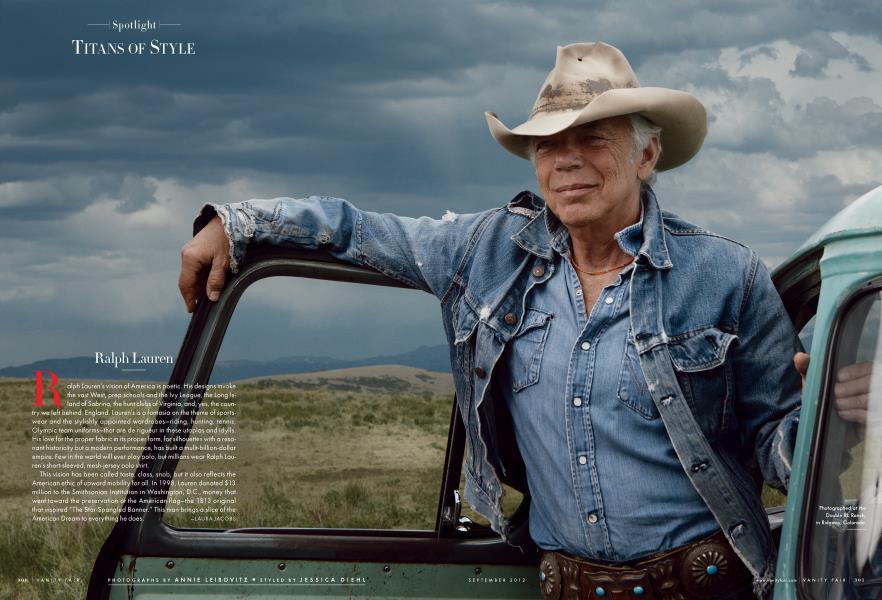
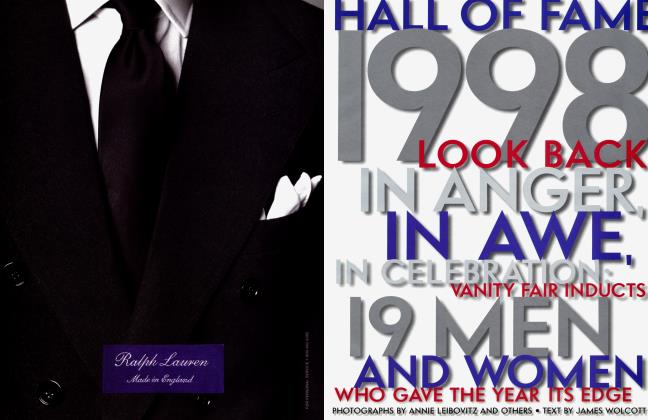
Ralph Lauren
Ralph Lauren's vision of America is poetic. His designs invoke the vast West, prep schools and the Ivy League, the Long Island of Sabrina, the hunt clubs of Virginia, and, yes, the country we left behind: England. Lauren's is a fantasia on the theme of sportswear and the stylishly appointed wardrobes—riding, hunting, tennis, Olympic team uniforms—that are de rigueur in these utopias and idylls. His love for the proper fabric in its proper form, far silhouettes with a resonant historicity but a modern performance, has built a mulit-billion-dollar empire. Few in the world will ever play polo, but millions wear Ralph Lauren's short-sleeved, mesh-jersey polo shirt.
This vision has been called taste, class, snob, but it also reflects the American ethic of upward mobility for all. In 1998, Lauren donated $13 million to the Smithsonian Institution in Washington, D.C., money that went toward the preservation of the American flag—the 1813 original that inspired "The Star-Spangled Banner." This man brings a slice of the American Dream to everything he does. - LAURA JACOBS
-Spotlight-
TITANS OF STYLE
Spotlight
Giorgio Armani
To get to the end, one has to go back to the beginning. It's 1945, the Second World War is winding down, and Giorgio Armani, aged 11, playing with gunpowder in a ditch with friends in the town of Piacenza, is badly burned. Maybe that taught him something about fear, because he would build an empire based on fearlessness. Armani's early fashion iconography—Richard Gere, supple and sleek, in those relaxed suits from American Gigolo, Jodie Foster strutting across the stage at the 1992 Oscars, confident in her beige Armani suit—has so informed modern dress that we take it for granted. But, in truth, Armani's boldness is a thing to behold. Just ask Lady Gaga, no shrinking violet, who had Armani design the costumes for her recent tours. Or the 2012 Italian Olympic team, whose uniforms he created.
One of the last big-time independents, he has always been critical of the mercurial fashion system, and when his beloved partner and chief booster, Sergio Galeotti, died in 1985, Armani faced rumors of his company's demise head-on. His role up to that point had been creative, but from then on he wore the business hat too. It fit. He is worth $7.2 billion and owns 100 percent of his empire. Now comes the constant murmuring about plans for succession, and the 78-year-old designer responds in true Armani style: The company is not for sale. He loves what he does.
Armani has often said that Giorgio Morandi, the 20th-century Italian still-life painter, is one of his favorite artists. Morandi wasn't one for constant change, either: he found his subject (bottles, vases, pitchers) and his palette (beiges, browns, grays, and creams) early, and he spent his life perfecting his vision. Armani has followed a similarly committed path. I'm reminded of Betty Parsons, the American art dealer, who it is said used to ask, "What's the difference between cats and dogs?" Her answer: "Cats aren't afraid of their jobs." Guess which one Armani is. And BTW, two of his most treasured companions are his gorgeous-coated felines, both Scottish Folds, Mairi and Angel. - INGRID SISCHY
FOR DETAILS, GO TO VF.COM/CREDITS
@vi.com
READ PROUST QUESTIONNAIRES FROM BOTH DESIGNERS. GO TO VF.COM/ SEPT20I2.
Subscribers have complete access to the archive.
Sign In Not a Subscriber?Join Now


