Sign In to Your Account
Subscribers have complete access to the archive.
Sign In Not a Subscriber?Join NowTHE VIEW FROM HOCKNEY
Spotlight
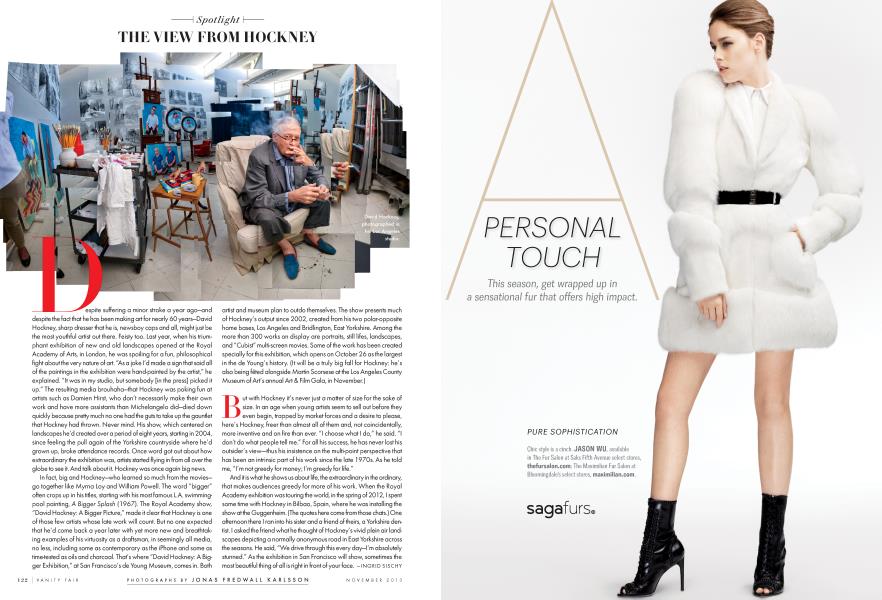
Despite suffering a minor stroke a year ago—and despite the fact that he has been making art for nearly 60 years—David Hockney, sharp dresser that he is, newsboy caps and all, might just be the most youthful artist out there. Feisty too. Last year, when his triumphant exhibition of new and old landscapes opened at the Royal Academy of Arts, in London, he was spoiling for a fun, philosophical fight about the very nature of art. "As a joke I'd made a sign that said all of the paintings in the exhibition were hand-painted by the artist," he explained. "It was in my studio, but somebody [in the press] picked it up." The resulting media brouhaha—that Hockney was poking fun at artists such as Damien Hirst, who don't necessarily make their own work and have more assistants than Michelangelo did—died down quickly because pretty much no one had the guts to take up the gauntlet that Hockney had thrown. Never mind. His show, which centered on landscapes he'd created over a period of eight years, starting in 2004, since feeling the pull again of the Yorkshire countryside where he'd grown up, broke attendance records. Once word got out about how extraordinary the exhibition was, artists started flying in from all over the globe to see it. And talk about it. Hockney was once again big news.
In fact, big and Hockney—who learned so much from the movies— go together like Myrna Loy and William Powell. The word "bigger" often crops up in his titles, starting with his most famous L.A. swimmingpool painting, A Bigger Splash (1967). The Royal Academy show, "David Hockney: A Bigger Picture," made it clear that Hockney is one of those few artists whose late work will count. But no one expected that he'd come back a year later with yet more new and breathtaking examples of his virtuosity as a draftsman, in seemingly all media, no less, including some as contemporary as the iPhone and some as time-tested as oils and charcoal. That's where "David Hockney: A Bigger Exhibition," at San Francisco's de Young Museum, comes in. Both artist and museum plan to outdo themselves. The show presents much of Hockney's output since 2002, created from his two polar-opposite home bases, Los Angeles and Bridlington, East Yorkshire. Among the more than 300 works on display are portraits, still lifes, landscapes, and "Cubist" multi-screen movies. Some of the work has been created specially for this exhibition, which opens on October 26 as the largest in the de Young's history. (It will be a truly big fall for Hockney: he's also being feted alongside Martin Scorsese at the Los Angeles County Museum of Art's annual Art & Film Gala, in November.)
But with Hockney it's never just a matter of size for the sake of size. In an age when young artists seem to sell out before they even begin, trapped by market forces and a desire to please, here's Hockney, freer than almost all of them and, not coincidentally, more inventive and on fire than ever. "I choose what I do," he said. "I don't do what people tell me." For all his success, he has never lost his outsider's view—thus his insistence on the multi-point perspective that has been an intrinsic part of his work since the late 1970s. As he told me, "I'm not greedy for money; I'm greedy for life."
And it is what he shows us about life, the extraordinary in the ordinary, that makes audiences greedy for more of his work. When the Royal Academy exhibition was touring the world, in the spring of 2012,1 spent some time with Hockney in Bilbao, Spain, where he was installing the show at the Guggenheim. (The quotes here come from those chats.) One afternoon there I ran into his sister and a friend of theirs, a Yorkshire dentist. I asked the friend what he thought of Hockney's vivid plein air landscapes depicting a normally anonymous road in East Yorkshire across the seasons. He said, "We drive through this every day—I'm absolutely stunned." As the exhibition in San Francisco will show, sometimes the most beautiful thing of all is right in front of your face. -INGRID SISCHY
INGRID SISCHY
Subscribers have complete access to the archive.
Sign In Not a Subscriber?Join Now