Sign In to Your Account
Subscribers have complete access to the archive.
Sign In Not a Subscriber?Join NowTHE ROYAL WE
Vanity Fair has long covered the royal courts of Europe, In the magazine's earliest issues (during its first American incarnation, as the Jazz Age began), the editors ran monthly features on monarchs and their country estates, their lavish weddings, their palace intrigues. Needless to say, there were a few missteps along the way. In October 1913, Vanity Fair predicted that nine-year-old Alexei, the hemophilia-stricken son of Russia's czar, Nicholas II, would "some day rule over one hundred and fifty million people," (Five years later, in the bloody aftermath of the Russian Revolution, the heir to the House of Romanov would die in a cellar after being shot with his family.) In January 1914, the editors spoke glowingly of Archduke Franz Ferdinand, who, in order to marry the Duchess of Hohenberg, had handed over his claim to the Austro-Hungarian throne. (The couple's assassination, six months later, would trigger World War I.)
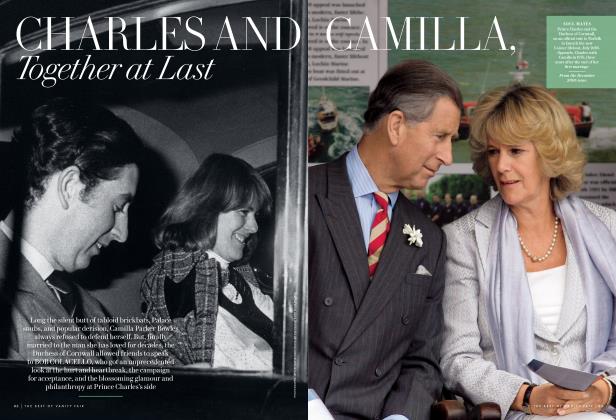
That was a full century ago, during the reign of England's King George V, grandfather of Queen Elizabeth II. Lately, however, we've been a bit more accurate in the way of regal handicapping. In our 2003 Young Royals issue, overseen by deputy editor Aimee Bell—our resident guide to this rarefied world—we predicted that Britain's Prince Charles would tie the knot with Camilla Parker Bowles ("when—not if"). Two years later, they did just that. In 2010, writer Katie Nicholl accurately forecast the nuptials of Prince William and Kate Middleton. And while the magazine has always had a rebellious, strident, democratic voice—missing no opportunity to question authority—we have nevertheless found guilty fascination in the pageantry, power, and audacious entitlement that surround dynastic families.
Two of our most beloved contributing editors have stood firmly on either side of this divide. The late Christopher Hitchens, an Englishman who received his American citizenship in 2007, believed the British royal family to be dysfunctional in the extreme, going as far as to call the monarchy "absurd," the Princess of Wales irrelevant ("You may take Diana or leave her"), and the Queen Mum a lush. "She drinks... at least a bottle of gin a day, " he once observed in our pages. "Her small talk... is that of an averagely batty and sozzled British Tory matron." Reinaldo Herrera, on the other hand (a descendant of a distinguished Venezuelan family), has expressed the opinion that monarchy—"the oldest system of government the world has known"—has become the one modern mode of governance (meaning: constitutional monarchy) "that ensures the greatest liberties to its subjects."
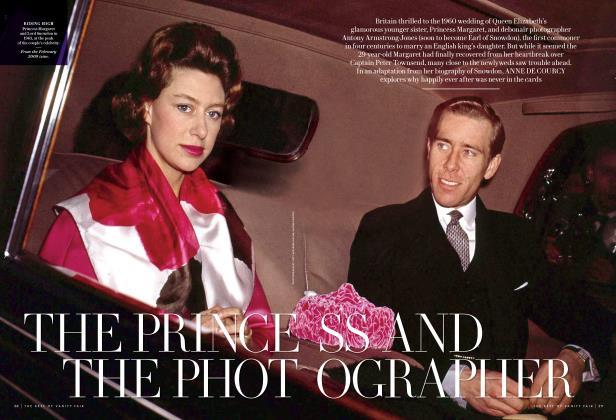
We're certainly not royalists here. We'll take constitutional democracy— any day. But one needn't look much farther than our masthead to get a sense of this publication's connections to titled Europe. Currently, Pippa Middleton, the younger sister of the Duchess of Cambridge, is a Vanity Fair writer. Several of our contributing editors are of royal lineage. Alice Brudenell-Bruce is a descendant of the seventh Earl of Cardigan, who led the Charge of the Light Brigade. Alex Shoumatoff traces his roots to Russian nobility. Diane von Furstenberg was formerly married to the Swiss-born Prince Egon von Furstenberg. Marina Cicogna is a countess; Beatrice Monti della Corte, a baroness. One of our contributing photographers, Lord Snowdon (page 28), even married Princess Margaret, in 1960. Born Antony Armstrong-Jones, Snowdon was the first British commoner in 400 years to wed a King's daughter. (They divorced in 1978.)
Over the years, three of our contributors, Cecil Beaton (page 20), Mario Testino (page 58), and, more recently, Jason Bell, have served as virtual court photographers for the Windsor brood. In 2007, Annie Leibovitz became the first American invited to make an official portrait of Queen Elizabeth II—on the occasion of the 400th anniversary of the founding of Jamestown. This year photographer Harry Benson received a special commission to capture Her Majesty on-camera as well. And the V.F. team of special correspondent Bob Colacello and photographer Jonathan Becker have been granted unique access to Prince Charles's inner circle. During Colacello's nearly three decades at the magazine, he has written about kings (Juan Carlos of Spain, Constantine of Greece), Prince Victor Emmanuel of Savoy, Princess Gloria von Thurn und Taxis, and the Austrian Archduchess Francesca von Habsburg. His assessment: "As Fitzgerald said of the rich, the royals really are different from you and me."
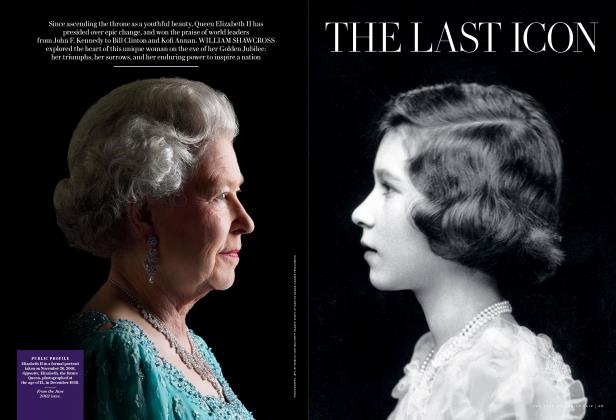
In recent years, we have opened our pages and our Web site to pieces by Prince Michael of Greece, Prince Charles (on one of his pet subjects: environmental awareness), and the ninth Earl Spencer (Princess Diana's brother, Charles, who contributed an essay on the perils of stepmothers and primogeniture). Queen Elizabeth II's biographer William Shawcross has also been an occasional Vanity Fair presence.
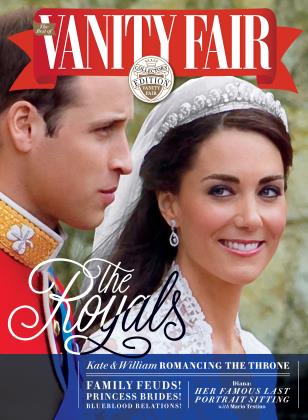
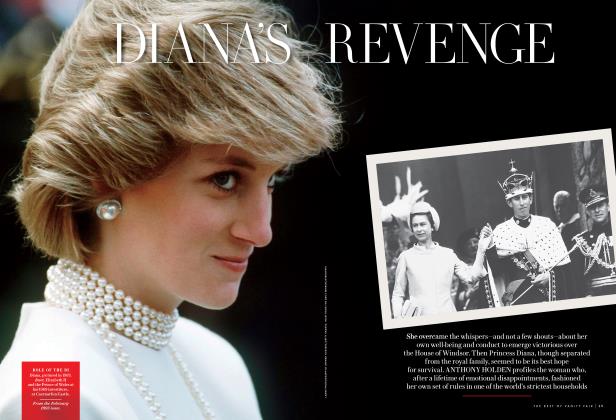
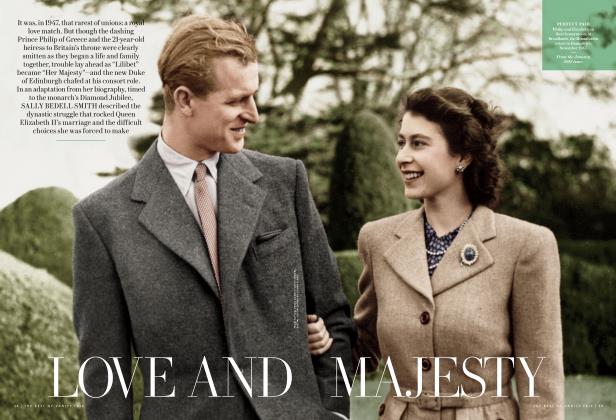
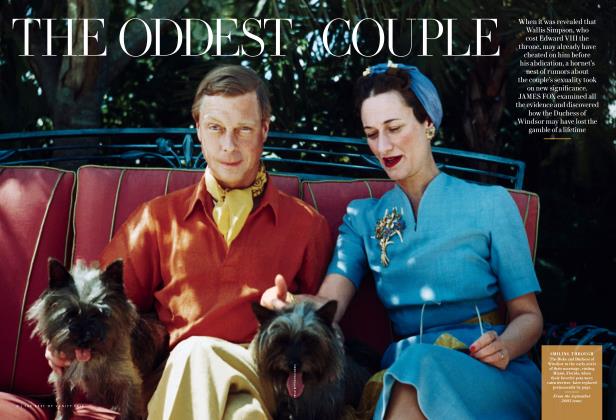
Here, then, are 10 of our favorite stories on the British royals. It's quite a package: the charming (William and Kate, each having graced two V.F. covers), the star-crossed (Princess Diana, having appeared on five covers—and counting), and the positively ghastly (Edward VIII and Wallis Simpson). And, simply because we couldn't resist, we end with the newest addition to the family, Prince George Alexander Louis of Cambridge. After Princes Charles and William, the child is third in the line of succession, while Prince Harry—the proverbial "spare" to the heir—has been relegated to fourth.
Baby George turns one year old on July 22. We can only imagine how we'll cover the terrible twos.
THE EDITORS
Subscribers have complete access to the archive.
Sign In Not a Subscriber?Join Now