Sign In to Your Account
Subscribers have complete access to the archive.
Sign In Not a Subscriber?Join NowWHAT CHRISTIE'S WON'T SELL
THE BACK PAGE
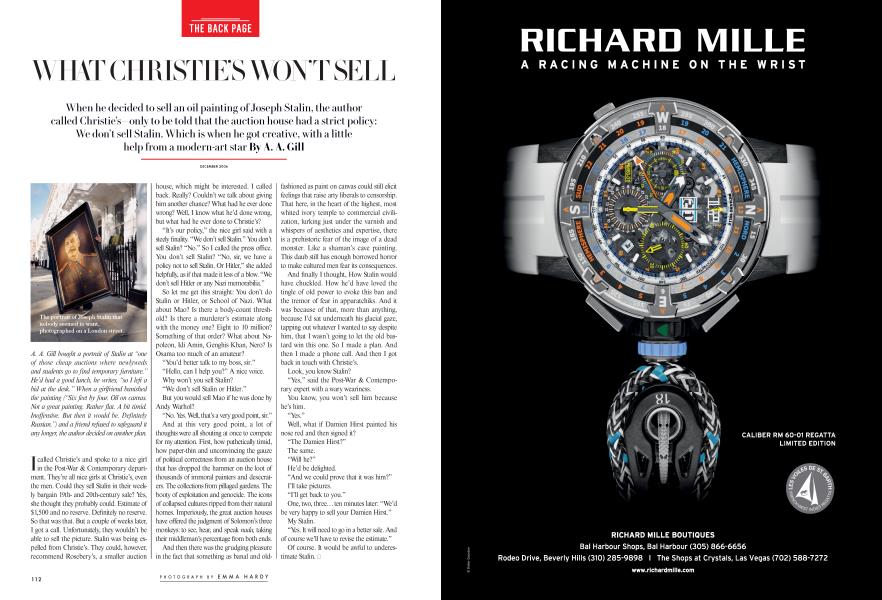
When he decided to sell an oil painting of Joseph Stalin, the author called Christie's—only to be told that the auction house had a strict policy: We don't sell Stalin. Which is when he got creative, with a little help from a modern-art star By A. A. Gill
A. A. Gill
DECEMBER 2006
A. A. Gill bought a portrait of Stalin at "one of those cheap auctions where newlyweds and students go to find temporary furniture. " He'd had a good lunch, he writes, "so I left a bid at the desk. " When a girlfriend banished the painting ("Six feet by four. Oil on canvas. Not a great painting. Rather flat. A bit timid. Inoffensive. But then it would be. Definitely Russian. ") and a friend refused to safeguard it any longer, the author decided on another plan.
I called Christie's and spoke to a nice girl in the Post-War & Contemporary department. They're all nice girls at Christie's, even the men. Could they sell Stalin in their weekly bargain 19thand 20th-century sale? Yes, she thought they probably could. Estimate of $1,500 and no reserve. Definitely no reserve. So that was that. But a couple of weeks later, I got a call. Unfortunately, they wouldn't be able to sell the picture. Stalin was being expelled from Christie's. They could, however, recommend Rosebery's, a smaller auction house, which might be interested. I called back. Really? Couldn't we talk about giving him another chance? What had he ever done wrong? Well, I know what he'd done wrong, but what had he ever done to Christie's?
"It's our policy," the nice girl said with a steely finality. "We don't sell Stalin." Abu don't sell Stalin? "No." So I called the press office. You don't sell Stalin? "No, sir, we have a policy not to sell Stalin. Or Hitler," she added helpfully, as if that made it less of a blow. "We don't sell Hitler or any Nazi memorabilia."
So let me get this straight: You don't do Stalin or Hitler, or School of Nazi. What about Mao? Is there a body-count threshold? Is there a murderer's estimate along with the money one? Eight to 10 million? Something of that order? What about Napoleon, Idi Amin, Genghis Khan, Nero? Is Osama too much of an amateur?
"Yiu'd better talk to my boss, sir."
"Hello, can I help you?" A nice voice.
Why won't you sell Stalin?
"We don't sell Stalin or Hitler."
But you would sell Mao if he was done by Andy Warhol?
"No. Yes. Well, that's a very good point, sir."
And at this very good point, a lot of thoughts were all shouting at once to compete for my attention. First, how pathetically timid, how paper-thin and unconvincing the gauze of political correctness from an auction house that has dropped the hammer on the loot of thousands of immoral painters and desecraters. The collections from pillaged gardens. The booty of exploitation and genocide. The icons of collapsed cultures ripped from their natural homes. Imperiously, the great auction houses have offered the judgment of Solomon's three monkeys: to see, hear, and speak nada, taking their middleman's percentage from both ends.
And then there was the grudging pleasure in the fact that something as banal and old-fashioned as paint on canvas could still elicit feelings that raise arty liberals to censorship. That here, in the heart of the highest, most whited ivory temple to commercial civilization, lurking just under the varnish and whispers of aesthetics and expertise, there is a prehistoric fear of the image of a dead monster. Like a shaman's cave painting. This daub still has enough borrowed horror to make cultured men fear its consequences.
And finally I thought, How Stalin would have chuckled. How he'd have loved the tingle of old power to evoke this ban and the tremor of fear in apparatchiks. And it was because of that, more than anything, because I'd sat underneath his glacial gaze, tapping out whatever I wanted to say despite him, that I wasn't going to let the old bastard win this one. So I made a plan. And then I made a phone call. And then I got back in touch with Christie's.
Look, you know Stalin?
"Yes," said the Post-War & Contemporary expert with a wary weariness.
You know, you won't sell him because he's him.
"Yes."
Well, what if Damien Hirst painted his nose red and then signed it?
"The Damien Hirst?"
The same.
"Wifi he?"
He'd be delighted.
"And we could prove that it was him?"
I'll take pictures.
"I'll get back to you."
One, two, three... ten minutes later: "We'd be very happy to sell your Damien Hirst."
My Stalin.
"Yes. It will need to go in a better sale. And of course we'll have to revise the estimate."
Of course. It would be awful to underestimate Stalin.
Subscribers have complete access to the archive.
Sign In Not a Subscriber?Join Now