Sign In to Your Account
Subscribers have complete access to the archive.
Sign In Not a Subscriber?Join NowJAZZ ON THE LOOSE
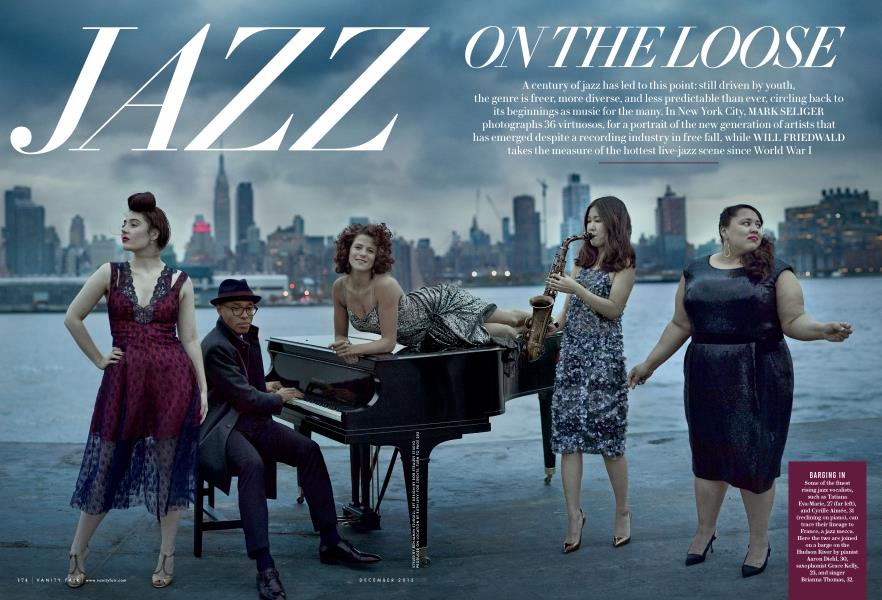
A century of jazz has led to this point: still driven by youth, the genre is freer, more diverse, and less predictable than ever, circling back to its beginnings as music for the many. In New York City, MARK SELIGER photographs 36 virtuosos, for a portrait of the new generation of artists that has emerged despite a recording industry in free fall, while WILL FRIEDWALD takes the measure of the hottest live-jazz scene since World War I
If the array of fresh faces on these pages surprises
-you, well, it shouldn’t. Jazz
has always been a young person’s game. Two of the greatest innovators in the history of jazz, Louis Armstrong and Charlie Parker, were both in their mid-20s when they made their breakthroughs, the ones that changed the music for all time. And most sidemen in the Big Band era were college-age.
So, what makes jazz—which is hot, hot, hot these days and nights—so different in the second decade of its second century? Once again, young musicians (whether first exposed via YouTube or one of the myriad high-school programs that have
sprouted across the land like clover) are taking the lead and flocking to jazz. But now they’re doing so in a way that’s linked to the genre’s 100-year history and, at the same time, completely unique to the current generation.
With a nod to this youth movement, we’ve defined the start of the contemporary era as 1981, when Wynton Marsalis— the 21st-century ambassador of jazz—recorded his eponymous first album. And every musician pictured on these pages was, in fact, born in or after that auspicious year. (This explains the absence of various thirtysomething standouts, such as Edmar Castaneda,
Alexis Cole, Jamie Cullum, Robert Glasper,
Mary Halvorson, Hiromi, Derrick Hodge, Jose James, Irvin Mayfield,
Gretchen Parlato, Jenny Scheinman, Marcus Strickland, Sachal Vasandani, Warren Wolf, and Miguel Zenon, among others. Anat Cohen and Jason Moran—both utterly remarkable—just hit 40.) The tempo has even picked up. In the months since these photos were
taken (as the 36 virtuosos captured here have zigged and zagged through New York en route to far-flung concert dates), there has been a parade of other young talents who have come to our attention. (See VF.com.)
It is important to note that both the music itself and the ways in which it’s being heard are much more open-ended than ever before. In the 1980s, when Marsalis ignited the hard-bop revival and what we now call the “Young Lions” era, it seemed like nearly every promising novice was playing as if he were auditioning for Miles Davis or John Coltrane. Thirty years later, things are much less predictable: you walk into a club in, say, Austin or Portland, or any of the dozens of venues that are currently hopping in New York City, and a 25-year-old might be playing music that reflects the absorbed influence of Monk, Stockhausen, or Django Reinhardt. Their styles and shadings come from jazz’s countless offshoots and from every continent.
The traditional music industry has been CONTINUED FROM PAGE 176 fil flee fall fol' the
TEXT CONTINUED ON PAGE 207
PHOTOGRAPHS CONTINUED ON PAGE 178
IT'S ALWAYS BEEN A YOUNG PERSON’S GAME LOUIS ARMSTRONG AND CHARLIE PARKER BROKE THROUGH IN THEIR 20S.
EVERY MUSICIAN HERE WAS BORN AFTER WYNTON MARSALIS RECORDED HIS FIRST ALBUM, IN 1981.
THEIR STYLES AND SHADINGS COME FROM JAZZ'S COUNTLESS OFFSHOOTS AND FROM EVERY CONTINENT
entire careers of these younger players. A generation ago, in contrast, emerging artists did everything they could to be noticed by producer Bruce Lundvall (who passed away in
May) or manager Mary Ann Topper; between them they helped launch the careers of Norah Jones, Diana Krall, and many of their peers. In the Spotify-Beats-MP3 age, the boundaries arc almost nonexistent, and the musicians are less dependent on the approval of such gatekeepers. In addition, the current decade has been much more of a five-music scene than any other time since World War I. Where tours used to coalesce around a new album, now, in the day of the download, physical CDs are primarily a “merch” item to sell at shows.
The overall result has been overwhelmingly positive: today, musicians, rather than following trends, have increased leeway to be themselves and can work, literally, without temporal or geographical limits. Contempo-
rary jazzmen and -women arc free to create in whatever style they want (and a stylish crowd they are), whether an existing format—from Jazz Age-inspired “hot jazz” to hip-hopinfused hybrids, to world jazz, which interacts with disparate rhythms and forms from around the globe—or a mode entirely of their own invention. When asked what distinguishes jazz from other music out there, virtually everyone included in this portfolio answered, “Freedom.” Insists Sam Friend, a 27-year-old New Orleans-based composer and bandleader (whose father, it so happens, is a V.F. editor): “The idea of jazz being ‘niche’ is just a phase. Jazz started out as pop—music for the many, not just the few. And judging by the energy and size of the jazz crowds today, who’s to say we can’t make it pop again?” □
Subscribers have complete access to the archive.
Sign In Not a Subscriber?Join Now


