


Sign In to Your Account
Subscribers have complete access to the archive.
Sign In Not a Subscriber?Join NowON A WING AND A HAIR
ED TOR'S LETTER
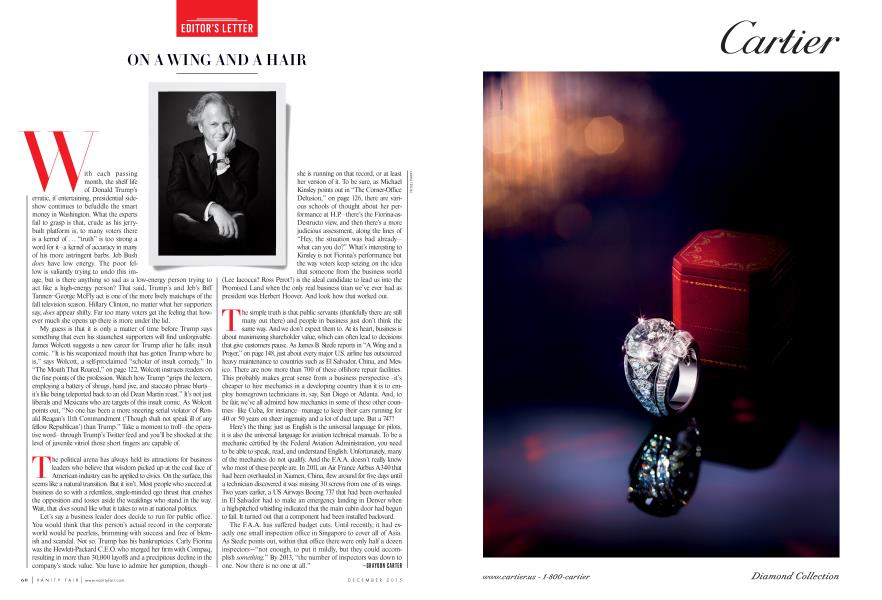
With each passing month, the shelf life of Donald Trump’s erratic, if entertaining, presidential sideshow continues to befuddle the smart money in Washington. What the experts fail to grasp is that, crude as his jerrybuilt platform is, to many voters there is a kernel of... “truth” is too strong a word for it—a kernel of accuracy in many of his more astringent barbs. Jeb Bush does have low energy. The poor fellow is valiantly trying to undo this image, but is there anything so sad as a low-energy person trying to act like a high-energy person? That said, Trump’s and Jeb’s Biff Tannen-George McFly act is one of the more lively matchups of the fall television season. Hillary Clinton, no matter what her supporters say, does appeal’ shifty. Far too many voters get the feeling that however much she opens up there is more under the lid.
My guess is that it is only a matter of time before Trump says something that even his staunchest supporters will rind unforgivable. James Wolcott suggests a new career for Trump after he falls: insult comic. “It is his weaponized mouth that has gotten Trump where he is,” says Wolcott, a self-proclaimed “scholar of insult comedy.” In “The Mouth That Roared,” on page 122, Wolcott instructs readers on the fine points of the profession. Watch how Trump “grips the lectern, employing a battery of shrugs, hand jive, and staccato phrase blurts it’s like being teleported back to an old Dean Martin roast.” It’s not just liberals and Mexicans who are targets of this insult comic. As Wolcott points out, “No one has been a more sneering serial violator of Ronald Reagan’s 11th Commandment (‘Though shalt not speak ill of any fellow Republican’) than Trump.” Take a moment to troll—the operative word—through Tramp’s Twitter feed and you’ll be shocked at the level of juvenile vitriol those short fingers are capable of.
The political arena has always held its attractions for business leaders who believe that wisdom picked up at the coal face of _l_ American industry can be applied to civics. On the surface, this seems like a natural transition. But it isn’t. Most people who succeed at business do so with a relentless, single-minded ego thrust that crushes the opposition and tosses aside the weaklings who stand in the way. Wait, that does sound like what it takes to win at national politics.
Let’s say a business leader does decide to run for public office. You would think that this person’s actual record in the corporate world would be peerless, brimming with success and free of blemish and scandal. Not so. Trump has his bankruptcies. Carly Fiorina was the Hewlett-Packard C.E.O. who merged her firm with Compaq, resulting in more than 30,000 layoffs and a precipitous decline in the company’s stock value. You have to admire her gumption, though—
she is running on that record, or at least ¾ her version of it. To be sure, as Michael ^ Kinsley points out in “The Corner-Office 1 Delusion,” on page 126, there are various schools of thought about her performance at H.P—there’s the Fiorina-asDestmcto view, and then there’s a more judicious assessment, along the fines of “Hey, the situation was bad already— what can you do?” What’s interesting to Kinsley is not Fiorina’s performance but the way voters keep seizing on the idea that someone from the business world (Lee Iacocca? Ross Perot?) is the ideal candidate to lead us into the Promised Land when the only real business titan we’ve ever had as president was Herbert Hoover. And look how that worked out.
The simple truth is that public servants (thankfully there are still many out there) and people in business just don’t think the _l_ same way. And we don’t expect them to. At its heart, business is about maximizing shareholder value, which can often lead to decisions that give customers pause. As James B. Steele reports in “A Wing and a Prayer,” on page 148, just about every major U.S. airline has outsourced heavy maintenance to countries such as El Salvador, China, and Mexico. There are now more than 700 of these offshore repair facilities. This probably makes great sense from a business perspective—it’s cheaper to hire mechanics in a developing country than it is to employ homegrown technicians in, say, San Diego or Atlanta. And, to be fail; we’ve all admired how mechanics in some of these other countries—like Cuba, for instance—manage to keep their cars running for 40 or 50 years on sheer ingenuity and a lot of duct tape. But a 747?
Here’s the thing: just as English is the universal language for pilots, it is also the universal language for aviation technical manuals. To be a mechanic certified by the Federal Aviation Administration, you need to be able to speak, read, and understand English. Unfortunately, many of the mechanics do not qualify. And the F.A.A. doesn’t really know who most of these people are. In 2011, an Air France Airbus A340 that had been overhauled in Xiamen, China, flew around for five days until a technician discovered it was missing 30 screws from one of its wings.
Two years earlier, a US Airways Boeing 737 that had been overhauled in El Salvador had to make an emergency landing in Denver when a high-pitched whistling indicated that the main cabin door had begun to fail. It turned out that a component had been installed backward.
The F.A.A. has suffered budget cuts. Until recently, it had exactly one small inspection office in Singapore to cover all of Asia.
As Steele points out, within that office there were only half a dozen inspectors—“not enough, to put it mildly, but they could accomplish somethingBy 2013, “the number of inspectors was down to one. Now there is no one at all.” -GRAYDON CARTER


Subscribers have complete access to the archive.
Sign In Not a Subscriber?Join Now