Sign In to Your Account
Subscribers have complete access to the archive.
Sign In Not a Subscriber?Join NowTHE MENTOR AND THE MOVIE STAR
MARILYN MONROE'S ACTING TEACHER, LEE STRASBERG, WAS A FATHER FIGURE TO THE WOMAN WHO NEVER HAD ONE. HIS ACTRESS DAUGHTER, SUSAN, WAS HER TRUSTED FRIEND AND CONFIDANTE—AS WELL AS MONROE'S RIVAL FOR HIS AFFECTIONS. IN THESE EXCERPTS FROM HER STORY ABOUT THE STRASBERGS, PATRICIA BOSWORTH EXAMINES THE LEGACY OF PERHAPS THE MOST IMPORTANT MAN IN MONROE'S LIFE
(ORIGINALLY PUBLISHED IN JUNE 2003)
On October 27 and 28, 1999, Christie's held a noisy, highly publicized auction of Marilyn Monroe's personal belongings, "a veritable time capsule of a great Hollywood icon," according to Nancy Valentino, a senior vice president at the auction house. Valentino estimated that the take from the Monroe auction would fall somewhere between the $5.7 million raised by the 1997 sale of dresses worn by Princess Diana and the $34.5 million earned the year before from the auction of Jackie Onassis's things. As it turned out, Marilyn's stuff brought in $13.4 million.
The approximately 1,000 items sold included 20 pairs of Ferragamo stilettos (slightly sweat-stained at the heels), rainbow-colored Pucci shifts, Maximilian furs, lace bustiers,
baby-doll nighties, and furry mules. There was a gold Magnavox television, a set of gilt lighters from Frank Sinatra's Cal-Neva Lodge, and the platinum-and-diamond wedding ring Joe DiMaggio gave Marilyn. The star's temporary driver's license went for $145,500, and an anonymous bidder paid $80,000 for the certificate Marilyn got when she converted to Judaism. "All these things reflect Marilyn's vulnerability," Nancy Valentino said. "Vulnerability was part of Marilyn Monroe's irresistible appeal." Some of the relics had a haunting quality: an open compact half full of crumbling pink face powder, a strand of blond hair clinging to a hat. Then there were the poems Marilyn scribbled to herself: "I'm lucky to be alive," read one. "It's hard to figure out when everything I feel hurts!"
One wondered how Monroe would have reacted. There was something creepy, almost obscene, about selling a celebrity's personal belongings to strangers. Maureen Dowd of The New York Times bluntly called this "stuff of fame" phenomenon part of our "vulture culture."
Marilyn Monroe died on August 4, 1962, at the age of 36, "of acute barbiturate poisoning," according to the Los Angeles coroner. She left all her clothes and personal effects to her friend and mentor Lee Strasberg, the famous director of the Actors Studio.
When Strasberg passed away in 1982, his third wife, Anna Mizrahi Strasberg, inherited everything. The vivacious, auburn-haired former actress had never known Marilyn Monroe, and she has never explained why she decided to auction off all the star's belongings. (Anna Strasberg declined to be interviewed for this story and said that questions submitted to her about its content contained information that was false.) Monroe's will stipulated that Lee Strasberg "distribute these, in his sole discretion, among my friends, colleagues and those to whom I am devoted." Until Anna Strasberg assumed responsibility for the estate, however, Monroe's things had been in storage for years—"in white coffin-shaped boxes," curator Meredith Etherington Smith wrote. Everything had remained in pristine condition except for the sober little black dress Marilyn had worn when she announced her engagement to Arthur Miller. The moths had chewed it to bits.
Anna Strasberg was not present at the auction, so she didn't hear the gasps and applause when the glittery, formfitting, flesh-colored gown Marilyn had worn when she sang a sultry "Happy Birthday, Mr. President" to John F. Kennedy at Madison Square Garden went for $1.26 million. The dress was purchased by Robert Schagrin, coowner of the New York shop Gotta Have It!, which specializes in pop-culture memorabilia. "Marilyn Monroe is one of a few international icons who will transcend time," Schagrin says. "Along with Elvis, Babe Ruth, and the Beatles, she is always a great investment for collectors. She's just gonna increase in value."
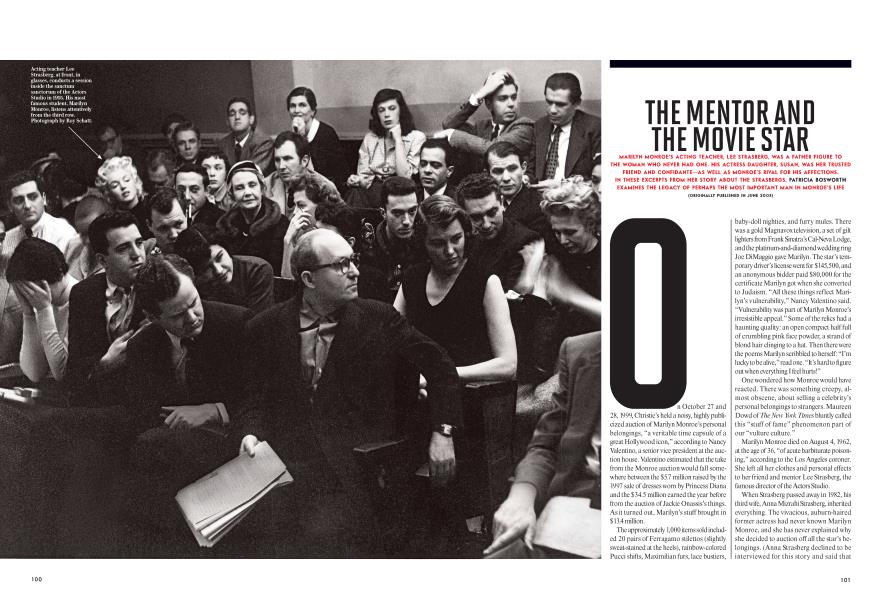
It was more than 40 years ago, and Broadway and Times Square were shabby and intimate. Many of my friends lived in coldwater flats, ate baked beans at the Automat, went to midnight screenings on 42nd Street, and shared in the adventure of becoming artists. That particular afternoon it had started to rain. Susan Strasberg and I had just run outside after a session at the Actors Studio and were standing on West 44th Street debating whether or not to go shopping at Jax. Our friend and fellow Actors Studio member Marty Fried owned a medallion cab, and it was already idling at the curb nearby. Suddenly Lee Strasberg appeared, dressed in mournful black. I was in awe of my strange, implacable acting teacher. His praise and encouragement could sustain me for months. Away from class he was cold and remote, so when he brusquely offered me a lift I was surprised. I was not part of his inner circle, which consisted of big stars.
It was raining quite heavily, and Susan cried, "Come on!" and squeezed into the front seat with Lee, who was staring straight ahead, an impenetrable expression on his face. As I slid into the backseat, I saw Marilyn Monroe huddled in the corner, dreamily smoking a cigarette. Her bleached-blonde hair was tousled; she wore no makeup, and I noticed that there was dirt beneath her fingernails. I couldn't stop looking at her.
We drove uptown in silence, and I knew she was aware I was looking at her. I always looked at her whenever I saw her—in and out of class, at the coffee shop where she hung out with Lee, at midnight screenings she attended with Susan and Marty. She was used to being looked at, and she wasn't selfconscious. She had a mysterious, indefinable quality that made her a star and separated her from everyone else.
She had done two scenes in Lee's private classes: Molly Bloom's monologue from James Joyce's Ulysses and a section of Breakfast at Tiffany's with Michael J. Pollard. In both she had projected a luminous, yearning quality that was very appealing. At the moment she appeared to be floating in another world as she puffed delicately on her cigarette and blew the smoke oh so softly out of her mouth.
The newspapers were full of stories about her—how she'd left Hollywood and come to New York to be a "serious actress," how Lee was coaching her at his apartment and letting her "observe" sessions at the studio. Part of Lee's great gift as a teacher was to get us to function at the highest level. He had a rare ability to pinpoint what we were capable of creating onstage, and his stern manner made us try to do our best to please him. According to Marty, Lee was encouraging Marilyn to play Cordelia in Shakespeare's King Lear. He would invite her to lunch at Sardi's with members of his inner circle, including the Greek director Andreas Voutsinas and the young Jane Fonda, and wax eloquent about theater history: Stanislavsky, Duse, Laurette Taylor. Then he would turn his attention to Marilyn's sparkling potential. Once, when Marilyn interrupted and said to Jane Fonda, "Aw, you play Cordelia, O.K.?," Lee's face cracked into a tiny smile.
Their relationship was intense and fascinating—the acting coach and the movie star. Clearly they saw each other in symbolic ways. Lee was the father Marilyn had never had (she called all the men in her life Daddy), and he validated her existence as an artist. Lee could give Marilyn respect. Marilyn was Lee's ticket to fame and celebrity.
It was muggy in the cab. The rain pelted down and lightning flashed as Marty drove through huge puddles on the street. Still no one spoke. After a while Susan rolled down the window and moist, cool air whooshed in. Marilyn gave a sigh and shrugged out of her coat.
That's when I noticed the pearls. She was wearing a necklace of what looked like vintage pearls; they were lustrous and creamy and matched her skin, which seemed almost iridescent. She positively glowed. "Those are gorgeous pearls, Miss Monroe," I said. I couldn't bring myself to call her Marilyn. "Yeah," Marilyn said as she fingered them absently. "The emperor gave them to me."
"The emperor?" asked Susan.
"Hirohito of Japan. When Joe and I were on our honeymoon in Tokyo, he gave them to me in a private ceremony. " Her voice trailed off as if she'd lost interest in the subject. She had, we knew, quickly lost interest in Joe DiMaggio. They were about to be divorced, after a marriage that had lasted only nine months. Lately she'd been telling her friend the Hollywood gossip columnist Sidney Skolsky that she was going to marry the playwright Arthur Miller.
"Darling?" Lee Strasberg murmured tenderly from the front seat.
"Tbah, Lee?"
"Did you say the Emperor of Japan gave you those pearls?"
"Tbah."
He turned and stared at her with burning eyes. "How wonderful, darling." His voice was full of feeling. He so rarely responded in an overt way that it was thrilling to see him react.
Silence once more. Then we reached our destination, the Strasberg apartment on Central Park West. Lee got out of the cab without a word and disappeared into the ornate lobby. Marilyn undulated after him. Apparently she was on her way to see her psychiatrist, Dr. Marianne Kris, who lived and worked in an apartment near the Strasbergs'. Marilyn saw Dr. Kris five times a week, and afterward she would take the elevator to Lee's, where he would guide her in a series of sense-memory exercises, in which she acted like a child, in an effort to get in touch with her "real self'—her "real tragic power." "Do this [exercise] and you'll feel something, " he would tell Marilyn, and she believed him because she needed to, for Marilyn Monroe was not often in touch with how she felt.
She would struggle mightily to release emotional and physical blocks as she recalled one of her most disturbing childhood memories— the time a relative tried to suffocate her with a pillow. But the pain of recalling those early years as Norma Jeane Baker, the abandoned and abused child, was excruciating. Marilyn confided to Susan that occasionally, when Lee's questions became too probing, she would just "make something up."
Marilyn Monroe was more and more a fixture in the Strasberg apartment. I " I Often she would have supper with the family and then wander into Susan's room to talk about her inability to sustain friendships and her paranoia about people. She would confide softly, "I always felt I was a nobody, and the only way for me to be somebody was to—well, be somebody else, which is probably why I wanted to act."
Since Lee couldn't leave his classes, [Susan's mother, Lee Strasberg's second wife] Paula coached Marilyn in Bus Stop and Some Like It Hot. For a short while Marilyn had a devoted manager, the photographer Milton Greene, who helped her launch the film company Marilyn Monroe Productions. After Greene almost went broke producing The Prince and the Showgirl, in which Marilyn starred opposite Laurence Olivier, she abruptly kicked him out of her life. His widow, Amy Greene, thinks the Strasbergs helped turn Marilyn against him. "And he only wanted the best for her," she says.
In time, Marilyn grew to be as dependent on Paula as she was on Lee. She never lost her terror of being on a movie set because Paula continually forced her to reach down for her "real self." In Monroe's case, that meant not only Norma Jeane, the abused orphan child, but also Marilyn, the blonde, wiggly sex symbol. Referring to her split personality, Marilyn would say, "I feel as though it's all happening to someone right next to me. I'm close to it—I feel it—but it really isn't me. "
"AW, YOU PLAY CORDELIA, O.K.?" MARILYN TOLD JANE FONDA. LEE'S FACE CRACKED INTO A TINY SMILE.
Paula constantly had to make excuses for Marilyn's lateness on the set. Often Marilyn would simply soak in a hot perfumed bath instead of showing up for filming. She'd explain in her baby voice, "It isn't Marilyn in the tub; it's Norma Jeane. I'm giving Norma Jeane a treat. She used to bathe in water used by six or eight people. Now she can bathe in water as clear and transparent as glass." So Paula became the heavy, hated by most of Marilyn's directors and producers. This was nerve-racking for her, and she suffered migraines as a result. "I'm not that much of a monster," Paula'd cry. She felt entitled to compensation for all the troubles Marilyn heaped on her, and indeed she was rewarded handsomely. Lee insisted that she be paid $25,000 for coaching Marilyn in The Prince and the Showgirl—as much as some of the featured actors were getting—and she got it. Marilyn would have gone into a panic if Paula hadn't been there to hold her hand.
Paula let Marilyn know that she coveted her pearl necklace. "Oh, Marilyn," she'd gush, "I just love looking at those pearls! " Marilyn would smile and caress the pearls, not telling Paula that she really wanted to give them away, since they reminded her of her disastrous marriage to Joe DiMaggio. "All he did was watch TV night and day," she told Sidney Skolsky.
On Christmas Eve 1957, Marilyn sent the pearls to Paula in a brown paper bag. They were left outside the Strasbergs' apartment door, with a hand-scrawled note that read, "For Paula—from Marilyn." [Susan's friend and hairdresser] John Patrick remembers that Paula ran around the living room waving the pearls, her eyes full of tears. "Look at what she gave me! She knows how much I loved those pearls!" She wore them everywhere. Nothing had ever pleased her more. Marilyn was very generous to all the Strasbergs that Christmas. She gave Susan a Chagall sketch and bought Lee expensive art books and records. Later she gave Johnny her Thunderbird convertible for his 18th birthday. "She knew I was being ignored by everybody, " he says. "She knew what that present meant to me. Everything."
By then Marilyn was married to Arthur Miller. She told Susan she hoped and prayed she could finally feel secure. Marty would drive her in his taxi to the hairdresser Kenneth or to the deli. At first she talked about how much she enjoyed being Arthur's wife. She was learning to bake bread and make noodles, she said. Later, Marty and Susan drove up to Connecticut, where Miller had just bought a house. "There was nothing to eat in the kitchen, and Marilyn seemed depressed, and Arthur was irritable," Marty recalled. "We finally got some takeout. "
Soon Marilyn began appearing at the Strasbergs' whenever she and Miller had a fight. She was on barbiturates—Seconal, Nembutal—and tranquilizers, such as Valium and Librium, which she'd wash down with champagne. The pills made her alternately moody and lethargic, but they no longer relieved her stress, as they had for years. She complained that Miller was treating her like a child, telling her he felt like a hanger-on in her life. He couldn't write and had resorted to pasting clippings in her scrapbook. Reporters dogged them wherever they went. He had virtually no money, and she was supporting him.
Late one night, when Susan couldn't sleep, she went out into the hall on her way to the kitchen for a glass of milk and saw Marilyn half naked and clearly drugged, crawling on all fours to Lee's room and scratching on the door like an animal. A groggy Lee came out and carried her back to Johnny's room. (Johnny was away at college.) He left the door partly open, and in the dim light Susan could see her father in his old blue bathrobe, cradling Marilyn in his arms and singing, " 'Go to sleep, little baby... dream of angels...' It was the lullaby he'd sung to me when I was a little girl. Now he was caressing Marilyn's golden hair as he once caressed mine." Susan thought, "What about me? I can't sleep, either."
The more she saw of Marilyn and her father together, the more confused and resentful she became because "Marilyn broke all the rules Iwas expected to follow," she wrote. "She was unpredictable, but he didn't yell at her. He constantly validated her. With her Pop was vulnerable, paternal, permissive. With me he was impersonal, critical, forbidding. What was I doing wrong? Why didn't he give me permission to be myself as he did her?"
Not long after that, Lee forbade Susan to star in the movie Peyton Place with Lana Turner. Playing Turner's daughter was beneath her, he said. Then he and Paula refused to allow her to do a screen test for the movie version of The Diary of Anne Frank, which the director, George Stevens, was insisting on. Shelley Winters, who had already been cast, arranged for Susan to have an interview with Stevens in Los Angeles, and Paula accompanied her. Stevens decided against using Susan as Anne, even though she had been so wonderful in the stage production, because he was afraid Paula would be on the set coaching her daughter as she had coached Marilyn in Some Like It Hot. Billy Wilder had told him "horror stories" about Paula, and Stevens didn't want her disrupting his movie.
And so it went for several years, until Susan escaped her parents' suffocating influence and flew to Rome to star in Kapd for director Gillo Pontecorvo. The movie, about concentration-camp victims and survivors, was nominated for the Academy Award for best foreign film of 1960.
Meanwhile, Marilyn Monroe was growing more and more despondent. She had an affair with Yves Montand in an effort to make Arthur Miller jealous, but he ignored her infidelity. "He wouldn't tell her off, and that really bugged her," Susan told me. "He wanted her to star in The Misfits, the picture he'd written for her. That seemed more important to him than anything, but Marilyn didn't like the part. In the end she agreed, but it was the end of her marriage."
The last time the entire Strasberg family visited Marilyn together was on location for The Misfits in the scorching Nevada desert. "Pop wore cowboy boots and a hat and tried unsuccessfully to mediate between [director John] Huston and Miller and Marilyn," Susan told me. "Marilyn was really misbehaving, always late, very into pills." The production had to shut down for a couple of weeks while Marilyn was hospitalized and detoxed.
Soon after the movie wrapped, Arthur Miller and Marilyn Monroe were divorced. She returned to California and drifted back into the tawdry life she'd had when she first went to Hollywood, posing nude for photographers and partying all night with powerful men. She had an affair with Frank Sinatra and, according to Susan, spent one night with John F. Kennedy at Bing Crosby's house in Palm Springs. "It was O.K. to sleep with a charismatic president," Susan said, "and Marilyn loved the secrecy and the drama of it, but Kennedy was not the kind of man she wanted to spend her life with, and she made that very clear." That night at Crosby's, Kennedy asked Marilyn to entertain at his 45thbirthday party at Madison Square Garden.
By then she'd bought a house in Brentwood. She had a new analyst, Dr. Ralph Greenson, who controlled her every move and tried to keep old friends such as Susan and Ralph Roberts away from her. Lee wanted to direct her in a television production of Somerset Maugham's Rain, and Sidney Skolsky planned to produce a movie about Jean Harlow with Marilyn.
On August 4, 1962, the last day of Marilyn's life, she was on the phone a lot, with old lovers, such as Marlon Brando, who later maintained that she had been murdered, and her former manager-producer Milton Greene, whom she hadn't spoken to in years. She confided to him that she felt suddenly paranoid about the Strasbergs, felt they had been using her, and said she was going to change her will. She called her lawyer, Mickey Rudin, to discuss the matter. But she died before she could follow through with the change. Her death was ruled an accidental overdose, but there has been endless speculation about the real cause ever since.
Lee flew out to California, and he and Paula joined a handful of mourners, including Joe DiMaggio, at the tiny Westwood funeral parlor where Marilyn lay in an open casket, wearing a green Pucci dress and a platinum wig. As the organist played "Somewhere over the Rainbow," Lee gave a tearful eulogy. He seemed genuinely stricken. He and Paula inherited all of Marilyn's clothes and personal possessions, and the estate was estimated to be worth $200,000.
Eventually, with the help of a maid, Paula cleaned out Marilyn's house and her apartment in New York, and everything, including Marilyn's greasy oven mitts, was put into storage. It was rumored that some of her possessions were in a small studio on the same floor as the Strasbergs' apartment on Central Park West. Every so often Lee would say reverently, "Marilyn's things will ultimately go to a museum." He and Paula kept her white piano in a place of honor in the apartment, as well as some artifacts and photographs.
They were both indignant when Lincoln Center staged Arthur Miller's After the Fall, directed by Elia Kazan, in October 1962. The events and characters in the play were obviously inspired by Miller's tempestuous marriage to Marilyn. "Pop thought After the Fall was a betrayal of Marilyn," Susan told me not long before she died. "Pop thought Arthur had portrayed Marilyn as a whore. Didn't he remember how she'd stood up for him when he was called up in front of HUAC to answer questions about his Communist affiliations? She risked her entire career for him. "
Subscribers have complete access to the archive.
Sign In Not a Subscriber?Join Now


