Sign In to Your Account
Subscribers have complete access to the archive.
Sign In Not a Subscriber?Join NowCOLD BLOODED
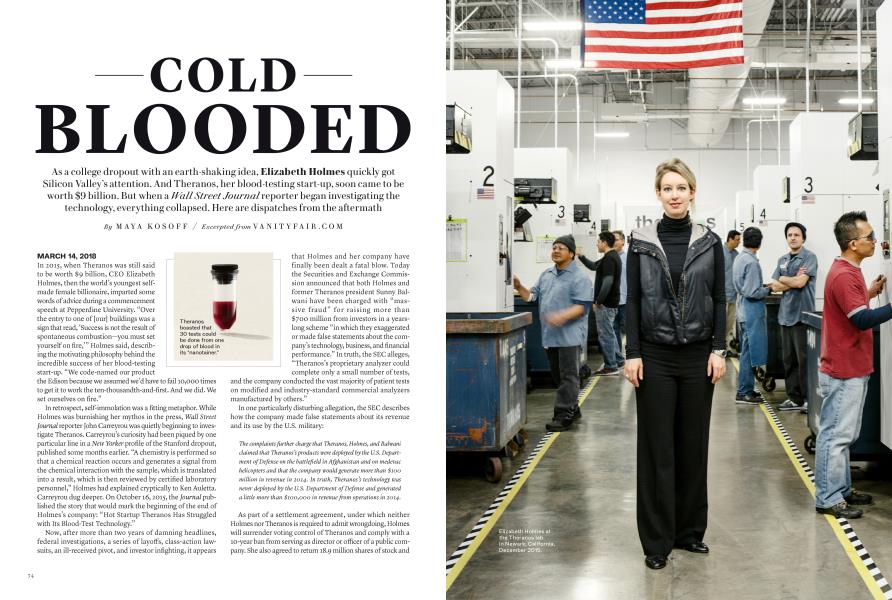
As a college dropout with an earth-shaking idea, Elizabeth Holmes quickly got Silicon Valley's attention. And Theranos, her blood-testing start-up, soon came to be worth $9 billion. But when a Wall Street Journal reporter began investigating the technology, everything collapsed. Here are dispatches from the aftermath
MAYA KOSOFF
Excerpted from VANITYFAIR.COM
MARCH 14, 2018
In 2015, when Theranos was still said to be worth $9 billion, CEO Elizabeth Holmes, then the world's youngest selfmade female billionaire, imparted some words of advice during a commencement speech at Pepperdine University. "Over the entry to one of [our] buildings was a sign that read, 'Success is not the result of spontaneous combustion—you must set yourself on fire,"' Holmes said, describing the motivating philosophy behind the incredible success of her blood-testing start-up. "We code-named our product the Edison because we assumed we'd have to fail 10,000 times to get it to work the ten-thousandth-and-first. And we did. We set ourselves on fire."
In retrospect, self-immolation was a fitting metaphor. While Holmes was burnishing her mythos in the press, Wall Street Journal reporter John Carreyrou was quietly beginning to investigate Theranos. Carreyrou's curiosity had been piqued by one particular line in a New Yorker profile of the Stanford dropout, published some months earlier. "A chemistry is performed so that a chemical reaction occurs and generates a signal from the chemical interaction with the sample, which is translated into a result, which is then reviewed by certified laboratory personnel," Holmes had explained cryptically to Ken Auletta. Carreyrou dug deeper. On October 16,2015, the Journal published the story that would mark the beginning of the end of Holmes's company: "Hot Startup Theranos Has Struggled with Its Blood-Test Technology."
Now, after more than two years of damning headlines, federal investigations, a series of layoffs, class-action lawsuits, an ill-received pivot, and investor infighting, it appears that Holmes and her company have finally been dealt a fatal blow. Today the Securities and Exchange Commission announced that both Holmes and former Theranos president Sunny Balwani have been charged with "massive fraud" for raising more than $700 million from investors in a yearlong scheme "in which they exaggerated or made false statements about the company's technology, business, and financial performance." In truth, the SEC alleges, "Theranos's proprietary analyzer could complete only a small number of tests, and the company conducted the vast majority of patient tests on modified and industry-standard commercial analyzers manufactured by others."
In one particularly disturbing allegation, the SEC describes how the company made false statements about its revenue and its use by the U.S. military:
The complaints further charge that Theranos, Holmes, and Balwani claimed that Theranos's products were deployed hy the U.S. Department of Defense on the battlefield in Afghanistan and on medevac helicopters and that the company would generate more than $100 million in revenue in 2014. In truth, Theranos's technology was never deployed by the U.S. Department of Defense and generated a little more than $100,000 in revenue from operations in 2014.
As part of a settlement agreement, under which neither Holmes nor Theranos is required to admit wrongdoing, Holmes will surrender voting control of Theranos and comply with a 10-year ban from serving as director or officer of a public company. She also agreed to return 18.9 million shares of stock and to pay a $500,000 penalty. Under the terms of the settlement, even if Theranos is acquired by a third party, Holmes won't profit from the sale "untiL.over $750 million is returned to defrauded investors and other preferred shareholders." The agency is still pursuing charges against Balwani, who jointly ran Theranos with Holmes for seven years. ("The Company is pleased to be bringing this matter to a close and looks forward to advancing its technology," Theranos said in a statement, adding that both Holmes and the company complied with the SEC's investigation.)
Chapter Three/Captains of Infamy
The charges herald a fresh round of humiliation for a company once seen as Silicon Valley's brightest star. Theranos came with the perfect origin story: a blonde, turtlenecked dropout dedicated to revolutionizing the blood-testing industry. The fledgling start-up raised hundreds of millions from Sand Hill Road and less traditional tech investors. The tech world fawned. "When I finally connected with what Elizabeth fundamentally is, I realized that I could have just as well been looking into the eyes of a Steve Jobs or a Bill Gates," Stanford chemicalengineering professor and Theranos adviser Channing Robertson told Fortune in 2014.
Today, the SEC pointed a finger at the credulous business press, which covered Holmes and her company so breathlessly for years, "investors are entitled to nothing less than complete truth and candor from companies and their executives," the SEC's Enforcement Division codirector Steven Peikin said in a press release. "The charges against Theranos, Holmes, and Balwani make clear that there is no exemption from the antifraud provisions of the federal securities laws simply because a company is nonpublic, development-stage, or the subject of exuberant media attention."
MARCH 15, 2018
While Holmes settled with the SEC without admitting any wrongdoing, plenty in Silicon Valley see what Theranos did as a blight on the industry itself. It's on her, it's on the company, it's on the investors, and the board members who didn't ask any of the right questions," one Silicon Valley investor told me. "Or, evidently, any questions at all."
Another tech investor was more direct. "The race to be the biggest, in an environment that rewards taking chances [and] breaking rules, can tempt people to do things they normally wouldn't do," they said, "if what she's been charged with is true, she's a criminal who should be in prison. I highly doubt Elizabeth Holmes set out to be a fraud—much in the same way that I don't really think Bernie Madolf's business plan from day one was to run a Ponzi scheme. Does that even matter? All founders are faced with difficult choices, and the vast majority of them make the right call, erring on the side of transparency and honesty. To dismiss her wrongdoing is to discount all the founders who, knowing they had the wrong answer for an investor, made the hard choice to tell the truth, knowing it might be the final nail for their company."
But for Theranos, there was always a fresh round of funding, often from an investor outside of Silicon Valley, wooed by the company's benevolent promises, its rapidly inflating valuation, and the eternal hunt for the next successful unicorn. A handful of venture capitalists privately admitted that the tech-world hype cycle, in which they are complicit, was at least in part to blame. "I actually think that the VC business model has changed and encourages this type of behavior. I see companies raise massive amounts of funding without even having a product and raise additional rounds as they pivot the company with greater valuations, without having once sold anything or proven a market exists," a third investor told me. Some seem to realize that young entrepreneurs hit the market and make the rounds on Sand Hill Road before their products are fully developed. "I find many investors encourage massive growth in the marketing side of a business outside of the product side, and what happens is products are being marketed as complete that don't exist," this same investor told me. "On top of that, it reduces the actual price of the product to a point that it squeezes out any margin—meaning even if the product and company are successful, they won't turn a profit."
Though Theranos's undoing began more than two years ago, this final blow comes at a time of reckoning for Silicon Valley as a whole. Facebook, Twitter, and Google are struggling to dig themselves out from the rubble of a disastrous PR crisis, weathering the disillusionment of lawmakers and consumers following their manipulation by Russian operatives. Holmes is hardly the first CEO to let her company spiral out of control. But her grandiose promises to revolutionize an industry that affects people's lives so intimately— and her equally dangerous fictions about the accuracy of her results—have made her a pariah on a plane of her own.
MAY 4, 2018
In hindsight, it's easy to see why a who's who of business, government, and finance scions were duped by Holmes. Not only did she embody the romantic ideal of Silicon Valley, but her company promised something equally revolutionary: a way to benefit the world, with almost no conceivable downside. And her passion was catching: Investors poured $1.4 billion into Theranos, never suspecting that a series of damning headlines, federal investigations, and failed pivots would eventually drive the company into the ground.
Now, thanks to documents unsealed in an ongoing lawsuit against the company and obtained by The Wall Street Journal, we know exactly how much each investor sunk into the failed venture. Perhaps the most notable individual on the list is Education Secretary Betsy DeVos, whose family invested $100 million—literally 100 times the lifetime earnings of the average American—in Theranos between 2013 and 2015. Others include:
• The family of Walmart founder Sam Walton, who invested $150 million in the company;
• Mexican newspaper investor Carlos Slim, who invested $30 million;
• Greek shipping heir Andreas Dracopoulos, who went in for $25 million;
• Members of South Africa's Oppenheimer family, who put up $20 million;
• Atlanta's billionaire Cox family, which invested $100 million;
• Riley Bechtel, former chairman of construction company Bechtel Corp., who invested $6.2 million;
• New England Patriots owner Robert Kraft, whose frugal investment of $1 million seems, in retrospect, uncannily wise;
• Rupert Murdoch, who sunk $125 million into Theranos, was the company's largest individual investor, though his name did not appear in the documents, as he sold back his shares for $1 in early 2017, people familiar with the matter told the Journal.
SEPTEMBER 5, 2018
Holmes may have tacitly admitted defeat when she settled with the SEC over charges of "massive fraud" earlier this year, but the final nail in the coffin containing the blood-testing firm's zombie corpse came in a recent e-mail to shareholders. On Tuesday, David Taylor, the firm's acting chief and general counsel, wrote that Theranos is formally dissolving, noting that the company has no choice but to shut down, due to the conditions of a last-minute loan it received from the Fortress Investment Group. The deal was a sort of Hail Mary, made in desperation after the Wall Street Journal investigation revealed that the company was more smoke and mirrors than legit science. Now, after more than two years of damning headlines, federal investigations, layoffs, classaction lawsuits, an ill-received pivot, and investor infighting, Theranos's time is finally up.
The Fortress deal was always seen as a sort of Faustian bargain: In exchange for a cash infusion, Theranos would give the investment firm the right to "foreclose upon, and to sell or take ownership of" Theranos's assets and intellectual property, if its cash fell beneath a certain amount. Though Theranos attempted to bring other investors on board to shore up its cash stores, Taylor indicated that none of the deals were finalized in time to rescue the company. And though Jefferies Group, Theranos's investment-bank partner, had reportedly reached out to more than 80 potential buyers, none were interested. " We are now out of time," Taylor wrote, according to a copy of the e-mail published by the Journal.
After collecting $1.4 billion from investors mostly outside of Silicon Valley, Theranos saw its valuation balloon to more than $9 billion. But after a series of damning investigations, the company's value was slashed to nothing. The company is currently attempting to work out a settlement with Fortress that would give the private-equity firm ownership of Theranos's patents, but would leave its remaining estimated $5 million in cash to pay off investors. The agreement could take another year to be finalized, but the company's last two-dozen employees worked their final day on August 31.
Though it's now a matter of if—not when—Theranos will finally close its doors, Holmes's personal ordeal may drag on. In June, she and former Theranos president Sunny Balwani were indicted on nine counts of wire fraud and two counts of conspiracy to commit wire fraud, and Holmes stepped down as CEO. Both have denied the charges, and, according to the Journal, will "face a coming criminal trial."
UPDATE
Jennifer Lawrence is set to star as Holmes in Bad Blood, a film adaptation of John Carreyrou's bestselling book.
Subscribers have complete access to the archive.
Sign In Not a Subscriber?Join Now


