








Sign In to Your Account
Subscribers have complete access to the archive.
Sign In Not a Subscriber?Join NowMemory Palace
SPOTLIGHT
Inspired by the urbanscapes of Mexico City and director Alfonso Cuarón's reminiscences of his childhood, the cast of Roma artfully— and stylishly—evoke another time
Keziah Weir
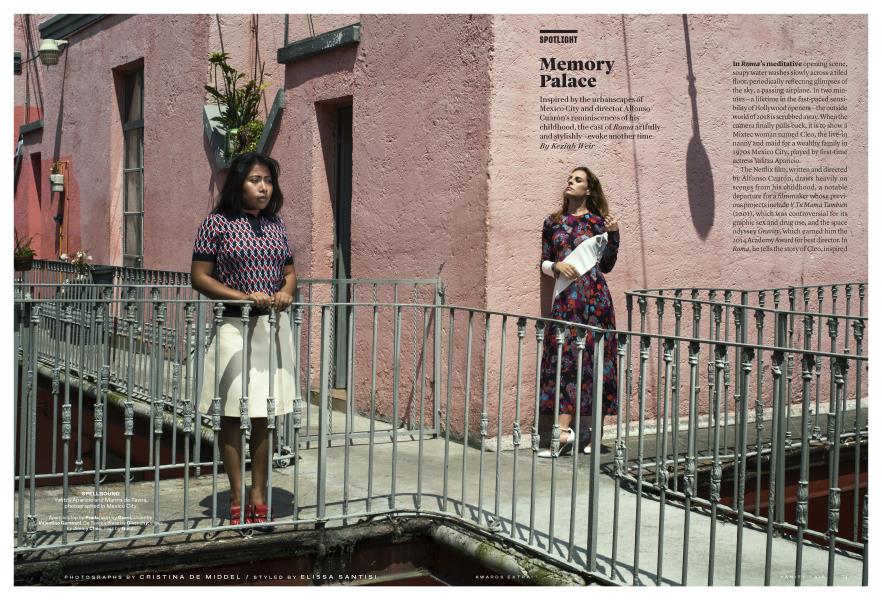
In Roma's meditative opening scene, soapy water washes slowly across a tiled floor, periodically reflecting glimpses of the sky, a passing airplane. In two minutes—a lifetime in the fast-paced sensibility of Hollywood openers—the outside World of 2018 is scrubbed away. When the camera finally pulls back, it is to show a Mixtec woman named Cleo, the live-in nanny and maid for a wealthy family in 1970s Mexico City, played by first-time actress Yalitza Aparicio.
The Netflix film, written and directed by Alfonso Cuaron, draws heavily on scenes from his childhood, a notable departure for a filmmaker whose previous.projects include Y TuMamá Tambien (2001), which was controversial for its graphic sex and drug use, and the space odyssey Gravity, which earned him the 2014 Academy Award for best director. In Roma, he tells the story of Cleo, inspired by Liboria "Libo" Rodriguez, his childhood nanny, with whom he remains close, and Sofia, based on his mother and played by Marina de Tavira. Roma frames one year in their complicated, co-dependent relationship, during a time of great personal upheaval: Sofia's husband departs on an indeterminate business trip, leaving his wife behind with their four young children; Cleo becomes pregnant. There are mmblings of political unease. Cuaron, who compares making the film to " [walking a] tightrope without the safety net," had his cast work without access to the full script, instead communicating the mood, action, and dialogue of each scene as they shot it. "He had an ease in making us feel that there was no camera or crew present," Aparicio says, "that it was just us, interacting, in a world apart."
FOR DETAILS, GO TO VF.COM/CREDITS
Cuaron says he has challenged himself to imagine the women in his family simply as people, rather than in the reductive "sister, daughter, mother" roles with which male auteurs frequently populate their films. Cleo and Sofia are presented as caregivers, as lovers, as subject to the whims of boyfriends and husbands—but just as much, they are women without men, possessing internal lives, individual hopes, and personal agency. To accomplish this, Cuaron spent hours talking to Libo about her own history and daily routine during the years she worked for his family—which in retrospect he realized he knew little of. "it was not until later in my life that I started confronting how the background of one member of my family is so absolutely different from most of my family," says Cuaron. "Not only in terms of class but also in terms of her race and indigenous background." An early shadow of this realization—and of Roma's opening scene—shows up in his beloved 1995 children's movie, A Little Princess, when the wealthy young protagonist lingers, discomfited, at the sight of the boardingschool servant girl mopping the floor.
What made Aparicio most interested in playing the part was "learning that Libo was from Oaxaca and knowing that I would represent a real person who was a domestic worker." The story felt personal, she says, reminding her of her own mother's life. And though it was Aparicio's first time on a film set—she had been cast just weeks before, a 24-yearold elementary-school teacher scouted in Tlaxiaco—she deftly navigated her character's vast range of emotions: love, betrayal, intense physical pain, fear. It helped, she says, that the film was shot in continuity; it allowed her to imagine that in "each sequence we filmed were the things and events happening in my day-to-day life."
Americans watching the film can easily pinpoint reasons Roma feels particularly resonant now: stark differences in race and class, the underlying threat of brutality baited by the government, omnipresent male violence. But for de Tavira, an experienced actress who grew up and still lives in Mexico City, the appeal is something even more universal: "it connects with all of our childhoods. It is that moment in life when we lose paradise. Our little nest breaks," she says. "Who are the people that are going to be there to guide us and to protect us and to love us?" De Tavira remembers spending three days on an early scene, which is simple but nonetheless supercharged with emotion: Sofia watches her husband pack himself into a taxi and leave on what they insist to their children is a trip for work, but which she and the audience know is something more foreboding. "I remember Alfonso told me, 'I want to see grief. Don't act it. I want to see sadness—not the acting of sadness, but sadness itself.' "
If Roma is a love letter to the women who raised him, it is also one to the Mexico City of Cuaron's youth. The director, who has lived in London and Italy for nearly two decades, says that each trip back home reveals significant change, "it's a city that grows so fast," he says. "I see a corner and I cannot help remembering how it was." He describes Roma as "looking to my past from the standpoint of the present," resulting in a cinematic palimpsest that echoes the construction of Mexico City itself. "You have this cosmopolitan, modern city," he says, "but it's built over colonial stone buildings, and those were built over pyramids and temples, and those were built over a lake."
Now the neighborhood of Roma is home to a thriving cultural scene, replete with galleries, restaurants, bookstores, and art-house cinemas—these a far cry from the almost carnival atmosphere outside a theater in one of Roma's pivotal scenes, when vendors peddle toys to the departing moviegoers. "That's the way I used to go to the movies with my dad," de Tavira says. "That doesn't happen anymore. When I saw that scene I started crying."
Subscribers have complete access to the archive.
Sign In Not a Subscriber?Join Now


