
Sign In to Your Account
Subscribers have complete access to the archive.
Sign In Not a Subscriber?Join NowANATOMY of a SCENE: ALL ABOUT EVE
Breaking down the meticulous choreography of Killing Eve's midseason showdown between Sandra Oh's intelligence officer and her deadly nemesis
JOANNA ROBINSON
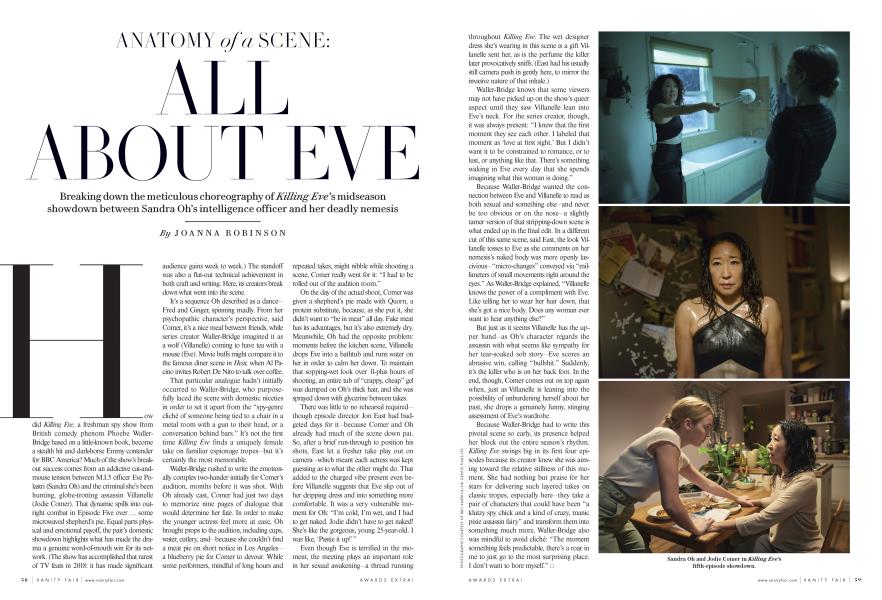
How did Killing Eve, a freshman spy show from British comedy phenom Phoebe WallerBridge based on a little-known book, become a stealth hit and dark-horse Emmy contender for BBC America? Much of the show's breakout success comes from an addictive cat-andmouse tension between M.I.5 officer Eve Polastri (Sandra Oh) and the criminal she's been hunting, globe-trotting assassin Villanelle (Jodie Comer). That dynamic spills into outright combat in Episode Five over ... some microwaved shepherd's pie. Equal parts physical and emotional payoff, the pair's domestic showdown highlights what has made the drama a genuine word-of-mouth win for its network. (The show has accomplished that rarest of TV feats in 2018: it has made significant audience gains week to week.) The standoff was also a flat-out technical achievement in both craft and writing. Here, its creators break down what went into the scene.
It's a sequence Oh described as a dance— Fred and Ginger, spinning madly. From her psychopathic character's perspective, said Comer, it's a nice meal between friends, while series creator Waller-Bridge imagined it as a wolf (Villanelle) coming to have tea with a mouse (Eve). Movie buffs might compare it to the famous diner scene in Heat, when At Pacino invites Robert De Niro to talk over coffee.
That particular analogue hadn't initially occurred to Waller-Bridge, who purposefully laced the scene with domestic niceties in order to set it apart from the "spy-genre cliche of someone being tied to a chair in a metal room with a gun to their head, or a conversation behind bars." It's not the first time Killing Eve finds a uniquely female take on familiar espionage tropes—but it's certainly the most memorable.
Waller-Bridge rushed to write the emotionally complex two-hander initially for Comer's audition, months before it was shot. With Oh already cast, Comer had just two days to memorize nine pages of dialogue that would determine her fate. In order to make the younger actress feel more at ease, Oh brought props to the audition, including cups, water, cutlery, and—because she couldn't find a meat pie on short notice in Los Angeles— a blueberry pie for Comer to devour. While some performers, mindful of long hours and repeated takes, might nibble while shooting a scene, Comer really went for it: "I had to be rolled out of the audition room."
On the day of the actual shoot, Comer was given a shepherd's pie made with Quorn, a protein substitute, because, as she put it, she didn't want to "be in meat" all day. Fake meat has its advantages, but it's also extremely dry. Meanwhile, Oh had the opposite problem: moments before the kitchen scene, Villanelle drops Eve into a bathtub and runs water on her in order to calm her down. To maintain that sopping-wet look over 11-plus hours of shooting, an entire tub of "crappy, cheap" gel was dumped on Oh's thick hair, and she was sprayed down with glycerine between takes.
There was little to no rehearsal required— though episode director Jon East had budgeted days for it—because Comer and Oh already had much of the scene down pat. So, after a brief run-through to position his shots, East let a fresher take play out on camera—which meant each actress was kept guessing as to what the other might do. That added to the charged vibe present even before Villanelle suggests that Eve slip out of her chipping dress and into something more comfortable. It was a very vulnerable moment for Oh: "I'm cold, I'm wet, and I had to get naked. Jodie didn't have to get naked! She's like the gorgeous, young 25-year-old. I was like, 'Pastie it up!' "
Even though Eve is terrified in the moment, the meeting plays an important role in her sexual awakening—a thread running throughout Killing Eve. The wet designer dress she's wearing in this scene is a gift Villanelle sent her, as is the perfume the killer later provocatively sniffs. (East had his usually still camera push in gently here, to mirror the invasive nature of that inhale.)
Waller-Bridge knows that some viewers may not have picked up on the show's queer aspect until they saw Villanelle lean into Eve's neck. For the series creator, though, it was always present: "I knew that the first moment they see each other. I labeled that moment as 'love at first sight.' But I didn't want it to be constrained to romance, or to lust, or anything like that. There's something waking in Eve every day that she spends imagining what this woman is doing."
Because Waller-Bridge wanted the connection between Eve and Villanelle to read as both sexual and something else—and never be too obvious or on the nose—a slightly tamer version of that stripping-down scene is what ended up in the final edit. In a different cut of this same scene, said East, the look Villanelle tosses to Eve as she comments on her nemesis's naked body was more openly lascivious—"micro-changes" conveyed via "millimeters of small movements right around the eyes." As Waller-Bridge explained, "Villanelle knows the power of a compliment with Eve. Like telling her to wear her hair down, that she's got a nice body. Does any woman ever want to hear anything else?"
But just as it seems Villanelle has the upper hand—as Oh's character regards the assassin with what seems like sympathy for her tear-soaked sob story—Eve scores an abrasive win, calling "bullshit." Suddenly, it's the killer who is on her back foot. In the end, though, Comer comes out on top again when, just as Villanelle is leaning into the possibility of unburdening herself about her past, she drops a genuinely funny, stinging assessment of Eve's wardrobe.
Because Waller-Bridge had to write this pivotal scene so early, its presence helped her block out the entire season's rhythm. Killing Eve swings big in its first four episodes because its creator knew she was aiming toward the relative stillness of this moment. She had nothing but praise for her stars for delivering such layered takes on classic tropes, especially here—they take a pair of characters that could have been "a klutzy spy chick and a kind of crazy, manic pixie assassin fairy" and transform them into something much more. Waller-Bridge also was mindful to avoid cliche: "The moment something feels predictable, there's a roar in me to just go to the most surprising place. I don't want to bore myself."
Subscribers have complete access to the archive.
Sign In Not a Subscriber?Join Now
