
Sign In to Your Account
Subscribers have complete access to the archive.
Sign In Not a Subscriber?Join NowFLOWER POWER
SPOTLIGHT
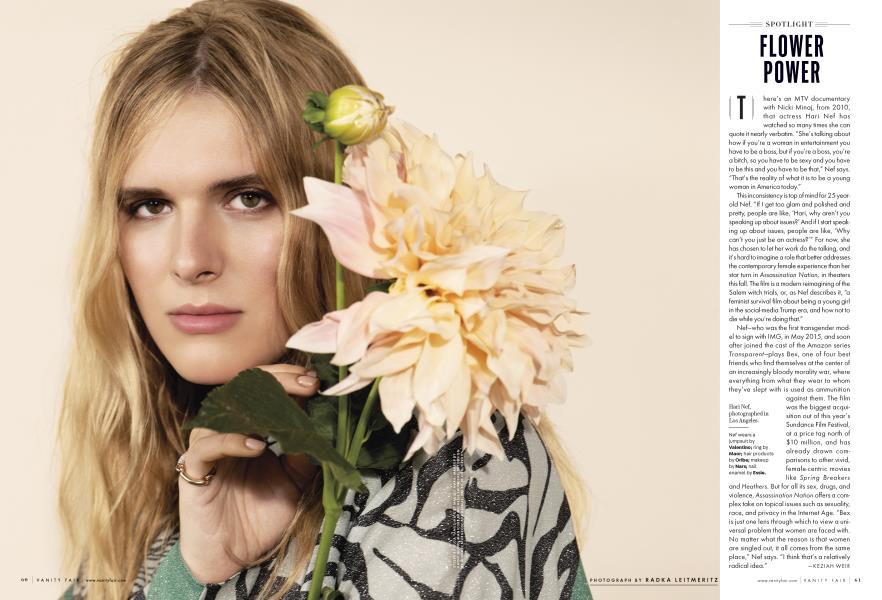
There's an MTV documentary with Nicki Minaj, from 2010, that actress Hari Nef has watched so many times she can quote it nearly verbatim. "She's talking about how if you're a woman in entertainment you have to be a boss, but if you're a boss, you're a bitch, so you have to be sexy and you have to be this and you have to be that," Nef says. "That's the reality of what it is to be a young woman in America today."
This inconsistency is top of mind for 25-yearold Nef. "If I get too glam and polished and pretty, people are like, 'Hari, why aren't you speaking up about issues?' And if I start speaking up about issues, people are like, 'Why can't you just be an actress?"' For now, she has chosen to let her work do the talking, and it's hard to imagine a role that better addresses the contemporary female experience than her star turn in Assassination Nation, in theaters this fall. The film is a modern reimagining of the Salem witch trials, or, as Nef describes it, "a feminist survival film about being a young girl in the social-media Trump era, and how not to die while you're doing that."
Nef—who was the first transgender model to sign with IMG, in May 2015, and soon after joined the cast of the Amazon series Transparent—plays Bex, one of four best friends who find themselves at the center of an increasingly bloody morality war, where everything from what they wear to whom they've slept with is used as ammunition against them. The film was the biggest acquisition out of this year's Sundance Film Festival, at a price tag north of $10 million, and has already drawn comparisons to other vivid, female-centric movies like Spring Breakers and Heathers. But for all its sex, drugs, and violence, Assassination Nation offers a complex take on topical issues such as sexuality, race, and privacy in the Internet Age. "Bex is just one lens through which to view a universal problem that women are faced with. No matter what the reason is that women are singled out, it all comes from the same place," Nef says. "I think that's a relatively radical idea."
KEZIAH WEIR
Subscribers have complete access to the archive.
Sign In Not a Subscriber?Join Now
