




Sign In to Your Account
Subscribers have complete access to the archive.
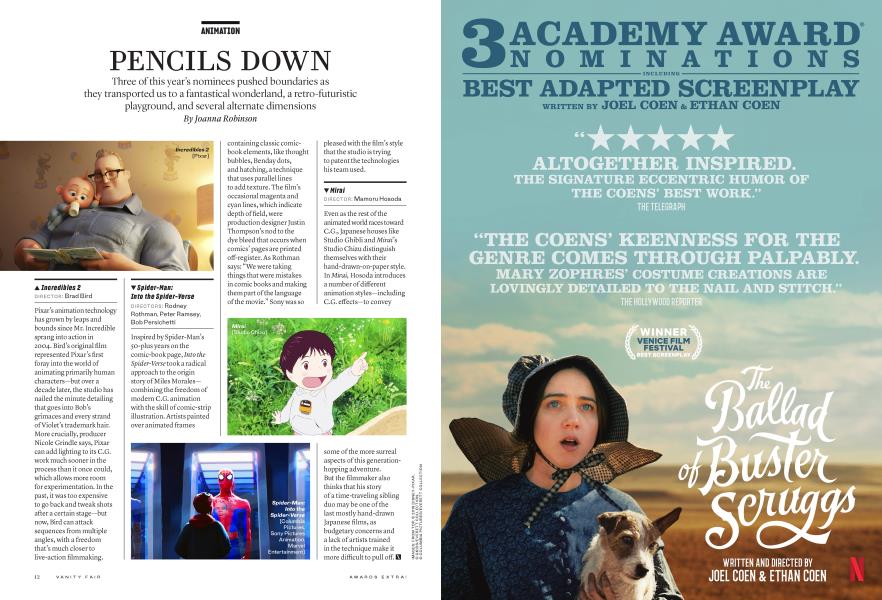
Sign In Not a Subscriber?Join NowPENCILS DOWN
ANIMATION
Three of this year's nominees pushed boundaries as they transported us to a fantastical wonderland, a retro-futuristic playground, and several alternate dimensions
Joanna Robinson
▲ Incredibles 2 DIRECTOR: Brad Bird
Pixar's animation technology has grown by leaps and bounds since Mr. Incredible sprang into action in 2004. Bird's original film represented Pixar's first foray into the world of animating primarily human characters—but over a decade later, the studio has nailed the minute detailing that goes into Bob's grimaces and every strand of Violet's trademark hair. More crucially, producer Nicole Grindle says, Pixar can add lighting to its C.G. work much sooner in the process than it once could, which allows more room for experimentation. In the past, it was too expensive to go back and tweak shots after a certain stage—but now, Bird can attack sequences from multiple angles, with a freedom that's much closer to live-action filmmaking.
▼ Spider-Man: Into the Spider-Verse DIRECTORS: Rodney Rothman, Peter Ramsey, Bob Persichetti
Inspired by Spider-Man's 50-plus years on the comic-book page, Into the Spider-Verse took a radical approach to the origin story of Miles Morales— combining the freedom of modern C.G. animation with the skill of comic-strip illustration. Artists painted over animated frames containing classic comicbook elements, like thought bubbles, Benday dots, and hatching, a technique that uses parallel lines to add texture. The film's occasional magenta and cyan lines, which indicate depth of field, were production designer Justin Thompson's nod to the dye bleed that occurs when comics' pages are printed off-register. As Rothman says: "We were taking things that were mistakes in comic books and making them part of the language of the movie." Sony was so pleased with the film's style that the studio is trying to patent the technologies his team used.
▼ Mirai DIRECTOR: Mamoru Hosoda
Even as the rest of the animated world races toward C.G., Japanese houses like Studio Ghibli and Mirai's Studio Chizu distinguish themselves with their hand-drawn-on-paper style. In Mirai, Hosoda introduces a number of different animation styles—including C.G. effects—to convey some of the more surreal aspects of this generationhopping adventure. But the filmmaker also thinks that his story of a time-traveling sibling duo may be one of the last mostly hand-drawn Japanese films, as budgetary concerns and a lack of artists trained in the technique make it more difficult to pull off.
Subscribers have complete access to the archive.
Sign In Not a Subscriber?Join Now