Sign In to Your Account
Subscribers have complete access to the archive.
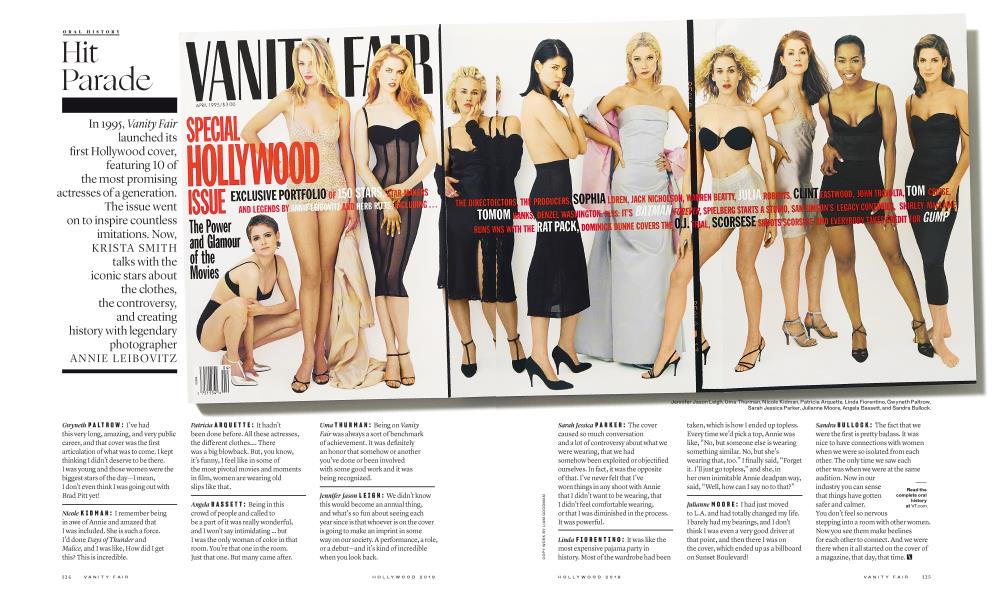
Sign In Not a Subscriber?Join NowIn 1995, Vanity Fair launched its first Hollywood cover, featuring 10 of the most promising actresses of a generation. The issue went on to inspire countless imitations. Now, KRISTA SMITH talks with the iconic stars about the clothes, the controversy, and creating history with legendary photographer ANNIE LEIBOVITZ
In 1995, Vanity Fair launched its first Hollywood cover, featuring 10 of the most promising actresses of a generation. The issue went on to inspire countless imitations. Now, KRISTA SMITH talks with the iconic stars about the clothes, the controversy, and creating history with legendary photographer ANNIE LEIBOVITZ
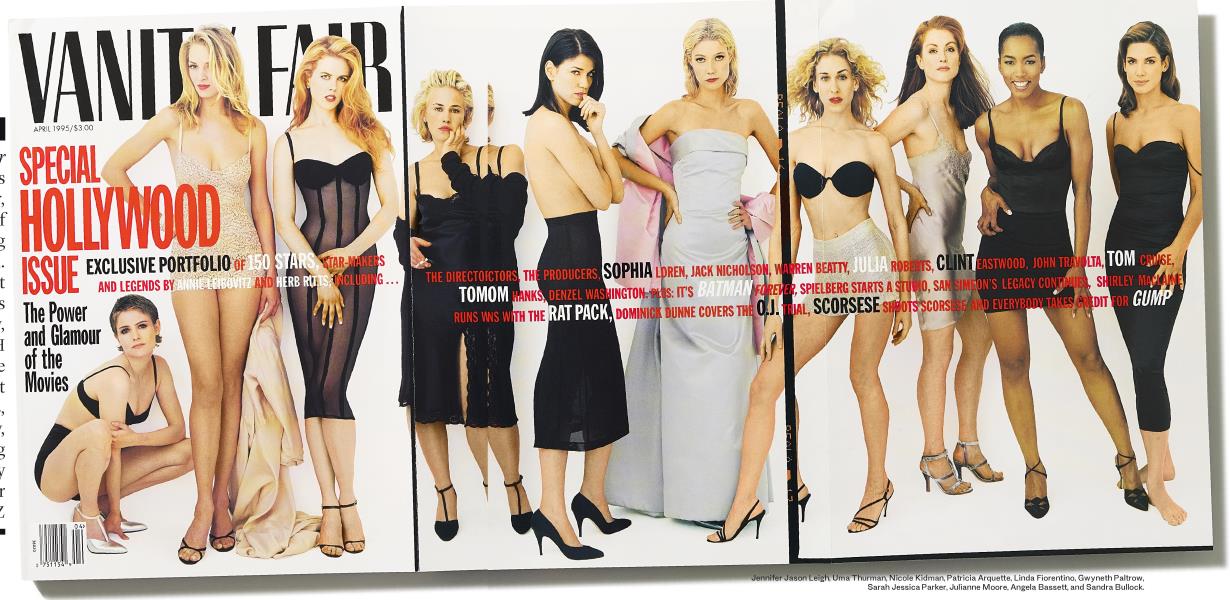 Jennifer Jason Leigh, Uma Thurman, Nicole Kidman, Patricia Arquette, Linda Fiorentino, Gwyneth Paltrow, Sarah Jessica Parker, Julianne Moore, Angela Bassett, and Sandra Bullock.
Gwyneth PALTROW: I've had this very long, amazing, and very public career, and that cover was the first articulation of what was to come. I kept thinking I didn't deserve to be there. I was young and those women were the biggest stars of the day—I mean, I don't even think I was going out with Brad Pitt yet!
Nicole KIDMAN: I remember being in awe of Annie and amazed that I was included. She is such a force. I'd done Days of Thunder and Malice, and I was like, How did I get this? This is incredible.
Patricia ARQUETTE: It hadn't been done before. All these actresses, the different clothes.... There was a big blowback. But, you know, it's funny, I feel like in some of the most pivotal movies and moments in film, women are wearing old slips like that.
Angela BASSETT: Being in this crowd of people and called to be a part of it was really wonderful, and I won't say intimidating... but I was the only woman of color in that room. You're that one in the room. Just that one. But many came after.
Uma THURMAN: Being on Vanity Fair was always a sort of benchmark of achievement. It was definitely an honor that somehow or another you've done or been involved with some good work and it was being recognized.
Jennifer Jason LEIGH: We didn't know this would become an annual thing, and what's so fun about seeing each year since is that whoever is on the cover is going to make an imprint in some way on our society. A performance, a role, or a debut—and it's kind of incredible when you look back.
Sarah Jessica PARKER: The cover caused so much conversation and a lot of controversy about what we were wearing, that we had somehow been exploited or objectified ourselves. In fact, it was the opposite of that. I've never felt that I've worn things in any shoot with Annie that I didn't want to be wearing, that I didn't feel comfortable wearing, or that I was diminished in the process. It was powerful.
Linda FIORENTINO: It was like the most expensive pajama party in history. Most of the wardrobe had been taken, which is how I ended up topless. Every time we'd pick a top, Annie was like, "No, but someone else is wearing something similar. No, but she's wearing that, too." I finally said, "Forget it. I'll just go topless," and she, in her own inimitable Annie deadpan way, said, "Well, how can I say no to that?"
Sandra BULLOCK: The fact that we were the first is pretty badass. It was nice to have connections with women when we were so isolated from each other. The only time we saw each other was when we were at the same audition. Now in our industry you can sense that things have gotten safer and calmer. You don't feel so nervous stepping into a room with other women. Now you see them make beelines for each other to connect. And we were there when it all started on the cover of a magazine, that day, that time.
Julianne MOORE: I had just moved to L.A. and had totally changed my life. I barely had my bearings, and I don't think I was even a very good driver at that point, and then there I was on the cover, which ended up as a billboard on Sunset Boulevard!
Subscribers have complete access to the archive.
Sign In Not a Subscriber?Join Now
