








Sign In to Your Account
Subscribers have complete access to the archive.
Sign In Not a Subscriber?Join NowThe epiphany that led Michael Cohen, Trump's disgraced former lawyer, to a public triumph
The epiphany that led Michael Cohen, Trump's disgraced former lawyer, to a public triumph
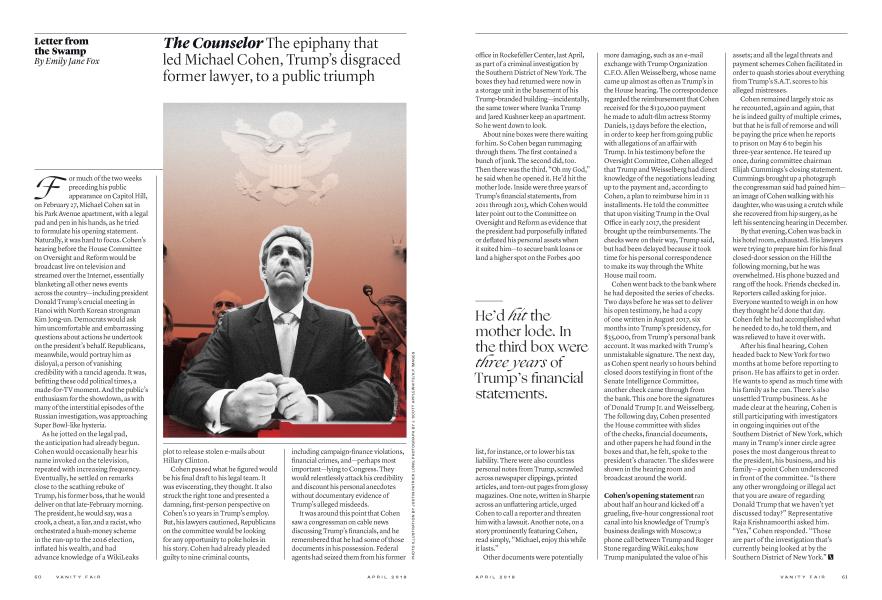
For much of the two weeks preceding his public appearance on Capitol Hill, on February 27, Michael Cohen sat in his Park Avenue apartment, with a legal pad and pen in his hands, as he tried to formulate his opening statement. Naturally, it was hard to focus. Cohen's hearing before the House Committee on Oversight and Reform would be broadcast live on television and streamed over the Internet, essentially blanketing all other news events across the country—including president Donald Trump's crucial meeting in Hanoi with North Korean strongman Kim Jong-un. Democrats would ask him uncomfortable and embarrassing questions about actions he undertook on the president's behalf. Republicans, meanwhile, would portray him as disloyal, a person of vanishing credibility with a rancid agenda. It was, befitting these odd political times, a made-for-TV moment. And the public's enthusiasm for the showdown, as with many of the interstitial episodes of the Russian investigation, was approaching Super Bowl-like hysteria.
As he jotted on the legal pad, the anticipation had already begun. Cohen would occasionally hear his name invoked on the television, repeated with increasing frequency. Eventually, he settled on remarks close to the scathing rebuke of Trump, his former boss, that he would deliver on that late-February morning. The president, he would say, was a crook, a cheat, a liar, and a racist, who orchestrated a hush-money scheme in the run-up to the 2016 election, inflated his wealth, and had advance knowledge of a WikiLeaks plot to release stolen e-mails about Hillary Clinton.
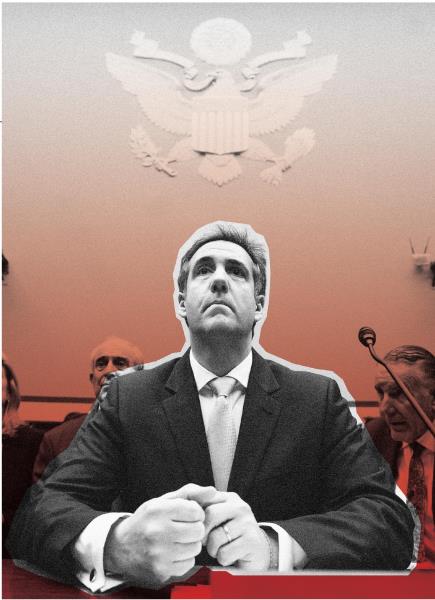
Cohen passed what he figured would be his final draft to his legal team. It was eviscerating, they thought. It also struck the right tone and presented a damning, first-person perspective on Cohen's 10 years in Trump's employ. But, his lawyers cautioned, Republicans on the committee would be looking for any opportunity to poke holes in his story. Cohen had already pleaded guilty to nine criminal counts, including campaign-finance violations, financial crimes, and—perhaps most important—lying to Congress. They would relentlessly attack his credibility and discount his personal anecdotes without documentary evidence of Trump's alleged misdeeds.
It was around this point that Cohen saw a congressman on cable news discussing Trump's financials, and he remembered that he had some of those documents in his possession. Federal agents had seized them from his former office in Rockefeller Center, last April, as part of a criminal investigation by the Southern District of New York. The boxes they had returned were now in a storage unit in the basement of his Trump-branded building—incidentally, the same tower where Ivanka Trump and Jared Kushner keep an apartment. So he went down to look.
He'd hit the mother lode. In the third box were three years of Trump's financial statements.
About nine boxes were there waiting for him. So Cohen began rummaging through them. The first contained a bunch of junk. The second did, too. Then there was the third. "Oh my God," he said when he opened it. He'd hit the mother lode. Inside were three years of Trump's financial statements, from 2011 through 2013, which Cohen would later point out to the Committee on Oversight and Reform as evidence that the president had purposefully inflated or deflated his personal assets when it suited him—to secure bank loans or land a higher spot on the Forbes 400 list, for instance, or to lower his tax liability. There were also countless personal notes from Trump, scrawled across newspaper clippings, printed articles, and torn-out pages from glossy magazines. One note, written in Sharpie across an unflattering article, urged Cohen to call a reporter and threaten him with a lawsuit. Another note, on a story prominently featuring Cohen, read simply, "Michael, enjoy this while it lasts."
Other documents were potentially more damaging, such as an e-mail exchange with Trump Organization C.F.O. Allen Weisselberg, whose name came up almost as often as Trump's in the House hearing. The correspondence regarded the reimbursement that Cohen received for the $130,000 payment he made to adult-film actress Stormy Daniels, 13 days before the election, in order to keep her from going public with allegations of an affair with Trump. In his testimony before the Oversight Committee, Cohen alleged that Trump and Weisselberg had direct knowledge of the negotiations leading up to the payment and, according to Cohen, a plan to reimburse him in 11 installments. He told the committee that upon visiting Trump in the Oval Office in early 2017, the president brought up the reimbursements. The checks were on their way, Trump said, but had been delayed because it took time for his personal correspondence to make its way through the White House mail room.
Cohen went back to the bank where he had deposited the series of checks. Two days before he was set to deliver his open testimony, he had a copy of one written in August 2017, six months into Trump's presidency, for $35,000, from Trump's personal bank account. It was marked with Trump's unmistakable signature. The next day, as Cohen spent nearly 10 hours behind closed doors testifying in front of the Senate Intelligence Committee, another check came through from the bank. This one bore the signatures of Donald Trump Jr. and Weisselberg. The following day, Cohen presented the House committee with slides of the checks, financial documents, and other papers he had found in the boxes and that, he felt, spoke to the president's character. The slides were shown in the hearing room and broadcast around the world.
Cohen's opening statement ran about half an hour and kicked off a grueling, five-hour congressional root canal into his knowledge of Trump's business dealings with Moscow; a phone call between Trump and Roger Stone regarding WikiLeaks; how Trump manipulated the value of his assets; and all the legal threats and payment schemes Cohen facilitated in order to quash stories about everything from Trump's S.A.T. scores to his alleged mistresses.
Cohen remained largely stoic as he recounted, again and again, that he is indeed guilty of multiple crimes, but that he is full of remorse and will be paying the price when he reports to prison on May 6 to begin his three-year sentence. He teared up once, during committee chairman Elijah Cummings's closing statement. Cummings brought up a photograph the congressman said had pained him—an image of Cohen walking with his daughter, who was using a crutch while she recovered from hip surgery, as he left his sentencing hearing in December.
By that evening, Cohen was back in his hotel room, exhausted. His lawyers were trying to prepare him for his final closed-door session on the Hill the following morning, but he was overwhelmed. His phone buzzed and rang off the hook. Friends checked in. Reporters called asking for juice. Everyone wanted to weigh in on how they thought he'd done that day. Cohen felt he had accomplished what he needed to do, he told them, and was relieved to have it over with.
After his final hearing, Cohen headed back to New York for two months at home before reporting to prison. He has affairs to get in order. He wants to spend as much time with his family as he can. There's also unsettled Trump business. As he made clear at the hearing, Cohen is still participating with investigators in ongoing inquiries out of the Southern District of New York, which many in Trump's inner circle agree poses the most dangerous threat to the president, his business, and his family—a point Cohen underscored in front of the committee. "Is there any other wrongdoing or illegal act that you are aware of regarding Donald Trump that we haven't yet discussed today?" Representative Raja Krishnamoorthi asked him. "Yes," Cohen responded. "Those are part of the investigation that's currently being looked at by the Southern District of New York."
Subscribers have complete access to the archive.
Sign In Not a Subscriber?Join Now
