



Sign In to Your Account
Subscribers have complete access to the archive.
Sign In Not a Subscriber?Join NowAs the 2024 race crashes into our midst, audiences are getting the feeling that we've been there, seen that
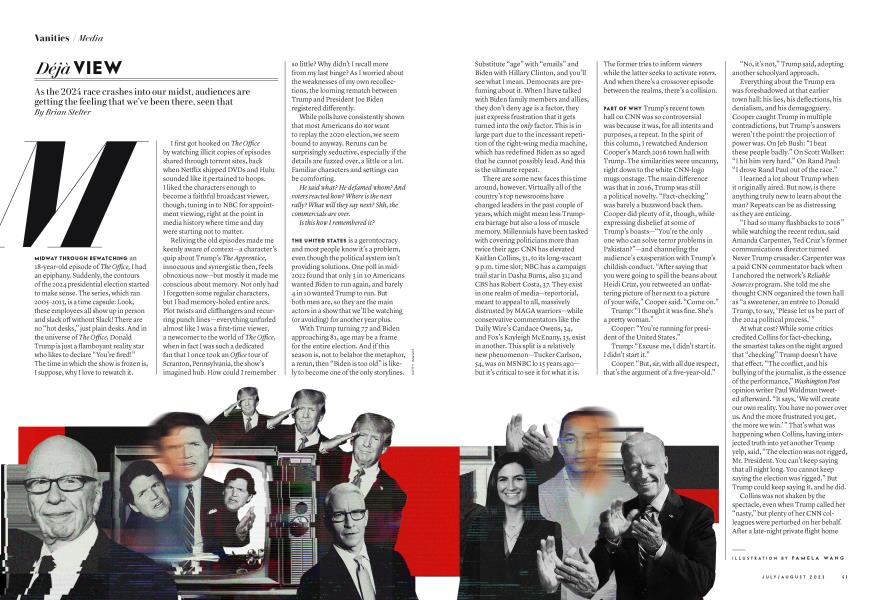
As the 2024 race crashes into our midst, audiences are getting the feeling that we've been there, seen that
MIDWAY THROUGH REWATCHING an 18-year-old episode of The Office, I had an epiphany. Suddenly, the contours of the 2024 presidential election started to make sense. The series, which ran 2005–2013, is a time capsule: Look, these employees all show up in person and slack off without Slack! There are no "hot desks," just plain desks. And in the universe of The Office, Donald Trump is just a flamboyant reality star who likes to declare "You're fired!" The time in which the show is frozen is, I suppose, why I love to rewatch it.
I first got hooked on The Office by watching illicit copies of episodes shared through torrent sites, back when Netflix shipped DVDs and Hulu sounded like it pertained to hoops. I liked the characters enough to become a faithful broadcast viewer, though, tuning in to NBC for appointment viewing, right at the point in media history where time and day were starting not to matter.
Reliving the old episodes made me keenly aware of context—a character's quip about Trump's The Apprentice, innocuous and synergistic then, feels obnoxious now—but mostly it made me conscious about memory. Not only had I forgotten some regular characters, but I had memory-holed entire arcs. Plot twists and cliffhangers and recurring punch lines—everything unfurled almost like I was a first-time viewer, a newcomer to the world of The Office, when in fact I was such a dedicated fan that I once took an Office tour of Scranton, Pennsylvania, the show's imagined hub. How could I remember so little? Why didn't I recall more from my last binge? As I worried about the weaknesses of my own recollections, the looming rematch between Trump and President Joe Biden registered differently.
While polls have consistently shown that most Americans do not want to replay the 2020 election, we seem bound to anyway. Reruns can be surprisingly seductive, especially if the details are fuzzed over, a little or a lot. Familiar characters and settings can be comforting.
He said what? He defamed whom? And voters reacted how? Where is the next rally? What will they say next? Shh, the commercials are over.
Is this how I remembered it?
THE UNITED STATES is a gerontocracy and most people know it's a problem, even though the political system isn't providing solutions. One poll in mid-2022 found that only 3 in 10 Americans wanted Biden to run again, and barely 4 in 10 wanted Trump to run. But both men are, so they are the main actors in a show that we'll be watching (or avoiding) for another year plus.
With Trump turning 77 and Biden approaching 81, age may be a frame for the entire election. And if this season is, not to belabor the metaphor, a rerun, then "Biden is too old" is likely to become one of the only storylines.
Substitute "age" with "emails" and Biden with Hillary Clinton, and you'll see what I mean. Democrats are pre-fuming about it. When I have talked with Biden family members and allies, they don't deny age is a factor, they just express frustration that it gets turned into the only factor. This is in large part due to the incessant repetition of the right-wing media machine, which has redefined Biden as so aged that he cannot possibly lead. And this is the ultimate repeat.
There are some new faces this time around, however. Virtually all of the country's top newsrooms have changed leaders in the past couple of years, which might mean less Trump-era barrage but also a loss of muscle memory. Millennials have been tasked with covering politicians more than twice their age: CNN has elevated Kaitlan Collins, 31, to its long-vacant 9 p.m. time slot; NBC has a campaign trail star in Dasha Burns, also 31; and CBS has Robert Costa, 37. They exist in one realm of media—reportorial, meant to appeal to all, massively distrusted by MAGA warriors—while conservative commentators like the Daily Wire's Candace Owens, 34, and Fox's Kayleigh McEnany, 35, exist in another. This split is a relatively new phenomenon—Tucker Carlson, 54, was on MSNBC lo 15 years ago—but it's critical to see it for what it is. The former tries to inform viewers while the latter seeks to activate voters. And when there's a crossover episode between the realms, there's a collision.
PART OF WHY Trump's recent town hall on CNN was so controversial was because it was, for all intents and purposes, a repeat. In the spirit of this column, I rewatched Anderson Cooper's March 2016 town hall with Trump. The similarities were uncanny, right down to the white CNN-logo mugs onstage. The main difference was that in 2016, Trump was still a political novelty. "Fact-checking" was barely a buzzword back then. Cooper did plenty of it, though, while expressing disbelief at some of Trump's boasts—"You're the only one who can solve terror problems in Pakistan?"—and channeling the audience's exasperation with Trump's childish conduct. "After saying that you were going to spill the beans about Heidi Cruz, you retweeted an unflattering picture of her next to a picture of your wife," Cooper said. "Come on."
Trump: "I thought it was fine. She's a pretty woman."
Cooper: "You're running for president of the United States."
Trump: "Excuse me, I didn't start it. I didn't start it."
Cooper: "But, sir, with all due respect, that's the argument of a five-year-old."
"No, it's not," Trump said, adopting another schoolyard approach.
Everything about the Trump era was foreshadowed at that earlier town hall: his lies, his deflections, his denialism, and his demagoguery. Cooper caught Trump in multiple contradictions, but Trump's answers weren't the point: the projection of power was. On Jeb Bush: "I beat these people badly." On Scott Walker: "I hit him very hard." On Rand Paul: "I drove Rand Paul out of the race."
I learned a lot about Trump when it originally aired. But now, is there anything truly new to learn about the man? Repeats can be as distressing as they are enticing.
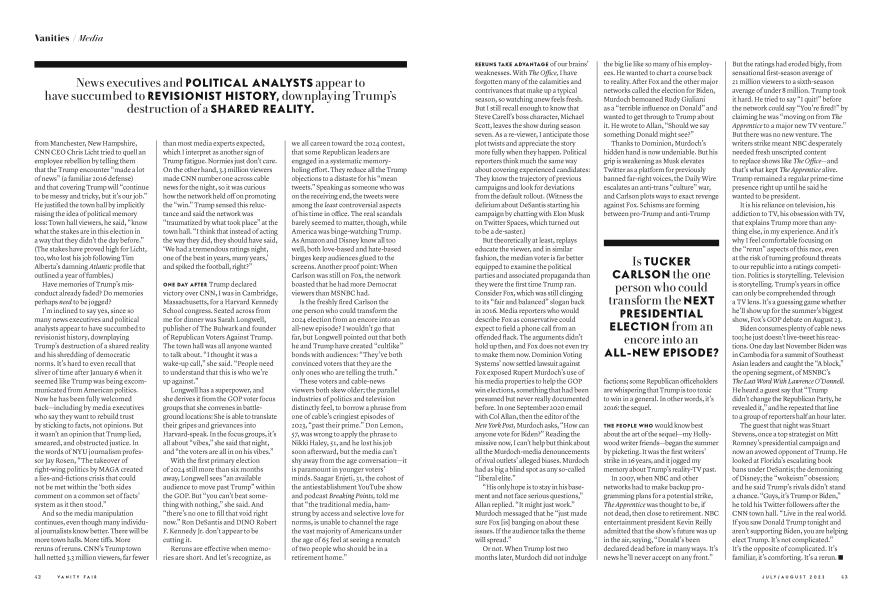
News executives and POLITICAL ANALYSTS appear to have succumbed to REVISIONIST HISTORY, downplaying Trump's destruction of a SHARED REALITY.
"I had so many flashbacks to 2016" while watching the recent redux, said Amanda Carpenter, Ted Cruz's former communications director turned Never Trump crusader. Carpenter was a paid CNN commentator back when I anchored the network's Reliable Sources program. She told me she thought CNN organized the town hall as "a sweetener, an entree to Donald Trump, to say, 'Please let us be part of the 2024 political process.' "
At what cost? While some critics credited Collins for fact-checking, the smartest takes on the night argued that "checking" Trump doesn't have that effect. "The conflict, and his bullying of the journalist, is the essence of the performance," Washington Post opinion writer Paul Waldman tweeted afterward. "It says, 'We will create our own reality. You have no power over us. And the more frustrated you get, the more we win.' " That's what was happening when Collins, having interjected truth into yet another Trump yelp, said, "The election was not rigged, Mr. President. You can't keep saying that all night long. You cannot keep saying the election was rigged." But Trump could keep saying it, and he did.
Collins was not shaken by the spectacle, even when Trump called her "nasty," but plenty of her CNN colleagues were perturbed on her behalf. After a late-night private flight home from Manchester, New Hampshire, CNN CEO Chris Licht tried to quell an employee rebellion by telling them that the Trump encounter "made a lot of news" (a familiar 2016 defense) and that covering Trump will "continue to be messy and tricky, but it's our job." He justified the town hall by implicitly raising the idea of political memory loss: Town hall viewers, he said, "know what the stakes are in this election in a way that they didn't the day before." (The stakes have proved high for Licht, too, who lost his job following Tim Alberta's damning Atlantic profile that outlined a year of fumbles.)
Have memories of Trump's misconduct already faded? Do memories perhaps need to be jogged?
I'm inclined to say yes, since so many news executives and political analysts appear to have succumbed to revisionist history, downplaying Trump's destruction of a shared reality and his shredding of democratic norms. It's hard to even recall that sliver of time after January 6 when it seemed like Trump was being excommunicated from American politics. Now he has been fully welcomed back—including by media executives who say they want to rebuild trust by sticking to facts, not opinions. But it wasn't an opinion that Trump lied, smeared, and obstructed justice. In the words of NYU journalism professor Jay Rosen, "The takeover of right-wing politics by MAGA created a lies-and-fictions crisis that could not be met within the 'both sides comment on a common set of facts' system as it then stood."
And so the media manipulation continues, even though many individual journalists know better. There will be more town halls. More tiffs. More reruns of reruns. CNN's Trump town hall netted 3.3 million viewers, far fewer than most media experts expected, which I interpret as another sign of Trump fatigue. Normies just don't care. On the other hand, 3.3 million viewers made CNN number one across cable news for the night, so it was curious how the network held off on promoting the "win." Trump sensed this reluctance and said the network was "traumatized by what took place" at the town hall. "I think that instead of acting the way they did, they should have said, 'We had a tremendous ratings night, one of the best in years, many years,' and spiked the football, right?"
ONE DAY AFTER Trump declared victory over CNN, I was in Cambridge, Massachusetts, for a Harvard Kennedy School congress. Seated across from me for dinner was Sarah Longwell, publisher of The Bulwark and founder of Republican Voters Against Trump. The town hall was all anyone wanted to talk about. "I thought it was a wake-up call," she said. "People need to understand that this is who we're up against."
Longwell has a superpower, and she derives it from the GOP voter focus groups that she convenes in battleground locations: She is able to translate their gripes and grievances into Harvard-speak. In the focus groups, it's all about "vibes," she said that night, and "the voters are all in on his vibes."
With the first primary election of 2024 still more than six months away, Longwell sees "an available audience to move past Trump" within the GOP. But "you can't beat something with nothing," she said. And "there's no one to fill that void right now." Ron DeSantis and DINO Robert L. Kennedy Jr. don't appear to be cutting it.
Reruns are effective when memories are short. And let's recognize, as we all careen toward the 2024 contest, that some Republican leaders are engaged in a systematic memory-holing effort. They reduce all the Trump objections to a distaste for his "mean tweets." Speaking as someone who was on the receiving end, the tweets were among the least controversial aspects of his time in office. The real scandals barely seemed to matter, though, while America was binge-watching Trump. As Amazon and Disney know all too well, both love-based and hate-based binges keep audiences glued to the screens. Another proof point: When Carlson was still on Fox, the network boasted that he had more Democrat viewers than MSNBC had.
Is the freshly fired Carlson the one person who could transform the 2024 election from an encore into an all-new episode? I wouldn't go that far, but Longwell pointed out that both he and Trump have created "cultlike" bonds with audiences: "They've both convinced voters that they are the only ones who are telling the truth."
These voters and cable-news viewers both skew older; the parallel industries of politics and television distinctly feel, to borrow a phrase from one of cable's cringiest episodes of 2023, "past their prime." Don Lemon, 57, was wrong to apply the phrase to Nikki Haley, 51, and he lost his job soon afterward, but the media can't shy away from the age conversation—it is paramount in younger voters' minds. Saagar Enjeti, 31, the cohost of the antiestablishment YouTube show and podcast Breaking Points, told me that "the traditional media, hamstrung by access and selective love for norms, is unable to channel the rage the vast majority of Americans under the age of 65 feel at seeing a rematch of two people who should be in a retirement home."
RERUNS TAKE ADVANTAGE of our brains' weaknesses. With The Office, I have forgotten many of the calamities and contrivances that make up a typical season, so watching anew feels fresh. But I still recall enough to know that Steve Carell's boss character, Michael Scott, leaves the show during season seven. As a re-viewer, I anticipate those plot twists and appreciate the story more fully when they happen. Political reporters think much the same way about covering experienced candidates: They know the trajectory of previous campaigns and look for deviations from the default rollout. (Witness the delirium about DeSantis starting his campaign by chatting with Elon Musk on Twitter Spaces, which turned out to be a de-saster.)
But theoretically at least, replays educate the viewer, and in similar fashion, the median voter is far better equipped to examine the political parties and associated propaganda than they were the first time Trump ran. Consider Fox, which was still clinging to its "fair and balanced" slogan back in 2016. Media reporters who would describe Fox as conservative could expect to field a phone call from an offended flack. The arguments didn't hold up then, and Fox does not even try to make them now. Dominion Voting Systems' now settled lawsuit against Fox exposed Rupert Murdoch's use of his media properties to help the GOP win elections, something that had been presumed but never really documented before. In one September 2020 email with Col Allan, then the editor of the New York Post, Murdoch asks, "How can anyone vote for Biden?" Reading the missive now, I can't help but think about all the Murdoch-media denouncements of rival outlets' alleged biases. Murdoch had as big a blind spot as any so-called "liberal elite."
"His only hope is to stay in his basement and not face serious questions," Allan replied. "It might just work." Murdoch messaged that he "just made sure Fox [is] banging on about these issues. If the audience talks the theme will spread."
Is TUCKER CARLSON the one person who could transform the NEXT PRESIDENTIAL ELECTION from an encore into an ALL-NEW EPISODE?
Or not. When Trump lost two months later, Murdoch did not indulge the big lie like so many of his employees. He wanted to chart a course back to reality. After Fox and the other major networks called the election for Biden, Murdoch bemoaned Rudy Giuliani as a "terrible influence on Donald" and wanted to get through to Trump about it. He wrote to Allan, "Should we say something Donald might see?"
Thanks to Dominion, Murdoch's hidden hand is now undeniable. But his grip is weakening as Musk elevates Twitter as a platform for previously banned far-right voices, the Daily Wire escalates an anti-trans "culture" war, and Carlson plots ways to exact revenge against Fox. Schisms are forming between pro-Trump and anti-Trump factions; some Republican officeholders are whispering that Trump is too toxic to win in a general. In other words, it's 2016: the sequel.
THE PEOPLE WHO would know best about the art of the sequel—my Hollywood writer friends—began the summer by picketing. It was the first writers' strike in 16 years, and it jogged my memory about Trump's reality-TV past.
In 2007, when NBC and other networks had to make backup programming plans for a potential strike, The Apprentice was thought to be, if not dead, then close to retirement. NBC entertainment president Kevin Reilly admitted that the show's future was up in the air, saying, "Donald's been declared dead before in many ways. It's news he'll never accept on any front." But the ratings had eroded bigly, from sensational first-season average of 21 million viewers to a sixth-season average of under 8 million. Trump took it hard. He tried to say "I quit!" before the network could say "You're fired!" by claiming he was "moving on from The Apprentice to a major new TV venture." But there was no new venture. The writers strike meant NBC desperately needed fresh unscripted content to replace shows like The Office—and that's what kept The Apprentice alive. Trump remained a regular prime-time presence right up until he said he wanted to be president.
It is his reliance on television, his addiction to TV, his obsession with TV, that explains Trump more than anything else, in my experience. And it's why I feel comfortable focusing on the "rerun" aspects of this race, even at the risk of turning profound threats to our republic into a ratings competition. Politics is storytelling. Television is storytelling. Trump's years in office can only be comprehended through a TV lens. It's a guessing game whether he'll show up for the summer's biggest show, Fox's GOP debate on August 23.
Biden consumes plenty of cable news too; he just doesn't live-tweet his reactions. One day last November Biden was in Cambodia for a summit of Southeast Asian leaders and caught the "A block," the opening segment, of MSNBC's The Last Word With Lawrence O'Donnell. He heard a guest say that "Trump didn't change the Republican Party, he revealed it," and he repeated that line to a group of reporters half an hour later.
The guest that night was Stuart Stevens, once a top strategist on Mitt Romney's presidential campaign and now an avowed opponent of Trump. He looked at Florida's escalating book bans under DeSantis; the demonizing of Disney; the "wokeism" obsession; and he said Trump's rivals didn't stand a chance. "Guys, it's Trump or Biden," he told his Twitter followers after the CNN town hall. "Live in the real world. If you saw Donald Trump tonight and aren't supporting Biden, you are helping elect Trump. It's not complicated." It's the opposite of complicated. It's familiar, it's comforting. It's a rerun.
Subscribers have complete access to the archive.
Sign In Not a Subscriber?Join Now


