Sign In to Your Account
Subscribers have complete access to the archive.
Sign In Not a Subscriber?Join NowConfessions on a Dance Floor
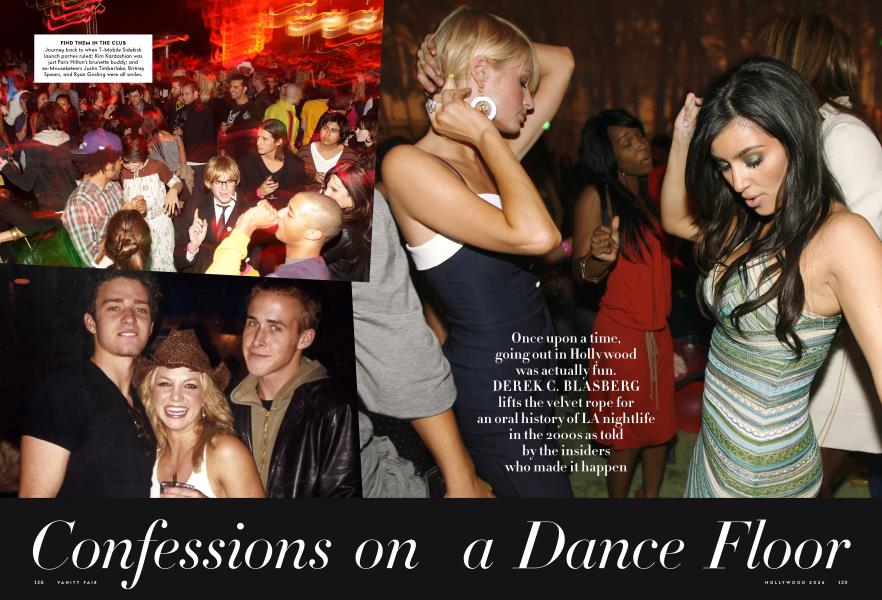
Once upon a time, going out in Hollywood was actually fun. DEREK C. BLASBERG lifts the velvet rope for an oral history of LA nightlife in the 2000s as told by the insiders who made it happen
DEREK C. BLASBERG
In the early to mid-aughts, Los Angeles nightlife wasn't a marketing strategy—it was a ritual, a religion. This was a sweet spot of Hollywood's (pre-streaming) power, before social media and the World Wide Web broke the spell of secretive hedonism.
Stars and starlets mingled with promoters, stylists, and publicists in dark rooms with strong drinks and weak camera flashes. They flocked to Hyde, Teddy's at the Roosevelt Hotel, the Lounge, Joseph's, Les Deux, the Sunset Room, Area, the Chateau Marmont; places immortalized on The Hills, in the pages of Us Weekly, and on fledgling gossip sites like TMZ and Perez Hilton.
I can still see digital cameras catching the shine of MAC Lipglass, the shimmer of an Herve Léger bandage dress undulating over a magnum of Grey Goose in a branded ice bucket. These bright young things texted on flip phones, smoked indoors, and the worst that could happ en was Page Six mentioning a day later who they sat next to at a club.
Tabloids couldn't get enough of Paris Hilton (now a mother and mogul who politely declined to respond to our questions), Britney Spears (whose reps didn't respond to our inquiries), and Lindsay Lohan, who stumbled through the 2010s but came back looking better than ever in this year's hit film Freakier Friday. (Still, her rep passed on participating in this story and CC'd a lawyer in her response.)
These weren't just clubs—they were stages. And the players who filled them were writing the last chapter of a bygone era: a world where celebrity was witnessed, not posted. Here, the promoters, PR fixers, club owners, and photographers who came alive at 1 a.m. reminisce about the golden age of noughties nightlife.
BRENT BOLTHOUSE, founder, Bolthouse Productions and Bungalow Hospitality Group: I remember moments in Hyde where I was looking at A-list actresses making out with two girls, going, "Well, thank God there's no cameras in here."
JASON POMERANC,cofounder, Thompson Hotels Group: The only thing they really had to worry about was a flip phone photograph—and maybe somebody would call something into Us Weekly, which would run four days later.
CARLOS LOPEZ,photographer: I wasn't even 20. Everyone was underage! And at the clubs, raging.
ELLIOT MINTZ,publicist: There were lines outside all those clubs, like the Roosevelt and Teddy's. You had to really pull your weight. And that meant being a little bit more famous than the person who was standing behind you.
JESSICA MEISELS,publicist: If you got into Hyde, through that gate—you were in. If you were in that room, you were in that room. And we pretty much owned all those rooms.
RACHEL ZOE,stylist and designer: The party scene was everything. It was like Entourage life, you knowwhat I mean? It was like, Les Deux was everything.
LISA VONi, former West Coast director of Vogue and Teen Vogue: For me, it was always Les Deux Cafes. And that was before the Brent Bolthouses.
You can't tell the story of LA nightlife in the aughts without Bolthouse—who got his start promoting grunge-era hotspots like the Viper Room and House ofBlues—and his business partner, Jen Rosero.
BOLTHOUSE: I moved to Los Angeles to get sober, and somehow I fell into the nightclub business in 1989.
JEN ROSERO,partner, Bungalow Hospitality Group: Brent and I came together in 1991 and started off with Roxbury—like, A Night at the Roxbury.
BOLTHOUSE: What we did that was really sp ecial is we created a community. As people were arriving in town in the '90s, they grew up with us. I met Leo [DiCaprio] when he was 16; I did Paris [Hilton] 's 16th birthday party. She grew up going to all of our things. And in those early days, we were handing out fliers, we were doing mailers. We would do stuffing-envelope parties on a Friday nightwith Charlize [Theron] and Scott Weiland from Stone Temple Pilots. And these people weren't famous at that time. They were just kids trying to go somewhere. And then a couple of years later, they blew up.
ROSERO: I managed the door. My whole thing was to get the most interesting bowl of fruit—not all one flavor. You had to have a lot of different backgrounds; it wasn't just one type of person.
LOVE: The Brent Bolthouse circuit, I feel like that really brought in bottle service.
BOLTHOUSE: I brought bottle service from Europe to America. I don't know what's going on in New York, but in LA, it hadn't happened. We kind of invented it because I saw my friends in Paris doing it.
LOVE: Well, he didn't invent bottle service. But anyway, I think that's when the richer people would come.
As Bolthouse andRosero's business was on the upswing, a new generation of talent was coming ofage in the scene they helped create.
LOPEZ: I moved to LA in 1999. My first job was at the Tommy Hilfiger store on Rodeo Drive. I was folding denim upstairs on the second floor, and my best friend at the time, Mandolin Morgan—this hot little blond with blue eyes and a tiny little waist—was like, "Do you want to go to a party with me? Brent Bolthouse Productions is doing the party, and I'll bring you as my guest."
I go in, and one of the first people that I meet is Nicole Richie. She roller-skates up to me—which I thought was so iconic—and she's like, "Do you want to meet my friends? Okay, everyone, this is Carlos. This is Paris. This is Kelly," which is Kelly Osbourne. "This is Kim," meaning Kim Stewart.
MINTZ: Read Paris's autobiography. She speaks about her first meeting with me and why we decided that I would be her PR rep. It was after a burglary had taken place—this was even before the Bling Ring—and I had done some PR work for her sister, Nicky. We had a meeting, and I told [Paris], do you ever worry about too much publicity, becoming overexposed? And she looked at me and she said, "There's no such thing."
POMERANC: The Roosevelt was the first Hollywood project that got that new generation of celebrity. Hollywood was a little gritty still, and then the Roosevelt kind of exploded. Teddy's was the small, really exclusive part that became a celebrity haven.
AMANDA DEMME,photographer and creative director: I brought in Jason Pomeranc at the Roosevelt, and I made it huge.
POMERAHC: Let's just say the group had creative differences. I have since spoken to Amanda many times. She's super creative; she's really interesting. But there was a little drama there.
LOPEZ: I want to say it was the opening night [of Teddy's]—I remember going with Lindsay [Lohan], and I think Donatella Versace was there. It was a very hot night, very exclusive, and you would lo ok around, and it was all the girls. It was like, Mischa Barton, Nicole Richie, Paris Hilton.
POMERAHC: Leo, Lindsay, Paris, that group kind of exploded. They were going out all
the time, and Teddy's was their hub. Kim [Kardashian] was just, like, a footnote.
MIHTZ: I recall the first night that we invited Kim Kardashian to j oin us at Hyde. Kim
Kardashian's first real job in Hollywoodwas building closets for celebrities. Paris hired her, and Kim worked diligently for weeks. MEISELS: I had hired Kim, who didn't have a job at the time, to clean out Paris's closets. Because she didn't want to work at Dash.
MIHTZ: One night when Kim was doing some finishing touches, Paris said to me, "You know that girl who did my closet? She's really, really nice. I get really good vibes from her. Why don't you invite her to join us tonight at Hyde?"
Kim's first reaction was to look a little horrified. She said, "That's so kind of her, but I just want you to know I don't smoke. I don't drink. I don't dance. And besides, look at me—I have nothing to wear." Paris said, "Oh, don't be silly—she doesn't have to smoke, she doesn't have to drink, pick something of mine and change into it." As the visits increased—because Paris liked her and invited her to many of them—Kim usually waited for the other women to enter first, and then she would walk in. Of course, no flashbulbs were flashing on this woman with the long brown hair.
LOPEZ: These girls were unapologetic and very confident, and they grew up in front of the camera lens. And the more outrageousness and controversy there was, the more the world loved watching them.
MIHTZ: I was not a partyer as much as I was a guardian of the party—father confessor, public relations, spin doctor, whatever you want to call my role—[for] all those people that you can think of: Britney [Spears], Paris, Lindsay. Those women treated me not as a father figure, because their fathers never would've approved the behavior—but if there were any slipups, any mistakes, Elliot would find some way to smooth it out. To arrange a backdoor exit if a client was in such a state that it would do her no good to be photographed and pushed around outside by paps or fans, or to make what's called a trade-out paparazzi deal.
POMERAHC: Going out was super serious. The guy who was our doorman, a guy named Johnny Zander, was an ex-male model. I don't really know what happened to him, but Ben Stiller used him as the inspiration for Zoolander.
LOPEZ: I'll never forget going home with Nicole after a club or a T-Mobile party. We would pull up WireImage, and we would lay in bed and look at who was at the party. That was our pre-Instagram.
CONTINUED ON PAGE 174
CONTINUED FROM PAGE 131
BOLTHOUSE: People were not paid to go to parties. That did not exist. Celebrities were coming to these parties because they were actually fun.
LOPEZ: There were no contracts. You were going because you were friends with the owners, you were friends with the club promoters. I joke with people now, with all these 17-year-old influencers who are making $ 10 million a post—I'm like, I would literally get on a plane for a drink ticket. I would go to a club and a party, get wasted for three days straight, come home, and all I got was a hangover.
POMERAHC: Even the award stuff was fun. You saw actual LA fun people engaged in these parties—it was more organic. Itwasn't quite so corporate.
LOPEZ: Iwas one of the only people who was carrying around an actual little disposable camera. And then when the digital camera started to become a thing, I was the only one carrying that around.
The air was electric with possibility, and it seemed any night could culminate in a private performance that had to be seen to be believed.
POMERAHC: Prince would come in and just start playing a random solo show at Teddy's until four or five in the morning, just because he felt like it, right? And these things were regular occurrences. If you weren't at the Prince pop-up show or you weren't [there] when Courtney Love showed up, it was gone. It was not on Instagram. I think that pushed people in LA to go out more.
DEMME: Babe, I had Prince perform. I went nuts. I had the fucking dopest shit ever.
POMERAHC: [Prince] would stay up in the penthouse, which we had to redecorate to his specifications ofwhite shag rugs and purple. And he would only eat pancakes for days.
LOPEZ: The Lounge is where the famousinfamous Britney dance-off happened with.. Justin Timberlake. Thank you. I forgot his name.
BOLTHOUSE: Britney Spears was there; Justin Timberlake was there. They had broken up. Suddenly, the dancers are doing a whole breakdancing thing. The press goes crazy for [it], and then SNL writes a skit—but it wasn't a dance-off between them. It was their dancers just showing off, doing spins and jumps and flips.
PAHTERA SARAH, promoter One had a table upstairs and one had a table downstairs, and never the twain shall meet. They never were on the dance floor at the same time. So it was a completely made-up story.
LOPEZ: Paris was having her 21st birthday, and she celebrated it in five different states and countries. I maybe went to three out of the five. It ended in Los Angeles, at a place called Sunset Room.
ZOE: I had a big birthday party that Bazaar shot. Were you there? When I did the one with Nicole and Lindsay and Mischa and AM DJ'd my party? It was the craziest party ever. It was me, Mischa, Nicole, and Lindsay, and then everyone—the Olsens. I could have sworn you were there.
BOLTHOUSE: What's going to happen? Is Snoop Dogg going to get on the microphone and freestyle that night? Is Jay-Z going to show up and do something? All kinds of things would happen.
LOPEZ: It was a full-time job.
At the same time, the culture of the aughts could be unforgiving—particularly for young women.
LOVE: It was not a period that I thought was really great in Hollywood. I thought it was the demise of the uncurated. That's not where you were going to find artists, actors that actually were proper actors. It was a very dark time, I think, for young girls.
MIHTZ: You'll notice that most of the people, if not all of the people, who took hits from that era and suffered through the scandals were women. There may have been one or two exceptions, but for the most part, it was girls wanting to have fun, to paraphrase an old song—by going out, having a couple of drinks, dancing, gossiping, and going home.
BOLTHOUSE: Plenty of men were there too. I just think that they didn't get the attention that the women did because on that front, fashion doesn't care what a man is wearing—unless it's like Leo or Brad Pitt.
POMERAHC: The Leos and the Jude Laws would come as well, but [the women] were more interesting because they were the ones dancing on tables. They were the ones creating the energy.
PEREZ HILTOH,blogger: Women can be guilty of misogyny too—and Us Weekly and Star and all of the celebrity magazines, their villains or their targets were also women. And I had friends in all these publications, and it was predominantly female staffs.
LOPEZ: Perez Hilton was the major enemy of every girl. Him coming for these girls started to affect their friendships. He would call out their flaws; he would call out their mistakes. The girls had to counteract him and create storylines, talking to the paparazzi and press to balance out whatever he's saying.
HILTOH: Listen, I take full accountability for all of my horrible decisions of the past—but they were all going out without underwear on, and part of me thinks they were doing that on purpose. It's like, "Oh, Paris got photographed without any underwear on? I'm going to get photographedwithout any underwear on too."
B 0 LT H 0 U S E: I was in a bitter war with Perez Hilton because I wouldn't let him into Hyde. I was like, "Well, dude, we say no cameras allowed, and there's no press allowed." So he hated me. Maybe he still does, I don't know. I have no ill will towards him.
PEREZ HILTOH: Hyde got off on rejecting famous people. Poor Tara Reid was not allowed to go inside Hyde, but Paris Hilton waltzes right in.
LOPEZ: Perez Hilton, he would cross my face out.
HILTOH: I might have. That sounds like something I would do.
The paparazzi, too, became relentless.
MIHTZ: In the beginning, I could walk outside and address the paparazzi by their first names.
MEISELS: Yeah, I had a whole list. You had some safe people that you worked with. And you knew who was bad.
MIHTZ: It would be easy for me to spot a newcomer. The newcomers were incredibly young, and they wanted to get something different—and they were the ones who began shooting the women as they were getting out of their cars and looking for what was referred to in those days as upskirt photographs.
ZOE: The girls were really pulled into the tabloid spotlight and I along with them. So that was hard. Because there was no social media, you couldn't control a narrative.
BO LT HOUSE: The line in the sand was Hyde. Harvey [Levin] used to stand outside with a camera by himself.
MIHTZ: TMZ opened their offices directly across the street from Hyde.
HILTOH: Harvey met with me to pick my brain before he launched TMZ.
BOLTHOUSE: That's where Britney didn't wear underwear; that's where Paris and Nicole had wars. And that is around the same time that phones got cameras.
ROSERO: At that point in time, you see that change where paparazzi will say anything to get the picture—anything to get somebody pissed off. TMZ made it harder for some of the higher-profile clients to come out, let their hair down, and do whatever they're going to do.
SARAH: It started becoming less respectful, and they would yell nasty things at Leo and his boys, trying to get a rise out of him. If they get them angry, that photo's going to sell for more.
The epoch may have reached its apotheosis on November 29, 2006, when the New York Post ran a now iconic cover photo ofLohan, Spears, and Paris Hilton trapped in a car outside of an unnamed "L.A. late-night spot. "
MIHTZ: I've been accused publicly of setting that up.
BOLTHOUSE: That was at Hyde.
MIHTZ: We were at the Beverly Hills Hotel.
HILTOH: That iconic holy trinity photo, that was leaving Paris's house.
BOLTHOUSE:I think I knew that they were coming. It was the craziest thing I'd ever se en in my life: They were b eing chase d by at least 20 cars. Paparazzi got out and parked cars in oncoming traffic, abandoned their cars on Sunset Boulevard, got out and then surrounded them. That's when that photograph was taken.
MIHTZ: It had an unfortunate headline on top of it. It was called the "bimbo summit," and the term was obviously derogatory.
ROSERO: I don't even remember exactly who it was; it was that crew that didn't wear underwear. It was actually dangerous—not what they did, but the paparazzi was so crazy.
MIHTZ: Paris and Brit got out of the room. I'm not certain if they took a window through the restroom or some backdoor route, but nevertheless, we found ourselves right on the street. And it was a moment or two later that I saw Lindsay approaching us from behind. It was raining hard, and I kind of sheltered Lindsay and walked her towards the car, and the paps were in full array—and they were screaming at Lindsay, who had been seen a few nights earlier voicing disapproval about Paris over something long ago and forgotten. And Paris said to her, because of the rain, "Just hop in with us." I moved around to the front of the car, because the lights were really blinding and it was raining, and I said, "You've got to give them some space"—because they were prepared to jump on the hood.
ROSERO: That was the thing about phones: Now the paparazzi can find out instantly where everybody was. I mean, PR people had a lot to do with this too. Let me tell you—there were PR people that definitely were working to keep certain people relevant. Because myself and my crew were tight, tight-lipped.
MIHTZ: I waited until they safely got out of there. I may have followed behind. And then the next day was the Post. Because I had been with them and because it got so much attention, there were those who said that I had arranged the whole thing, which I certainly didn't.
As time wore on, the scene was also afflicted by the same demons that have struck down generations of partyers.
LOPEZ: Without naming names, I saw a lot of ODs. I saw people that are no longer with us struggle with alcohol and drug addiction. And I saw the downfall of some of these It girls, when the fun started to be taken over by the addiction of going out. Everyone who knew when it was time to go home went home—and then there were those who didn't know when to stop.
MIHTZ: It was no big deal to smoke a joint before going to a club. But there was a point where marijuana usage was beginning to erode, and the influx of cocaine appeared.
POMERAHC: I mean, generally, the after hourswere not a good place to be.
MIHTZ: People were a little bit more self-absorbed, and people died and people went to jail, and people spent endless cycles in rehabilitation or in courtrooms or worse. And the scene was no longer warm or cuddly or sexy or glamorous.
LOPEZ: Do you know what's crazy? Brent was sober the entire time, and still is.
The age ended, as all eras do. Why? Some blame smartphones, which robbed revelers of their privacy. Some blame social media particularly Instagram, which launched in 2010—for transforming nights out into performative exercises.
LOPEZ: Adam DiVello, who created The Hills [in 2006], wanted to really capture this Los Angeles nightlife scene. And for us, it was like, "Oh, nightlife is starting to die. You're filming it. It's already starting to become covered and recorded."
MIHTZ: Admittedly, I haven't been to Hyde in 20 years, or the Rainbow, or the Roxy, or the Roosevelt. But I have a feeling that outside of a couple of straggling tourists, that scene does not happen anymore.
LOPEZ: Obviously, social media really ruined Los Angeles, because nothing was private anymore. After this group of girls, it was the High School Musical kids—Zac Efron, Vanessa Hudgens, and Rob Pattinson and Kristen Stewart. And they weren't really raging because I think they looked at the previous generation as kind of messy. Nowadays, no one knows where to go. There's nowhere to go; there's no nightlife in Los Angeles.
MIHTZ: I think that there was a slow erosion. They were growing up—and it was getting boring, because it really was the same thing night after night after night. Not for dozens of occasions, but hundreds of occasions.
MEISELS: It was an era where you would actually watch TV. And now it's like, I don't know the difference between somebody that's on Euphoria and Love Island, you know what I mean?
POMERAHC: Half the time we get hotel requests for influencers [now], I don't even knowwho these people are. For every Timothee Chalamet, there's just a bunch of random Instagram creators. A lot of these younger, interesting actors are recluses. Right? They're hanging out at Erewhon and drinking smoothies.
MEISELS: Even if you look at a publicist now—I would literally sleep for two hours and wake up, have a Coca-Cola and a cigarette, and start pitching media. And now, you can't even get a 26-year-old to [do that]. They would be like, "I need my mental health morning." There's no sense of urgency.
LOVE: I think there's definitely a cool scene downtown. There's dance clubs that are just bursting; there's Korean nightclubs that are insane.
DEMME: The nightclub people, it's a real breed, you know what I mean? It's a really beautiful breed of people. And the people that are in it I still give so much props to, because it's a real thing. People don't really take it as seriously. But now it's cheesy. Everything's cheesy.
BOLTHOUSE: Hopefully, nightlife goes back to creating things that are fun. I don't know who's going to do that. It's not going to be me, I can tell you that—not at this age.
LOPEZ: Those were the days. Now I'm about to go have gluten-free food at Nicole's house with all these moms.
Daniela Tijerina
Savannah Walsh
Subscribers have complete access to the archive.
Sign In Not a Subscriber?Join Now


