






Sign In to Your Account
Subscribers have complete access to the archive.
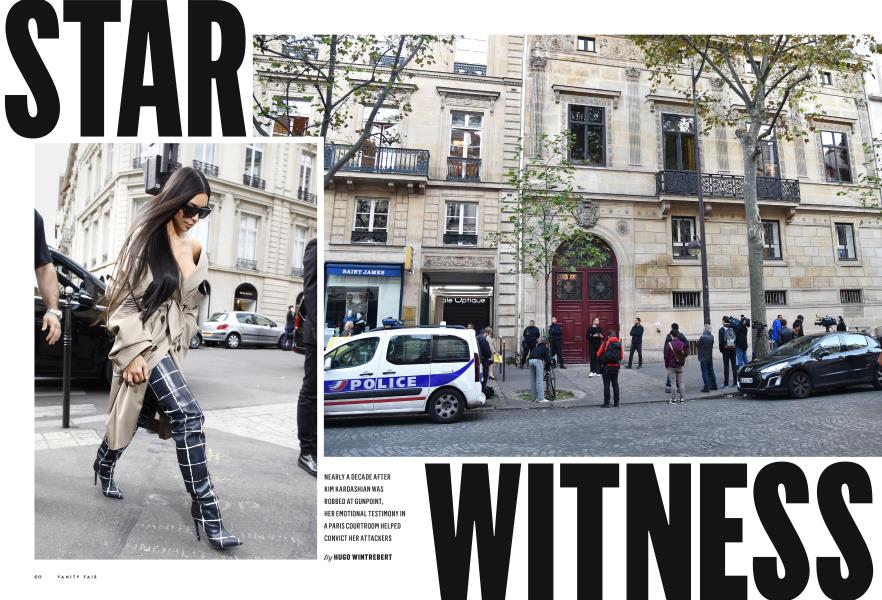
Sign In Not a Subscriber?Join NowSTAR WITNESS
NEARLY A DECADE AFTER KIM KARDASHIAN WAS ROBBED AT GUNPOINT, HER EMOTIONAL TESTIMONY IN A PARIS COURTROOM HELPED CONVICT HER ATTACKERS
HUGO WINTREBERT
KIM KARDASHIAN HAD only one desire: to flee as quickly as she could. "I want to leave and be reunited with my children in the United States," she said. "A private plane is waiting for me at Le Bourget." It wasn't that simple. Investigators from the Paris police's organized crime department still had a few questions to ask her. It was 4:30 a.m. on October 3,2016, and they were at her hotel to take her statement. The 35-yearold American star appeared distraught—"in shock, very pale, and she wasn't wearing any makeup," they noted. An hour and a half earlier, two men, one of them armed, burst into her suite at the Hotel de Pourtales, a stone's throw from the Madeleine church in the heart of the city. At first she believed she was dealing with "terrorists," as she put it. "I thought they were going to shoot me. When I realized that the gun was real, I decided to do whatever they asked." Kardashian told investigators the men demanded her jewelry, then bound her and duct-taped her mouth before carrying her into the bathroom. Her nightmare lasted about 10 minutes. "I had an indescribable feeling, like my heart was coming out of my chest," she said. "I knew I was going to die."
She also explained to the police that she wasn't able to see much of her assailants, who were masked. One must have been close to five foot eleven, and the other was between five seven and five nine. The investigators seized a number of items that the thieves might have touched for DNA testing. They took samples from Kardashian's wrists, ankles, and hair. At 7:40 a.m., she was allowed to depart on her private jet. Soon, the global media would arrive at the hotel.
In late April, almost a decade later, 10 defendants in the case appeared before the Paris Assize Court. Three of the defendants suspected of having broken into the Hotel de Pourtalds to rob Kardashian were by then between 68 and 71 years old. One wore a hearing aid; another had difficulty walking. They were tried for their alleged part in one of the most audacious robberies of recent decades, with an estimated haul valued between $6 million and $10 million.
The trial presented two spectacularly different worlds. On one side, the global star, one of the most famous and photographed women in the world, whose social media-abetted rise to fame represented an entirely new brand of celebrity; on the other, a gang of mostly repeat offenders, many past their prime. There was a California woman with an almost inconceivable fortune on one hand and a motley crew of criminals largely from the poor suburbs of Paris on the other.
Most of the accused denied any wrongdoing. Two of them provided limited confessions, taking care not to implicate others, and explained that some statements they provided were the result, in part, of being overwhelmed by events. The accused burglars had also been approached by American documentary producers and major Parisian publishers eager to share their stories. One agreed. He made the rounds of TV studios, facing the wrath of his supposed accomplices. According to his account, he didn't know who Kardashian was before targeting her. Patricia Tourancheau, who met most of the accused while writing Kim et Les Papys Braqueurs (Kim and the Grandpa Robbers), pointed out: "What struck me was their casualness. They're very experienced, but at the same time, there was something amateur about the operation. They certainly had good intelligence, but they also operated by instinct."
"I told myself they were going to shoot me. I knew I was going to die." -Kim Kardashian
Kardashian has rarely spoken publicly about her ordeal. By all appearances, the episode remains a source of trauma for her, but one she was prepared to revisit on the stand. " It could be an incredible moment in court," one Parisian defense lawyer told me before the trial, excited at the prospect.
THE STORY STARTS with Aomar Ait Khedache. He arrived in France from Algeria at the age of seven and grew up in Cormeilles-en-Parisis, northwest of Paris, in a public housing development surrounded
by open fields. He dabbled in petty theft from an early age, logging his first arrest at 14. He was sent to the juvenile section of the fvreux prison. Convictions for increasingly more serious crimes followed. Robberies, muggings, and other acts of violence led to more
frequent prison stays. Around 2010, the authorities lost track of Ait Khedache when he disappeared to avoid a five-year sentence for drug possession and trafficking. Eventually he resurfaced and could often be found in the capital's bistros, boasting of his exploits, even if his age and physical condition had curtailed his criminal activity. The former marathon runner is now half deaf and wears thick glasses.
Around spring 2016 a group of men were smoking Gitanes and sipping Ricard in a bar in the Marais district. It was then Ait Khedache heard about the wife of a famous rapper who regularly visits Paris during Fashion Weeks. She always had her jewelry with her, a fortune in diamonds that she displayed on social media. The person who gave him this tip assured him that he has a solid source in Kardashian's entourage during her visits to Paris. Every time she came to the city, she stays in a luxurious apartment-hotel that doesn't have the same level of security as some other hotels. On paper, it sounded like a very simple operation to Ait Khedache, whom prosecutors alleged was the plot's ringleader—a charge he always denied.
The thieves mimed the gesture of a groom slipping a wedding ring onto the finger of his bride. She still didn't get it. "I think they want your ring," the concierge suggested.
At that moment Ait Khedache didn't know who Kardashian was. But he appreciated his future target's array of jewels, including a ring set with an 18.8-carat diamond, given to her earlier that year by her husband, Kanye West. Its value is estimated at 4 million euros. According to the prosecution, Ait Khedache set to work assembling a team for the heist. All were trusted friends, mostly around his age, whom he met over the years in various Paris bistros. He also carried out the initial scouting to verify the low level of security at the hotel. He pushed open the gate, no key or code necessary, to enter a paved courtyard filled with statues. There's a museum open to the public, and at the far end is the Hotel de Pourta^s. The only challenge: You can't reach the building by car. The robbers would have to get away on bikes.
In June 2016, Kardashian and West traveled to Paris. The burgeoning heist team considered pulling off their robbery then but decided against it. They were not yet ready, and Kardashian was too often surrounded by photographers. It was better to be patient, they decided, and continue to build out their ranks. According to investigators, Didier Dubreucq joined them. Known as "Didier-les-Yeux-Bleus" ("Didier Blue Eyes"), he was an underemployed plumber and enthusiast of Cotes-du-Rhone wines with a dozen criminal convictions. He'd spent 23 years of his life in prison for theft, on drug charges, and for robberies, and now his head rings with tinnitus after living with the constant noise of detention centers.
An old friend of Ait Khedache's, Yunice Abbas, would also join the operation. Abbas had spent almost two decades in prison since his first conviction in 1972. When his friend told him about a job stealing the jewelry of the wife of a famous rapper, he hesitated. He didn't want to end up back behind bars. Besides, with his heart condition, he couldn't see himself committing a robbery that required escaping by bike. But he also owed his friend 3,500 euros, and the fear of missing out on what could be one of the biggest heists of the decade finally convinced him.
The opportunity presented itself that fall, during one of Paris's Fashion Weeks. Kardashian landed at 10:40 a.m. on September 28, 2016, in a private jet at Le Bourget airport. She was accompanied by her sister Kourtney; her mother, Kris Jenner; an assistant; a stylist; and a bodyguard. A phalanx of photographers followed her, though they dispersed each time she returned to her Parisian residence: the Hotel de Pourtalbs. The luxurious mansion in the Sth arrondissement catered almost exclusively to the rich and famous, and ideally guests who fit both of those descriptions. Madonna and Beyonce and Jay-Z have slept there. Prince bought out the entire hotel for a party in 2010. Soccer star Zlatan Ibrahimovic lived there for a year. Kardashian and West were regulars. They honeymooned there after they were married in 2014. There are 11 tastefully decorated apartments, with prices ranging from 1,000 to 15,000 euros per night. Kardashian settled into one of the most luxurious suites, the Garden Duplex. It measures more than 3,950 square feet. She was in and out between stops around the city—a fitting at Balmain with Olivier Rousteing, lunch at a restaurant off of Avenue Montaigne, and many fashion shows.
"I decided to write, not in the hope you will forgive me but as a human who wishes to tell you how much I regret what I did." -Aomar Ait Khedache
On Sunday, October 2, she sat front row at Riccardo Tisci's show for Givenchy at the Jardin des Plantes. Later, she headed back to the suite with her sister to change, then on to the Azzedine Alaia showroom for a private dinner. Bianca Jagger and architect Peter Marino were among the guests who dined on scrambled eggs with truffles and Saint-Honore cakes,
washed down with Louis XIII cognac from Maison Remy Martin. Then it was back to the hotel around midnight in a black Mercedes van. Kim decided not to join Kourtney, who was going clubbing at L'Arc, just off the Champs^lysees; their shared bodyguard went with her. Instead, Kim returned to her room with her stylist, put on a bathrobe, lay down on her bed, and started watching a documentary on her laptop.
Abderrahmane Ouatiki, a39-year-old student from northern Algeria, was working as the night concierge one floor down; he was mostly paid not to fall asleep and was fighting boredom by studying for a doctorate in semiology and discourse analysis at the Sorbonne. At 2:22 a.m., he was talking to a friend on Skype when someone knocked on the hotel door. In fact, there were three people at the entrance, dressed as police officers. Ouatiki wasn't concerned. Complaints of disturbances happen occasionally, though oddly these officers were hooded. As soon as he opened the door, he was confronted by an automatic pistol, handcuffed, and forced to his knees. "We're here for the money," shouted one of the assailants. "Who's in the hotel?" another demanded. The concierge offered a vague reply: "Fashion people, it's Fashion Week." During a brief moment of hesitation, he wondered who the criminals were really after. "The rapper's wife, where is she?" one assailant asked. Ouatiki led two of the robbers to Kardashian's room at gunpoint.
Kardashian thought she heard her sister coming home from the club and uttered an unanswered hello. Then she saw two men in police uniforms arrive, carrying the handcuffed concierge. Kardashian at first thought she was dealing with terrorists, panicked, and dialed 911, the emergency number in the United States. She didn't reach help (the police equivalent of 911 in France is 17). She then tried to call her bodyguard, but the robbers grabbed the star's BlackBerry. Then, again, they appeared to hesitate. What were their intentions? For five long minutes—"the most terrible" minutes, the reality TV star later explained to police—the room was plunged into an unbearable suspense. Then, finally, the hooded men called out "la ring, la ring." With their thick accents, the American didn't understand them. "What? What?" she
CONTINUED ON PAGE 124
CONTINUED FROM PAGE 65
asked. The thieves mimed the gesture of a groom slipping a wedding ring onto the finger of his bride. She still didn't get it. "I think they want your ring," the concierge suggested, Kardashian would later recall. He was still a hostage but also now a negotiator and interpreter. Kardashian pointed to the solitaire on her bedside table.
But the thieves wanted more: " Money! Money! Money!" one of them shouted. Kardashian had just a thousand dollars in her wallet, a disappointment for the thieves. She was distraught and cried, asking loudly: "Are we going to die? Tell them not to kill me, I have children." One of the assailants then took it upon himself to tie up the star. Meanwhile, his accomplice grabbed as much jewelry as he could. Just as they were about to move onto another room, Kardashian's phone started ringing. The concierge later explained to a police officer that he warned the thieves: "Do you know who's calling?" he asked them, "it's her bodyguard. If she doesn't answer, he'll arrive." Quickly, the victim was left in the bathroom, and eventually the thieves disappeared on their bikes.
ALTHOUGH THE ROBBERY was CUt short, the haul, including the 18.8-carat ring, a yellow gold Rolex Cosmograph Daytona, seven Cartier and Hermés bracelets, and three gold-and-diamond grills, exceeded the thieves' expectations. It could have been even more. As he fled, one of the thieves fell off his bike, spilling jewelry onto the sidewalk. That same morning, a local woman on her way to work came across a sumptuous pendant on the ground, wearing it all day long, to the amazement of her colleagues. In the evening she returned home, only to hear about the burglary. After some internet sleuthing she learned the value of the 3.5-carat jewel she'd found: $33,180. The next day she turned it in to the local police station.
Given the victim's state of shock, the investigators quickly ruled out insurance fraud. They were, however, suspicious of the night concierge. Could he have been part of an inside job, leading the thieves to the loot? Why would he open the door to hooded individuals? The cameras installed in the hotel were not operating that evening, so it was impossible to confirm parts of his account. Ouatiki, after being questioned at length and having spent 36 hours without sleep, finally went free. But his phone was tapped.
The investigators were immediately under pressure. The case was sensitive, and the image of Paris, already badly damaged by the wave of terrorist attacks the previous year, was at stake. They began by retrieving images from surveillance cameras near the hotel that showed some of the alleged thieves leaving by bicycle. Four days after the robbery, there was a break. Despite the gloves worn by the thieves, DNA was found on the rolls of tape used to tie up Kardashian and also on the cable used to restrain the concierge. This DNA was eventually traced back to a man called Pascal.
At the same time, investigators found several burner phones. They discovered that Pascal was in fact an alias used by Ait Khedache, whom they began to track. Within a few weeks, police realized that the owner of a bar Ait Khedache frequented was close to the brother of the driver that Kardashian regularly hired when she visited Paris.
The widening ring of suspects, unaware their phones were now tapped, talked about the heist among themselves. They expressed annoyance at not getting the money they expected from the robbery, and their loot was hard to unload. The police had a front-row seat for the gang's activities. According to later reports, Ait Khedache put pressure on a certain Nez Rape ("Rough Nose"), suspected of being the fence for the goods and entrusted with selling the jewels in Antwerp. But selling a ring like Kardashian's is not easy. Generally, thieves recover only a very small fraction of a piece's market value—10 to 15 percent once all the intermediaries have been paid.
AUTHORITIES MADE THEIR first arrests in the case on January 9, 2017, three months after the robbery, taking 17 people into custody early in the morning. They were almost all repeat offenders: a Marais bistro owner, the limo driver, the fence. Of the 10 defendants who would eventually face charges, most were over 60 years old, and at first all of them denied any involvement with the crime. But two came under particular pressure from the police. First, Ait Khedache. At his home the police found 16,900 euros in his refrigerator. He claimed to be "able to explain" but then struggled to do so when the investigators told him that his DNA was found in Kardashian's bedroom. Although he denied robbing her, he finally broke down and confessed to having played a small role in the affair.
The second was Abbas, Ait Khedache's old friend, who was quicker to confess. The investigators found almost 60,000 euros in small bills at his son's house, and his DNA was also at the hotel. Abbas says his role was merely to stay on the first floor of the Hotel de Pourta^s and keep watch. What about the others? They all denied the evidence against them. Take Dubreucq, " Didier Blue Eyes," for example. He is suspected of being the second hooded man to have entered the suite. But he insisted that he was the victim of a combination of circumstances, having merely been an acquaintance of Ait Khedache, whom he used to call Pascal. Even so, an individual on CCTV images bore a resemblance to him. And the police also said he had one of the burner phones. "I only have peace phones," he joked in a book interview, playing off the French phrase for a burner phone, portable de guerre, or "war mobile." Dubreucq presented himself as an innocent father.
DUBREUCQ SPENT NEARLY 11 months in pretrial detention, only to be released to receive chemotherapy for lung cancer. Abbas, after quadruple-bypass surgery and getting a new heart valve, spent 22 months in pretrial detention. Ait Khedache was the last to be released, in April 2020, due to the COVID pandemic. He returned to prison only a year later, after a police check unearthed the outstanding five-year sentence for drug trafficking. Abbas, Dubreucq, and Ait Khedache were all charged with a criminally organized robbery at gunpoint and sequestration and faced life imprisonment.
"My client will assume responsibility for his part in the crime," said Gabriel Dumenil, Abbas's lawyer, before the trial. According to Dumenil, Abbas couldn't wait for the process to be over, though his client didn't make it easy for himself. Abbas cowrote a 2021 book about the affair, ]'ai sequestre Kim Kardashian (I Kidnapped Kim Kardashian). It was like shooting himself in the foot, confessing to more than he was accused of, and perhaps even more than he actually did. Was it driven by a sudden desire for fame or money? Or both? Perhaps Abbas felt he'd be seen as a hero, as some sort of Robin Hood. In a newspaper interview, he explained how he enjoyed favorable treatment in prison from other inmates. "Some of them would pat me on the back and congratulate me: 'You did a good job, well done.' I'd say, 'Yeah, well, I ended up here with you, so I don't see what the big deal is.' " Strangers began to recognize him on the street and asked for selfies. And then Abbas became disillusioned with it all. At the request of the hotel concierge's lawyers, the copyright to his book was seized by the courts.
In June 2017, Ait Khedache wrote something of his own, a letter to Kardashian: "After witnessing your emotions and realizing the psychological damage I have inflicted on you, I decided to write, not in the hope you will forgive me but as a human who wishes to tell you how much I regret what I did, and how moved I was when I saw you in tears."
FOUR MONTHS AFTER the robbery, a French judge traveled to the US to question Kardashian. She said she had been transformed by the trauma and had become less materialistic after the robbery. "My perception of jewelry is that I don't care about it like I used to, I don't have the same feelings about it. In fact, I feel like it's become a burden to be responsible for such expensive items. No object of sentimental value can compare with coming home to your children, your family." On a Tuesday in May of this year, Kardashian arrived at the Paris courthouse in a cinched black dress designed by John Galliano and vertigo-inducing pumps. She accessorized with a necklace of gems around her neck and a dazzling ring. She was accompanied by her mother and five bodyguards with earpieces. It was the third week of the trial and a few yards away was Ait Khedache, now 69 but looking 15 years older, his arrival announced by the clanking of his cane. The dozens of reporters covering the proceedings watched as Kardashian testified that she had come to "let [her] truth be heard" about the night that "traumatized" her. "Paris is a place I love," she began. "I used to walk down the street even in the middle of the night. I felt safe in this city. I could walk around, window-shop. I'd stop in little hotels for hot chocolate. It was magical. But when I came for Fashion Week during that trip, it changed everything."
Over nearly five hours on the stand, Kardashian retold her story in painful detail—sometimes at a level not previously public. "I was sure they were going to shoot," Kardashian said when recalling the assailant with the gun. " I was sure that I was going to be raped." When asked by the judge if she feared for her life, she said, "I absolutely thought I was going to die." Kardashian continued, "I started praying for my family, my mom, my sisters, and my best friends. Kourtney was about to come home. And she was going to find me dead on the bed. She would have to live with that image in her memory forever." After the assailants had vanished, Kardashian tried to undo the ties around her hands by rubbing them against the bathroom sink. She succeeded and left to find her stylist Simone Harouche on the floor below.
Harouche had preceded Kardashian on the stand, testifying that she was asleep in her bedroom on the ground floor of the duplex when she was awakened by strange noises: "it was a sound I'd never heard coming from Kim. It was terror. She was pleading, 'I have babies, and I need to live. Take everything. I need to live.' " Harouche hid in the shower; she heard screams.
Harouche managed to warn the Kardashians' bodyguard and Kourtney, who had both left for the nightclub. A few minutes of hesitation followed. Eventually, Harouche heard Kardashian call her name. She ran out and saw Kardashian hopping down the stairs, her ankles still bound with tape. The stylist removed the ties before worrying: What if the assailants came back? For a while they considered jumping out of the first-floor window, before hiding on the terrace behind some bushes. The bodyguard finally arrived: "We told ourselves we could start breathing again."
Nearly nine years after the fact, Harouche recalled how little attention the police paid to her that night. She was quickly heard, at around 6 a.m. Her statement, written on a piece of paper, could be summed up in a few lines. She vividly remembered the flight back to the United States a few hours later. "I spent the whole flight crying. The person sitting next to me on the plane must have thought I was crazy." She also recounted being permanently traumatized by the episode. "After that, I didn't really want to be around celebrities anymore. So I stopped working for a while, and now I'm an interior designer."
On the stand Kardashian testified that at night she now lives under the surveillance of four to six bodyguards, whom she no longer shares with her sister. " We also have a trust issue" with her employees, she said, so she prefers not to talk about "personal things" in the cars she hires anymore. Nor does she leave jewelry at home: "My jewelry doesn't stay in the same house as my children." Even the way she uses social media has changed: "I can't post in real time anymore. I only post after I've left the premises. This also has an impact on my business." Since Kardashian's attack, she has studied law and said she regularly visits prison to "understand rehabilitation programs."
"I try to empathize with the inmates. Everyone has the right to a second chance," she said.
At one point, Ait Khedache's 2017 letter of apology was read aloud, and Kardashian burst into tears again.
"it's very moving. This experience has changed my life, my family life," she said. "I appreciate this letter, and I forgive you for what happened."
She looked straight at Ait Khedache, then continued, "But it doesn't change my trauma and the way my life has forever changed."
Moments later, he replied in writing. In addition to being largely deaf, he also can no longer speak. "This forgiveness is a ray of sunshine for me, thank you. For ten years now, regret and remorse have worn me down. I am eternally grateful."
A week and a half later, the court found Ait Khedache and seven of his codefendants guilty for their roles in the robbery. (Two others, suspected of having acted as informers, were acquitted.) Citing their age and health issues, the chief judge said the court would not impose additional prison time on any of them. To date, according to court documents, most of the jewels stolen in 2016 have not been recovered.
Subscribers have complete access to the archive.
Sign In Not a Subscriber?Join Now


