





Sign In to Your Account
Subscribers have complete access to the archive.
Sign In Not a Subscriber?Join NowFire and ICE
The women I met at a Louisiana detention center, where I was held for 45 days, demonstrated generosity and compassion through even the darkest times
Vanities / Free Speech
Rümeysa Öztürk
ON A TUESDAY in March, I had spent most of my day working on my dissertation proposal, growing exhausted and hungry. It was the holy month of Ramadan, and I was fasting. Once finished, I got ready to attend an iftar dinner, throwing on my hoodie, sweatpants, and a jersey headscarf—definitely not a day for being fancy. I was looking forward to catching up with friends at the Interfaith Center, when I was suddenly surrounded and grabbed by a swarm of masked individuals, who handcuffed me and shoved me into an unmarked car.
Suddenly, I was thrust into a nightmare. Thousands of questions crept up as my shackled body was jostled from one location to another. Who were these people? Had I been a good enough person if today was my final day? I was relieved to have finished filing my taxes, but I couldn't shake the thought of a book I needed to return to the library. I regretted not calling my grandparents and friends that day. My mom had heard my scream on the phone when they were taking me. As my body shook with fear, I found myself drowning in thoughts. I began my final prayers, communicating with God that I had tried my best every day.
I was shuttled from Somerville to another city in Massachusetts, then to New Hampshire and Vermont, followed by Georgia and Louisiana. I experienced countless changes in agents, cars, planes, and handcuffs. In Vermont, I was required to take a DNA test for the first time in my life. I hadn't yet been permitted to contact my parents, friends, or lawyer. I asked numerous questions, but I received few answers.
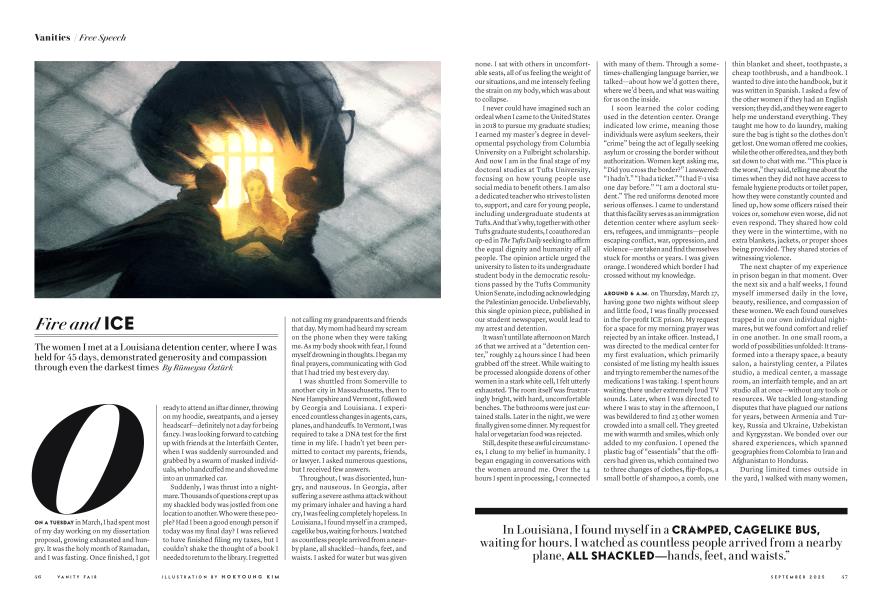
Throughout, I was disoriented, hungry, and nauseous. In Georgia, after suffering a severe asthma attack without my primary inhaler and having a hard cry, I was feeling completely hopeless. In Louisiana, I found myself in a cramped, cagelike bus, waiting for hours. I watched as countless people arrived from a nearby plane, all shackled—hands, feet, and waists. I asked for water but was given none. I sat with others in uncomfortable seats, all of us feeling the weight of our situations, and me intensely feeling the strain on my body, which was about to collapse.
I never could have imagined such an ordeal when I came to the United States in 2018 to pursue my graduate studies; I earned my master's degree in developmental psychology from Columbia University on a Fulbright scholarship. And now I am in the final stage of my doctoral studies at Tufts University, focusing on how young people use social media to benefit others. I am also a dedicated teacher who strives to listen to, support, and care for young people, including undergraduate students at Tufts. And that's why, together with other Tufts graduate students, I coauthored an op-ed in The Tufts Daily seekingto affirm the equal dignity and humanity of all people. The opinion article urged the university to listen to its undergraduate student body in the democratic resolutions passed by the Tufts Community Union Senate, including acknowledging the Palestinian genocide. Unbelievably, this single opinion piece, published in our student newspaper, would lead to my arrest and detention.
It wasn't until late afternoon on March 26 that we arrived at a "detention center," roughly 24 hours since I had been grabbed off the street. While waiting to be processed alongside dozens of other women in a stark white cell, I felt utterly exhausted. The room itself was frustratingly bright, with hard, uncomfortable benches. The bathrooms were just curtained stalls. Later in the night, we were finally given some dinner. My request for halal or vegetarian food was rejected.
Still, despite these awful circumstances, I clung to my belief in humanity. I began engaging in conversations with the women around me. Over the 14 hours I spent in processing, I connected with many of them. Through a sometimes-challenging language barrier, we talked—about how we'd gotten there, where we'd been, and what was waiting for us on the inside.
I soon learned the color coding used in the detention center. Orange indicated low crime, meaning those individuals were asylum seekers, their "crime" being the act of legally seeking asylum or crossing the border without authorization. Women kept asking me, "Did you cross the border?" I answered: "ihadn't." "I had a ticket." "ihad F-ivisa one day before." "I am a doctoral student." The red uniforms denoted more serious offenses. I came to understand that this facility serves as an immigration detention center where asylum seekers, refugees, and immigrants—people escaping conflict, war, oppression, and violence—are taken and find themselves stuck for months or years. I was given orange. I wondered which border I had crossed without my knowledge.
AROUND 6 A.M. on Thursday, March 27, having gone two nights without sleep and little food, I was finally processed in the for-profit ICE prison. My request for a space for my morning prayer was rejected by an intake officer. Instead, I was directed to the medical center for my first evaluation, which primarily consisted of me listing my health issues and trying to remember the name s of the medications I was taking. I spent hours waiting there under extremely loud TV sounds. Later, when I was directed to where I was to stay in the afternoon, I was bewildered to find 23 other women crowded into a small cell. They greeted me with warmth and smiles, which only added to my confusion. I opened the plastic bag of "essentials" that the officers had given us, which contained two to three changes of clothes, flip-flops, a small bottle of shampoo, a comb, one thin blanket and sheet, toothpaste, a cheap toothbrush, and a handbook. I wanted to dive into the handbook, but it was written in Spanish. I asked a few of the other women if they had an English version; they did, and they were eager to help me understand everything. They taught me how to do laundry, making sure the bag is tight so the clothes don't get lost. One woman offered me cookies, while the other offered tea, and they both sat down to chat with me. "This place is the worst," they said, telling me about the times when they did not have access to female hygiene products or toilet paper, how they were constantly counted and lined up, how some officers raised their voices or, somehow even worse, did not even respond. They shared how cold they were in the wintertime, with no extra blankets, jackets, or proper shoes being provided. They shared stories of witnessing violence.
The next chapter of my experience in prison began in that moment. Over the next six and a half weeks, I found myself immersed daily in the love, beauty, resilience, and compassion of these women. We each found ourselves trapped in our own individual nightmares, but we found comfort and relief in one another. In one small room, a world of possibilities unfolded: It transformed into a therapy space, a beauty salon, a hairstyling center, a Pilates studio, a medical center, a massage room, an interfaith temple, and an art studio all at once—without any tools or resources. We tackled long-standing disputes that have plagued our nations for years, between Armenia and Turkey, Russia and Ukraine, Uzbekistan and Kyrgyzstan. We bonded over our shared experiences, which spanned geographies from Colombia to Iran and Afghanistan to Honduras.
During limited times outside in the yard, I walked with many women, listening to their stories. Among us was a singer with almost a million followers, a talented violinist, a Pilates instructor, a visual arts teacher, a devoted mom, a loving grandmother, and a woman with a passion for arranging flowers. Someone's best friend. Someone's fiancee. Someone's wife. Someone's daughter. An aunt. A human rights activist. A human, like all of us, with a heart. And me, a very confused international doctoral student.
In Louisiana, I found myself in a CRAMPED, CAGELIKE BUS, waiting for hours. I watched as countless people arrived from a nearby plane, ALL SHACKLED—hands, feet, and waists."
A Catholic friend told me: "EVEN GOD CANNOT HEAR US HERE." She prayed night and day just the same.
Although I was comforted by the women around me, every day resembled a new chapter from Lemony Snicket's A Series of Unfortunate Events. We stumbled upon frogs, crawfish, snakes, and bugs in the yard and were ridiculed by some officers for being afraid. The temperatures in Louisiana were scorching. Our yard time was limited. We constantly faced a choice between the fresh air and shielding ourselves from the sun. In stark contrast, our room felt freezing. To find some relief, we heated plastic water bottles and used them as mini heaters.
Tve had asthma for several years, but Tve never suffered from it like I did in detention, given the damp, dusty, and overcrowded conditions. Once, when I suffered a severe asthma attack, the officers did not respond until many women began banging on the windows to get their attention. Afterward, I was not even allowed to take a few minutes of fresh air, being told that it was a risk to the officers' safety.
When our requests for care went unanswered by the medical center, we leaned on each other for support. One time, my friend had a severe allergic reaction and her entire eye became red and itchy. Despite her numerous requests for permission to visit the medical center, she was never given the help we pleaded for. In a desperate attempt to assist her, I used black tea bags on her eyelids to try to reduce the swelling. From cancer to colds to women's diseases, ibuprofen was the magical pill the medical staff offered. My friends had to wait for emergency help for a long time, sometimes for days. Other women shared that they had given up on seeking help, deciding it was better to endure severe health consequences than to visit that center and be treated inhumanely. Some of the medical staff would raise their voices at us. They'd say things like, "You're giving me a headache," "Why are you always coming during my shift?" and " I'm not giving you anything." When I asked questions, they responded that they couldn't "babysit" me. Many women said that the medical staff did not believe they were sick. They shared how, upon arrival, they were in relatively good health, but their conditions deteriorated day by day due to inadequate access to medical care, nutritious food, sleep, sunlight, and fresh air. They experienced lapses in menstruation, declining mental health, and even hair loss due to overwhelming stress. We worried about our friends with wheelchairs, cancer, a deaf friend, and friends with serious chronic illnesses such as diabetes.
We rarely got a proper night's rest. For the first time in my life, I realized that sleep—real sleep—is actually a luxury. The constant glare of fluorescent lighting made it almost impossible to doze off. Many officers marched through the area loudly, their chains and keys clattering, waking us at night with the booming sound of their walkie-talkies (except one officer, whom we frequently thanked for holding her key and chains so the sound would not disrupt us). All we wante d was uninterrupted, peaceful sleep.
IN THE EARLY days of my detention, I had no access to the commissary and was growing hungry and desperate as staff did not honor my request for a meal that met my dietary restrictions for many hours. But my friends generously stepped in to feed me. I remember us sharing two cookies or a package of snacks among many women in the room. My friends offered essentials like toilet paper and shampoo and generously lent me their pens and a few sheets of paper since I had none of my own. Women there reported that they "voluntarily" worked four to five hours in the kitchen for $3 per day and in the laundry, commissary, intake, and library for $1 per day.
Meals in the dining hall mainly comprised an overwhelming amount of beans, accompanied by some undercooked rice, highly processed bread, and sometimes a rather unappetizing salad. On rare occasions, we'd get a tiny serving of canned fruit; fresh fruit was rare. We had to rely on instant oatmeal and noodles just to feel full. All these dining experiences left us grappling with digestion issues and persistent stomachaches. We were constantly worried about the pregnant women among us.
All we wanted was to be seen as human again. We felt invisible, stripped of our identity as breathing and living human beings. One morning, we were head-counted seven times in the span of a few hours and woken up from our sleep to be lined up. During head counts, we communicated with our eyes, rejecting the dehumanization and silently agreeing that this is brutal. We longed to be recognized as more than just numbers, no longer reduced to figures in orange uniforms. An Armenian woman I considered an aunt asked me every time I saw her, "Riimeysa, please write about us. Please let the world hear our story." I am keeping my promise, Auntie. She spoke of the painful separations of mothers from their children and families. "I have three kids, and it's tough to get by each day." Many women wept day and night, longing for their families. My friends showed me letters from their young children, accompanied by sweet photos of them and mischievous pictures of their pets. Some of the children are in their home countries; some are waiting in different states with other caregivers; and others have been taken into the foster care system. I learned that women have even been separated from their babies after giving birth. I learned about miscarriages with heartbreak.
In my conversations with women there, I listened to stories of long journeys to the border that involved planes, buses, and boats. I heard tales of people who lost their lives at sea and those who climbed steep hills far away in search of safety. I heard about human beings who walked without food and water for many days. Many shared their experiences of escaping war, conflict, and violence, revealing a painful reality where they exchanged one form of oppression for another. A Catholic friend told me: "Even God cannot hear us here." She prayed night and day just the same. I asked her if it was God who could not hear us, or if it was people like
me before this experience, who either know nothing about the immigration detention system or prefer to ignore or forget about it.
Within this despair, we found small joys in life, like feeding the birds, finding their nests, and hearing them chirp—a reminder of our freedom and the better days to come. Friends made small decorations using bread as clay. They made colorful necklaces and bracelets from plastic commissary bags. Aunts from Russia warmly greeted me with kisses on the cheek, while friends from Georgia gifted me beautiful bracelets and colorful plastic necklaces made with their bare hands. I chuckled as my new friends from around the world playfully offered up their unaware brothers as potential husbands. Friends from Senegal enveloped me in warm hugs, and friends from Cameroon shared the recipes of their favorite regional dishes, promising to cook me fufu and eru—one day, when we are free.
[In response to questions from Yanit)) Fair about Oztiirk's experience, GEO Group, which runs the
Louisiana processing center where she was detained, said in a statement that its "support services are monitored by ICE, including by on-site agency personnel, and other organizations within the Department of Homeland Security to ensure strict compliance with ICE detention standards." GEO added that its "facilities are never overcrowded," and that its support services include "around-the-clock access to medical care"—physicians, nurses, dentists, psychologists, and psychiatrists—"in-person and virtual legal and family visitation, general and legal library access, translation services, dietician-approved meals, religious and specialty diets, recreational amenities, and opportunities to practice their religious beliefs."]
THE DAY BEFORE my bail hearing in early May, I shared with a few of my friends that I felt like I might be released. That night, I tucked a short letter for them to find under my bed, expressing my gratitude to each of these women for being the wonderful people they are: compassionate, kind, and remarkable individuals despite the countless challenges we faced. They held onto their dignity and humanity while making a conscious choice to be caring and loving. They uplifted each other, staying strong even when the circumstances were unimaginably challenging. I learned from these strong women what solidarity looks like.
Now I am back in Massachusetts, and I am heartbroken, knowing that each day ahead will continue to be a nightmare for them. No one deserves to live in cramped, unsanitary, inhumane conditions and have their medical needs ignored. No one deserves to have their religious needs ignored. And no one deserves to lack access to nutritious food. I am free, but my true freedom is interlinked with the freedom of many women I lived alongside in ICE prison. As a "detainee," I not only endured my struggles but also had the privilege of connecting with remarkable women who shared their stories with me. Their experiences opened my eyes to a new realm of humanitarian crisis, expanding the circle of grief and compassion in my heart.
Subscribers have complete access to the archive.
Sign In Not a Subscriber?Join Now


