
Sign In to Your Account
Subscribers have complete access to the archive.
Sign In Not a Subscriber?Join NowPUBLIC CONSCIENCE AND THE STAGE
The Tendency of Many Recent Dramatic Presentations Seems to Indicate an Awakening in Matters of Vital Public Importance
LOUIS SHERWIN
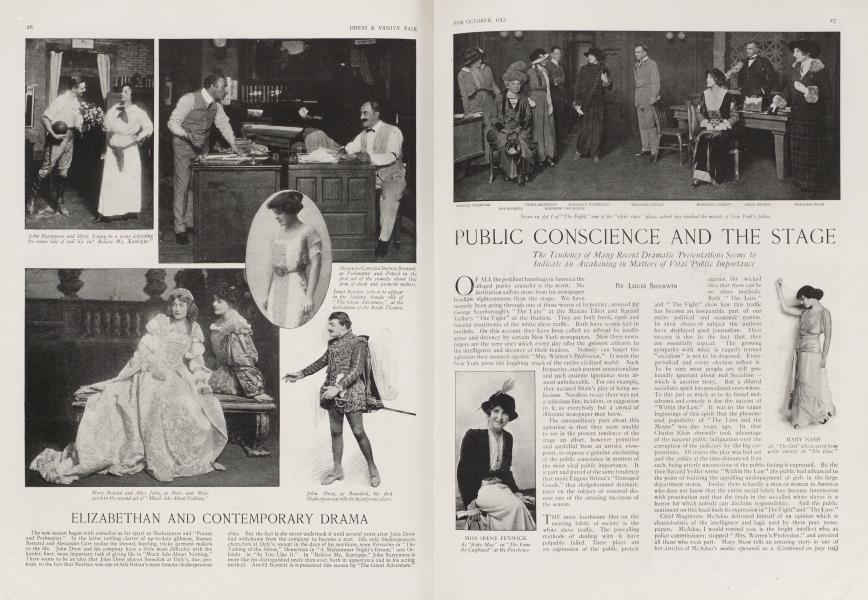
OF ALL the pestilent humbugs in America the alleged purity crusader is the worst. No institution suffers more from his newspaper headline righteousness than the stage. We have recently been going through one of those waves of hypocrisy, aroused by George Scarborough's "The Lure" at the Maxine Elliot and Bayard Veiller's "The Fight" at the Hudson. They are both frank, open and forceful treatments of the white slave traffic. Both have scenes laid in brothels. On this account they have been called an affront to intelligence and decency by certain New York newspapers. Now these newspapers are the very ones which every day offer the grossest affronts to the intelligence and decency of their readers. Nobody can forget the agitation they aroused against "Mrs. Warren's Profession." It made the New York press the laughing stock of the entire civilized world. Such hypocrisy, such purient sensationalism and such assinine ignorance were almost unbelievable. For one example, they accused Shaw's play of being salacious. Needless to say there was not a salacious line, incident, or suggestion in it, as everybody but a crowd of illiterate newspaper men knew.
The extraordinary part about this agitation is that they seem unable to see in the present tendency of the stage an effort, however primitive and unskilful from an artistic viewpoint, to express a genuine awakening of the public conscience in matters of the most vital public importance. It is part and parcel of the same tendency that made Eugene Brieux's" Damaged Goods," that sledgehammer dramatic tract on the subject of venereal disease one of the amazing successes of the season.
THE most loathsome blot on the existing fabric of society is the white slave traffic. The prevailing methods of dealing with it have palpably failed. These plays are an expression of the public protest
against the wicked idea that there can be no other methods. Both " The Lure " and "The Fight" show how this traffic has become an inseparable part of our entire political and economic system. In their choice of subject the authors have displayed good journalism. Their success is due to the fact that they are essentially topical. The growing sympathy with what is vaguely termed "socialism" is not to be disputed. Every periodical and every election reflect it. To be sure most people are still profoundly ignorant about real Socialism — which is another story. But a diluted socialistic spirit has percolated everywhere. To this just as much as to its broad melodrama and comedy is due the success of "Within the Law." It was to the vague beginnings of this spirit that the phenomenal popularity of "The Lion and the Mouse" was due years ago. In that Charles Klein shrewdly took advantage of the nascent public indignation over the corruption of the judiciary by the big corporations. Of course the play was bad art and the critics at the time denounced it as such, being utterly unconscious of the public feeling it expressed. By the time Bayard Veiller wrote "Within the Law" the public had advanced to the point of realizing the appalling underpayment of girls in the large department stores. To-day there is hardly a man or woman in America who does not know that the entire social fabric has become interwoven with prostitution and that the trade in the so-called white slaves is a horror for which nobody can disclaim responsibility. And the public sentiment on this head finds its expression in"The Fight"and "The Lure."
Chief Magistrate McAdoo delivered himself of an opinion which is characteristic of the intelligence and logic used by these pure newspapers. McAdoo, I would remind you, is the bright intellect who, as police commissioner, stopped " Mrs. Warren's Profession," and arrested all those who took part. Mary Shaw tells an amusing story in one of her articles of McAdoo's modus operandi as a censor of morals. At a critical moment in the play Miss Shaw glanced anxiously up at the good police commissioner's box to see how it was affecting him. McAdoo was fast asleep.
(Continued on page 102)
(Continued from page 27)
This is an excerpt of what he says anent "The Fight" and "The Lure"; "We do not need to uncover a sewer to convince people as to its filthiness, nor to warn those of ordinarily cleanly habits against getting into it." The analogy is absolutely unfair. A sewer is a necessary evil to carry off impurities. According to right minded people the brothel and the traffic in white slaves which recruits it are unnecessary evils. They may be necessary to Tammany and the pious minded gentry who lead that worthy institution. Mr. McAdoo, if I am not mistaken, is a Tammany man.
Furthermore our good magistrate has entirely missed the point of these plays. The purpose is not to show that brothels exist but to remind people as forcibly as possible that they exist by direct alliance with the big political machines and that they are recruited by the direct connivance of the leaders of those machines.
THE extremes to which this antiPuritan reaction is tending were only to be expected. For more than one hundred years the Puritan appeared to have a stranglehold on the American theatre. For more than one hundred years our drama was the most insipid, effeminate mass of feeble rubbish ever concocted since the invention of the stage. The rule of the Puritan had the baffling paradoxic effect of encouraging pornographic levity and throttling everything sincere and serious. To this condition the newspapers contributed freely with their "purity crusades" like that of last month. And of course the advertisement-hungry parson always adds his bray to the tumult.
HAD you observed the attitude of any audience at the Maxine Elliott you would have realized in ten minutes that the appeal of George Scarborough's piece is to the better instincts of the public — its sympathy with the unfortunate, its resentment of injustice. Line after line is applauded as no political speaker is ever applauded. Serious lines, mind you — some of them claptrap, some genuine, but all sincere in intent. Of course a few ribald spirits are always present, but always as surely suppressed.
The theme of the piece is the affiliation of the white slave traffic with the crapulous political machinery that grows naturally out of a wrong economic system. The district leader — himself an exmaquereau and owner of the brothel — is conspicuous throughout. The pious landlord and the greedy plutocrat are not actually seen. But their presence is felt just the same. "The Lure" is essentially melodrama in pattern. It has a slight suggestion of "Widowers' Houses" about it. The virtuous heroine is an underpaid department store girl. She has been laid off at the very moment when her mother is most in need of expensive drugs and change of air. Sylvia, the girl, talks of answering the advertisement of a Mrs. Catherine Lockwood offering employment during evening hours. From a secret service agent we learn that Mrs. Catherine Lockwood is the manager of a notorious disorderly house. (This information is imparted, of course, while the girl is out of the room.) The secret service agent's excuse for appearing in their tenement is that he is pursuing some white slavers whose headquarters are in the neighboring building. The second act takes place in Mrs. Lockwood's establishment. There we learn that one of the recent recruits has just committed suicide. She was the daughter of a Springfield banker who had been lured there by Paul, the piano-player and cadet of the house. The real owner of the place is McGuire, the district leader. This part of the act is not so germane to the plot. But it has the useful effect of alarming the complacent souls among the well-to-do bourgeois who have hitherto imagined that their daughters at least were safe and so they needed not to worry about it.
Sylvia appears in answer to the advertisement. When she realizes the nature of the employment offered her, she tries to go. But the female pander persuades her that her refusal to become a prostitute would be the cause of her mother's death. So the girl goes upstairs and puts on the gown that is laid out for her. The secret service agent comes in under the alias of a gas inspector. He is horrified to find Sylvia with whom he had already fallen in love. He harangues her and brings her to her senses. She rushes upstairs again, puts on her own dress and is about to leave when the cadet of the house stops her on the threshold. He is about to manhandle her. She splinters a beer bottle and sets about protecting herself with the jagged edges. Then the brothel keeper catches her from behind and the heroine is on the verge of being choked when in breaks the secret service agent who rescues both Sylvia and one of the cadet's other victims. In the last act both cadet and district leader are trapped and marched off to jail handcuffed together.
There is not a sentence in "The Lure" that is offensive to any intelligent person. The speech in which the "madam" bitterly refers to the "pious landlords who preach against us and charge us double rent" never fails to arouse a cheer of sympathy. The allusions to the connection between the Tammany leader in his "respectable" home and the procurer in his brothel are applauded as intensely as a Socialist speech in Clinton Hall.
N "THE FIGHT" Bayard Veiller makes the same use of concrete dramatic action to show that filthy politics and business are not only interwoven with but supported by prostitution. The keynote of the play is delivered in the speech in which Senator Woodford explains to Jane Thomas why he has been obliged to come all the way from Washington to prevent her election as mayor of a small Colorado town. " We can't let you win because it would shake the foundations of the party. When a contractor builds a house he has to go down into the muck and sink his foundations there. So it is with a political party. The local boss stands upon the shoulders of the ward heeler and cadet, the statesman on the shoulders of the boss. We in Washington are afraid to look down for fear of seeing what we are standing on."
The fight against Jane Thomas's candidacy is the sort of conflict that is constantly going on in any town in the United States. But with particular bitterness and cowardice in small towns. "The town's all right, let it alone: you're hurting business" say her friends and the Chamber of Commerce committee. The usual cuckoo cry. "Oh is it?" she replies. "Then look at this." She shows them a small, grimy, ill-nourished child who works eleven hours a day in the jute mills for $2 a week. She shows them a prostitute who lives in a brothel just six doors from the main street. "Now, gentlemen, is the town all right?" she asks.
THE second act takes place in the aforesaid brothel. The pander who runs it is asked by a ward heeler to procure a young girl for a mysterious degenerate "customer" who will pay $500. The woman sees a pretty girl in the street, sends the piano player out to insult her, then entices her into the house under the pretext of protecting her. When the child enters she is seen to be the senator's daughter. She is locked up in a room off stage. Then Jane Thomas rushes in. She has heard of the outrage and comes to rescue the victim. The brothel keeper defies her to search the house. While Jane is doing so the mysterious degenerate enters. It is the girl's father! He is given the key, unlocks the door with a lascivious grin, then recoils in horror as his own daughter rushes into his arms crying "Oh father, I knew you'd come for me." Jane Thomas reappears in time to catch the drift of the scene. Threatened with exposure, the senator turns on the woman who had tried to rescue his child. He promises to besmirch her name and drag her through the mire. (When this speech was delivered one night a voice from the gallery called: "That's what Murphy is doing to New York!" So you may judge in what spirit this play is received.) In fact he accuses Jane Thomas of having decoyed his daughter into the brothel.
THIS father and daughter incident is also used in a play called "Tiger," by Witter Bynner, recently published. Another variant of it also served in "Any Night," a gruesome little tragedy performed at the Princess Theatre. This act has since been eliminated from "The Fight" as the management decided to bow to the paper storm.
The third act of "The Fight" is by far the best, theatrically speaking. In this Jane stops the run on her bank by means of the now celebrated trick of calming the frenzied depositors by the sight of money bags filled with iron washers. This run is caused by a conspiracy among her political enemies. In the end she not only saves the bank but wins the election by means of a deus ex machina in the person of the Irish saloonkeeper-boss who turns upon the Senator for pious reasons.
Of course "The Fight" is melodrama and frequently crude. But it has the merit of a big topical theme and a big purpose. The one speech of the Senator alone redeems it from cheap triviality.
DAMAGED GOODS" is only mentioned in the same breath with these plays because its absolutely unexpected success was due to the same awakening of the public conscience on topics hitherto treated with hypocritical silence. Theatregoers and readers are by now so familiar with its overwhelming sermon on the unacknowledged perils of venereal disease that I shall not attempt to describe it at length. A million editorials could not have the homiletic force that Brieux has attained in showing us the wreck of an entire family by the criminal carelessness of a young man who ignores the danger of the horrible disease he has caught and marries despite the doctor's most solemn warning. The purpose of this play is purer, its workmanship finer and its sincerity infinitely more unassailable than any of these contemporary melodramas; for they have entire passages and incidents not free from buncombe and theatrical claptrap. There has been no more deliberate sacrifice of all rules of play-writing, all considerations of profit, all attempt at stagey effects than Brieux made in "Damaged Goods." And Brieux's reward has been the achievement of a work of intense dramatic power and sociological importance, the respect of all intelligent people and a quite tidy and wholly unanticipated financial guerdon into the bargain.
Subscribers have complete access to the archive.
Sign In Not a Subscriber?Join Now

