Sign In to Your Account
Subscribers have complete access to the archive.
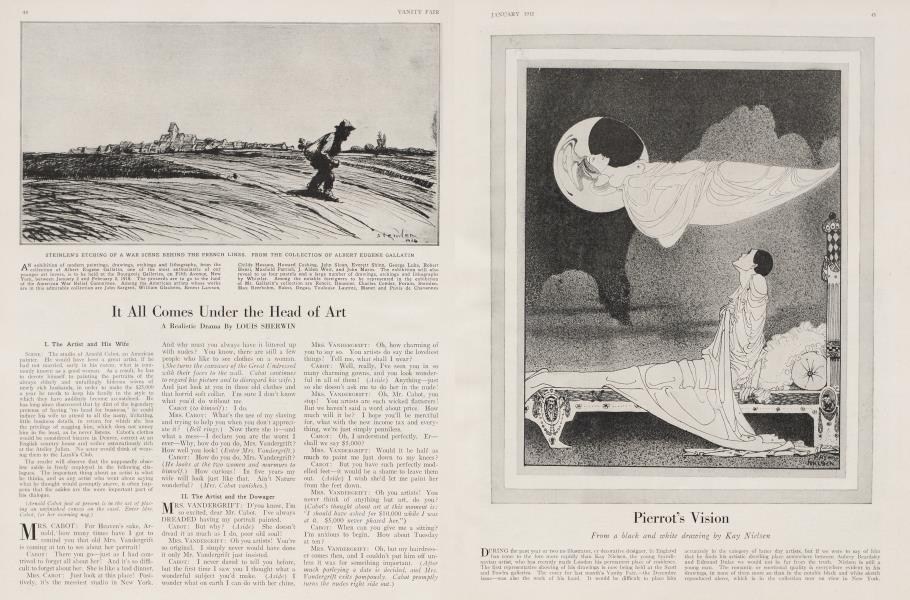
Sign In Not a Subscriber?Join NowIt All Comes Under the Head of Art
LOUIS SHERWIN
AN exhibition of modern paintings, drawings, etchings and lithographs, from the collection of Albert Eugene Gallatin, one of the most enthusiastic of our younger art lovers, is to be held at the Bourgeois Galleries, on Fifth Avenue, New York, between January 2 and February 2, 1918. The proceeds are to go to the fund of the American War Relief Committee. Among the American artists whose works are in this admirable collection are John Sargent, William Glackens, Ernest Lawson, Childe Hassam, Howard Cushing, John Sloan, Everett Shinn, George Luks, Robert Henri, Maxfield Parrish, J. Alden Weir, and John Marin. The exhibition will also reveal to us four pastels and a large number of drawings, etchings and lithographs by Whistler. Among the notable foreigners to be represented in the exhibition of Mr. Gallatin's collection are Renoir, Daumier, Charles Conder, Forain, Steinlen, Max Beerbohm, Bakst, Degas, Toulouse Lautrec, Manet and Puvis de Chavannes
I. The Artist and His Wife
SCENE: The studio of Arnold Cabot, an American painter. He would have been a great artist, if he had not married, early in his career, what is commonly known as a good woman. As a result, he has to devote himself to painting the portraits of the always elderly and unfailingly hideous wives of newly rich husbands, in order to make the $25,000 a year he needs to keep his family in the style to which they have suddenly become accustonied. He lias long since discovered that by dint of the legendary pretense of having "no head for business," he could induce his wife to attend to all the nasty, irritating, little business details, in return for which she has the privilege of nagging him, which does not annoy him in the least, as lie never listens. Cabot's clothes would be considered bizarre in Denver, correct at an English country house and rather ostentatiously rich at the Atelier Julien. No actor would think of wearing them to the Lamb's Club.
The reader will observe that the supposedly obsolete aside is freely employed in the following dialogues. The important thing about an artist is what he thinks, and as any artist who went about saying what he thought would promptly starve, it often happens that the asides arc the more important part of his dialogue.
(Arnold Cabot just at present is in the act of placing an unfinished canvas on the easel. Enter Mrs. Cabot, for her morning nag.)
MRS. CABOT: For Heaven's sake, Arnold,'how many times have I got to remind you that old Mrs. Vandergrift is coming at ten to see about her portrait!
CABOT: There you go—just as I had contrived to forget all about her! And it's so difficult to forget about her. She is like a bad dinner.
MRS. CABOT: Just look at this place! Positively, it's the messiest studio in New York.
And why must you always have it littered up with nudes? You know, there are still a few people who like to see clothes on a woman. (She turns the canvases of the Great Undressed with their faces to the wall. Cabot continues to regard his picture and to disregard his wife.) And just look at you in those old clothes and that horrid soft collar. I'm sure I don't know what you'd do without me.
CABOT (to himself): I do.
MRS. CABOT: What's the use of my slaving and trying to help you when you don't appreciate it? (Bell rings.) Now there she is—and what a mess—I declare you are the worst I ever—Why, how do you do, Mrs. Vandergrift? How well you look! {Enter Mrs. Vandergrift.)
CABOT: HOW do you do, Mrs. Vandergrift? (He looks at the two women and murmurs to himself.) How curious! In live years my wife will look just like that. Ain't Nature wonderful? {Mrs. Cabot vanishes.)
II. The Artist and the Dowager
MRS. VANDERGRIFT: D'you know, I'm so excited, dear Mr. Cabot. I've always DREADED having my portrait painted.
CABOT: But why? {Aside) She doesn't dread it'as much as I do, poor old soul!
MRS. VANDERGRIFT: Oh you artists! You're so original. I simply never would have done it only Mr. Vandergrift just insisted.
CABOT: I never dared to tell you before, but the first time I saw you I thought what a wonderful subject you'd make. {Aside) I wonder what on earth I can do with her chins.
MRS. VANDERGRIFT: Oh, how charming of you to say so. You artists do say the loveliest things! Tell me, what shall I wear?
CABOT: Well, really, I've seen you in so many charming gowns, and you look wonderful in all of them! {Aside) Anything—just so she doesn't ask me to do her in the nude!
MRS. VANDERGRIFT: Oh, Mr. Cabot, you stop! You artists are such wicked flatterers! But we haven't said a word about price. How much will it be? I hope you'll be merciful for, what with the new income tax and everything, we're just simply penniless.
CABOT: Oh, I understand perfectly. Er— shall we say $5,000?
MRS. VANDERGRIFT: Would it be half as much to paint me just, down to my knees?
CABOT: But you have such perfectly modelled feet—it would be a shame to leave them out. {Aside) I wish she'd let me paint her from the feet down.
MRS. VANDERGRIFT: Oh you artists! You never think of anything but art, do you? {Cabot's thought about art at this moment is: "I should have asked for $10,000 while I was at it. $5,000 never phased her.")
CABOT: When can you give me a sitting? I'm anxious to begin. How about Tuesday at ten?
MRS. VANDERGRIFT: Oh, but my hairdresser comes then, and I couldn't put him off unless it was for something important. {After much parleying a date is decided, and Mrs. Vandergrift exits pompously. Cabot promptly turns the nudes right side out.)
Subscribers have complete access to the archive.
Sign In Not a Subscriber?Join Now