
Sign In to Your Account
Subscribers have complete access to the archive.
Sign In Not a Subscriber?Join NowThe Proper Way to Use a Club
With a Suggestion as to How to Plan a War in a Club Bar
GEORGE S. CHAPPELL
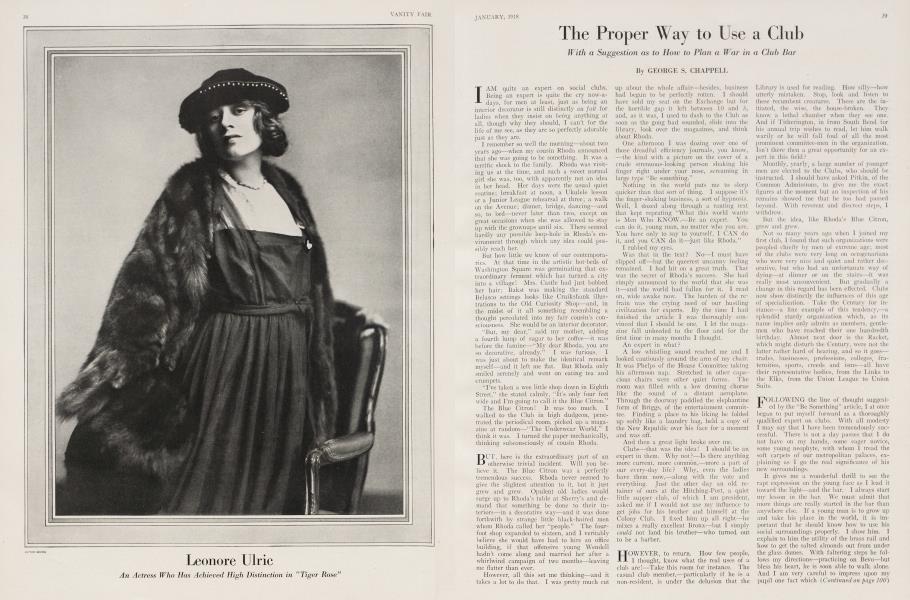
I AM quite an expert on social clubs. Being an expert is quite the cry nowadays, for men at least, just as being an interior decorator is still distinctly au fait for ladies when they insist on being anything at all, though why they should, I can't for the life of me see, as they are so perfectly adorable just as they are.
I remember so well the morning—about two years ago—when my cousin Rhoda announced that she was going to be something. It was a terrific shock to the family. Rhoda was visiting us at the time, and such a sweet normal girl she was, too, with apparently not an idea in her head. Her days were the usual quiet routine; breakfast at noon, a Ukulele lesson or a Junior League rehearsal at three; a walk on the Avenue; dinner, bridge, dancing—and so, to bed—never later than two, except on great occasions when she was allowed to stay up with the grownups until six. There seemed hardly any possible loop-hole in Rhoda's environment through which any idea could possibly reach her.
But how little we know of our contemporaries. At that time in the artistic hot-beds of Washington Square was germinating that extraordinary ferment which has turned a city into a village! Mrs. Castle had just bobbed her hair; Bakst was making the standard Belasco settings looks like Cruikshank illustrations to the Old Curiosity Shop—and, in the midst of it all something resembling a thought percolated into my fair cousin's consciousness. She would be an interior decorator.
"But, my dear," said my mother, adding a fourth lump of sugar to her coffee—it was before the famine—"My dear Rhoda, you are so decorative, already." I was furious. I was just about to make the identical remark myself—and it left me flat. But Rhoda only smiled serenely and went on eating tea and crumpets.
"I've taken a wee little shop down in Eighth Street," she stated calmly, "It's only four feet wide and I'm going to call it the Blue Citron."
The Blue Citron! It was too much. I walked to the Club in high dudgeon, penetrated the periodical room, picked up a magazine at random—"The Underwear World," I think it was. I turned the paper mechanically, thinking subconsciously of cousin Rhoda.
BUT, here is the extraordinary part of an otherwise trivial incident. Will you believe it. The Blue Citron was a perfectly tremendous success. Rhoda never seemed to give the slightest attention to it, but it just grew and grew. Opulent old ladies would surge up to Rhoda's table at Sherry's and demand that something be done to their interiors—in a decorative way—and it was done forthwith by strange little black-haired men whom Rhoda called her "people." The fourfoot shop expanded to sixteen, and I veritably believe she would have had to hire an office building, if that offensive young Wendell hadn't come along and married her after a whirlwind campaign of two months—leaving me flatter than ever.
However, all this set me thinking—and it takes a lot to do that. I was pretty much cut up about the whole affair—besides, business had begun to be perfectly rotten. I should have sold my seat on the Exchange but for the horrible gap it left between 10 and 3, and, as it was, I used to dash to the Club as soon as the gong had sounded, slide into the library, look over the magazines, and think about Rhoda.
One afternoon I was dozing over one of those dreadful efficiency journals, you know, —the kind with a picture on the cover of a crude strenuous-looking person shaking his finger right under your nose, screaming in large type "Be something."
Nothing in the world puts me to sleep quicker than that sort of thing. I suppose it's the finger-shaking business, a sort of hypnosis. Well, I dozed along through a ranting text that kept repeating "What this world wants is Men Who KNOW.—Be an expert. You can do it, young man, no matter Who you are. You have only to say to yourself, I CAN do it, and you CAN do it—just like Rhoda."
I rubbed my eyes.
Was that in the text? No—I must have slipped off—but the queerest uncanny feeling remained. I had hit on a great truth. That was the secret of Rhoda's success. She had simply announced to the world that she was it—and the world had fallen for it. I read on, wide awake now. The burden of the refrain was the crying need of our hustling civilization for experts. By the time I had finished the article I was thoroughly convinced that I should be one. I let the magazine fall unheeded to the floor and for the first time in many months I thought.
An expert in what?
A low whistling sound reached me and I looked cautiously around the arm of my chair. It was Phelps of the House Committee taking his afternoon nap. Stretched in other capa-cious chairs were other quiet forms. The room was filled with a low droning chorus like the sound of a distant aeroplane. Through the doorway paddled the elephantine form of Briggs, of the entertainment committee. Finding a place to his liking he folded up softly like a laundry bag, held a copy of the New Republic over his face for a moment and was off.
And then a great light broke over me.
Clubs—that was the idea! I should be an expert in them. Why not?—Is there anything more current, more common,—more a part of our every-day life? Why, even the ladies have them now,—along with the vote and everything. Just the other day an old retainer of ours at the Hitching-Post, a quiet little supper club, of which I am president, asked me if I would not use my influence to get jobs for his brother and himself at the Colony Club. I fixed him up all right—he mixes a really excellent Bronx—but I simply could not land his brother—who turned out to be a barber.
HOWEVER, to return. How few people, I thought, know what the real uses of a club are!—Take this room for instance. The casual club member,—particularly if he is a non-resident, is under the delusion that the Library is used for reading. How silly—how utterly mistaken. Stop, look and listen to these recumbent creatures. These are the initiated, the wise, the house-broken. They know a lethal chamber when they see one. And if Titherington, in from South Bend for his annual trip wishes to read, let him walk warily or he will fall foul of all the most prominent committee-men in the organization. Isn't there then a great opportunity for an expert in this field?
Monthly, yearly, a large number of younger men are elected to the Clubs, who should be instructed. I should have asked Pitkin, of the . Common Admissions, to give me the exact figures at the moment but an inspection of his remains showed me that he too had passed beyond. With reverent and discreet steps, I withdrew.
But the idea, like Rhoda's Blue Citron, grew and grew.
Not so many years ago when I joined my first club, I found that such organizations were peopled chiefly by men of extreme age; most of the clubs were very long on octogenarians who were very nice and quiet and rather decorative, but who had an unfortunate way of dying—at dinner or on the stairs—it was really most unconvenient. But gradually a change in this regard has been effected. Clubs now show distinctly the influences of this age of specialization. - Take the Century for instance—a fine example of this tendency,—a splendid sturdy organization which, as its name implies only admits as members, gentlemen who have reached their one hundredth birthday. Almost next door is the Racket, which might disturb the Century, were not the latter rather hard of hearing, and so it goes— trades, businesses, professions, colleges, fraternities, sports, creeds and isms—all have their representative bodies, from the Links to the Elks, from the Union League to Union Suits.
FOLLOWING the line of thought suggested by the "Be Something" article, I at once began to put myself forward as a thoroughly qualified expert on clubs. With all modesty I may say that I have been tremendously successful. There is not a day passes that I do not have on my hands, some eager novice, some young neophyte, with whom I tread the soft carpets of our metropolitan palaces, explaining as I go the real significance of his new surroundings.
It gives me a wonderful thrill to see the rapt expression on the young face as I lead it toward the light—and the bar. I always start my lesson in the bar. We must admit that more things are really started in the bar than anywhere else. If a young man is to grow up and take his place in the world, it is important that he should know how to use his social surroundings properly. I show him. I explain to him the utility of the brass rail and how to get the salted almonds out from under the glass domes. With faltering steps he follows my directions—practicing on Bevo—but bless his heart, he is soon able to walk alone. And I am very careful to impress upon my pupil one fact which has escaped most commentators, namely, that the real use of a bar is not convivial — oh, no! — perish the thought — the important work done in this much maligned refuge is the planning of the great war.
Continued on page 100
Continued from page 39
Only the other day Ramsey of our Library Committee was explaining a wonderful scheme for cracking the Boches' wide opening, which he explained most luminously. "You sec, here is Haig," he said, —as a matter of fact it was Haig-and-Haig—"and this," indicating a peanut, "is the Crown Prince." The thing was really stunningly done, you could see instantly that the peanut didn't have a chance.
THEN there is the Turkish bath where the men take their exercise. After a terrific work-out in the hot room, the members are brought to a boil and served on marble slabs. The exercise is then brought in by sturdy two-fisted males and all the athletes have to do is to lie there and take it.
Again, it has been my good fortune to be of practical assistance in arranging the bachelor-dinner of one of my pupils—where my expert knowledge was invaluable. Dinner was served in one of the Squash Courts, the appropriate red walls of which were hung with tufted mattresses from the adjacent gymnasium.
The inaccessible electric lights behind their stout, wire protections, shed their soft light on a scene of harmless joy,—harmless because there was absolutely nothing there to harm.
How modem and efficient this all is.
PERHAPS I have suggested a few of the details of my splendid vocation. Just one more word and I have done. Not only to the young and inexperienced can I be of assistance. Only last week I proved my value to one of the oldest and most active club men in New York . . . one of the type that has been called the "Club-marine" because he is apt to sink without warning. He telephoned me early one morning at my home. It was evident that he was in great distress. Half an hour later I met him and he poured out his story. It appears that early in his club career he had requested the office to send all notices of entertainments and lectures to his home address, Nutley, N. J., but to mail all house accounts, cancelled vouchers and other evidences of past performances to his office. The entertainment notices were convenient as occasional tickets of leave—for what is more innocently instructive than an evening with Ian Hay or Theodore Roosevelt?—but the other things,—well, of course, you have guessed my plot. A substitute clerk had mixed those babies up and the lion was loose in Nutley,
N. J. Atwater, my poor friend, was trembling like a leaf.
"Open 'em?" he groaned, "of course she opened em . . . She said she thought they were for her! Oh, Boy! There was a stack that thick for December 8th, when I was supposed to be at that Hero Land thing. . . . Some hero, believe me!—she could understand the Bronxes and most of the dinner checks, but did you ever try to explain a combination of orange-blossoms and stingers and blood hounds?"
I shook my head; such a combination could never be explained.
"Then there were telephone calls," Atwater went on, "to absurd numbers,—something or other River— and a taxi to Westchester—eleven dollars and a half, that I haven't the faintest recollection of. . . ."
"One moment," I interrupted, "you suggest something; let us look at the club book."
I turned to the non-resident list. To my delight there was an Atwater among the A's—who lived in Pueblo, Cal. "Always get 'em far off," I explained to my mystified friend. On a sheet of club paper I wrote a note addressed very plainly to Atwater so that his wife would be sure to open it It explained that through a mistake of the mailing clerk, his checks had been sent to Mr. J. D. Atwater of Pueblo, Cal., etc., etc.
I SAW my friend yesterday. His step had all its old spring, his eye its old sparkle.
"George," he said, "I'd run you for president of this organization if I didn't think you were doing a greater work right where you are. But there is one thing I am going to do for you. I am going to arrange a little dinner—à-trois—because I want you to meet a very dear friend of mine, a perfectly heavenly girl,— husband's in Washington most of the time.
"What is the lady's name?" I asked.
"Rhoda Wendell. I hope you'll like her. She's . . ."
"Atwater," I interrupted, "say no more. I am an expert at liking girls named Rhoda."
Subscribers have complete access to the archive.
Sign In Not a Subscriber?Join Now
