Sign In to Your Account
Subscribers have complete access to the archive.
Sign In Not a Subscriber?Join NowMotor Models for the Coming Shows
Some of the Cars for the New Year that Will Make Their Bows in January
THERE is no doubt that the year 1918 will find many problems to solve for the automobile world. The throwing of the resources of the country into war h a s already made it necessary for the Government to indicate that it would require an important percentage of the output of factories now making pleasure vehicles. This commandeering of not by any means resources need result in any serious embarrassment to the automobile companies, as they will be operating to capacity upon other products, but it will, of course, mean a radical reduction in the quantity of passenger automobiles produced.
Notwithstanding this condition, the automobile shows of the new year, that of the National Automobile Chamber of Commerce at the Grand Central Palace opening upon January 5th, and the Automobile Salon opening on January 2d at the Hotel Astor, will show a number, a variety and a degree of perfection of motor-driven passenger vehicles heretofore unparalleled. Both in number of exhibits and in quality of product they will exceed anything previously attempted.
STRIKING mechanical changes will be conspicuous by their absence this year as they were last year, with the single exception of the further development of the steam chassis, which bids fair to prove a magnet to the exhibitions. This type of vehicle, of which more will be said in detail in a later article, has been brought to a state of practical usefulness which indicates that it is to be a most important factor in the motoring of the future. There can be no doubt that engineering opinion has long inclined to the steam-driven vehicle for road use. The difficulty has always been, however, to find a method of applying this form of power without cumbersome apparatus and inherent inconveniences of use. These obstacles have now happily been overcome so that the steam car which will make its bow to the public at the show, will represent an efficiency and convenience of applied power heretofore largely considered unattainable.
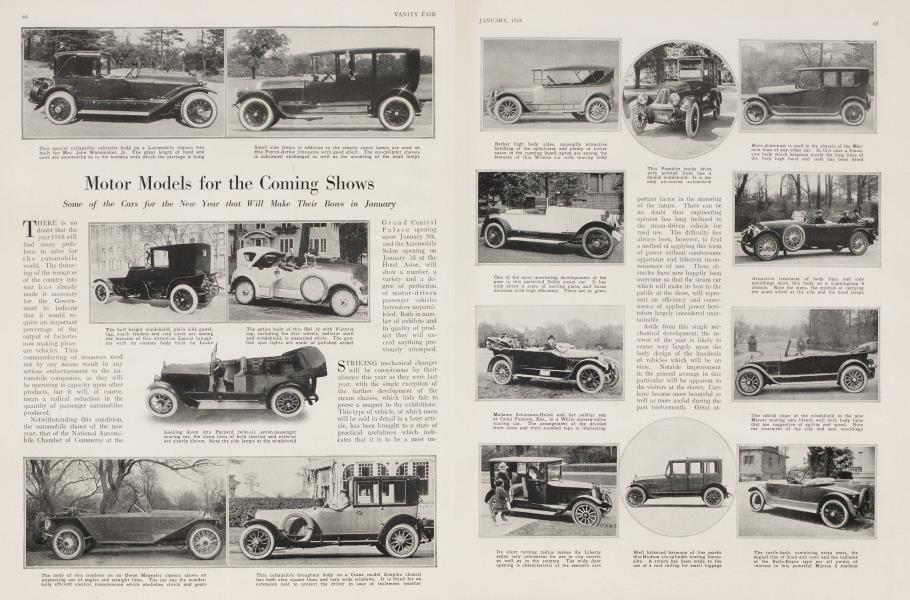
Aside from this single mechanical development, the interest of the year is likely to center very largely upon the body design of the hundreds of vehicles which will be on view. Notable improvement in the general average in this particular will be apparent to the visitors at the shows. Cars have become more beautiful as well as more useful during the past twelve-month. Great attention has been paid to the simplification of line, so that the term "clean lines" is nowapplicable to many more automobiles than it was in the seasons which are past. Great attention has also been concentrated on matters of riding comfort and body design as it is related to the practical use of the vehicle. Wide swinging doors, convenient curtains, quickly convertible bodies, additional protection through the means of tonneau wdnd shields and extension cowls, together with a multitude of small refinements such as step lights, trouble lamps, coat rails, compartments for umbrellas, cigar lighters, and the like, will be the rule rather than the exception in the new cars.
IT cannot be said that many radical departures in body design will bid for public favor during the 1918 show. Rather the changes have been along the lines of refinement and improvement upon designs already familiar. Very many types of convertible bodies will be found among the cars for the coming year: Some of the modifications for this type of body improvement are found in the inside-drive family and are interesting in their ingenuity. In one car, no less than five different types contained in a single body will be found. The number of devices to make the automobile adaptable to use in varying weather conditions and over a wide range of temperatures is also very noticeable.
Among the detailed improvements in what might be called the handling of the car, which will arrest the attention of show visitors, are those which tend to make starting and running more easy in both extremely cold and extremely warm weather. Arrangements for closing or opening the louvres in the hood from the driver's seat fall under this category as do improved priming and super-heating devices to facilitate combustion, in cold weather. Many cars also are fitted with devices for thermostatic control of the operating temperature. The purpose of devices of this kind is to automatically cause the engine to run at the most efficient temperature and control circulation of the water in the cooling system to this end.
ALTHOUGH many of the cars on exhibition at both shows will be treated rather radically as to color scheme, it may be said in general that the tendency of the year is rather toward sober and dignified combinations of tone. The automobile constantly tends to approximate more nearly the elegant carriage of the days when harness horses reigned supreme. With the exception of certain drags and road coaches, it was never good form to have one's carriage ape the peacock in hue and there is no reason why it should be good form to allow the automobile to become conspicuous by reason of its brilliant coloring. Simplicity in color scheme and in the treatment of the interior design is far more in keeping with the dictates of good taste and this quality will be clearly marked in the bodies of the better coach builders which will be on exhibition next month.
The motor carriage of today has reached a very high degree of refinement on the mechanical side. It is a far cry from the uncertain and hazardous vehicles which went by the name of automobiles within the scope of a very brief memory to the dependable, easily operated and altogether responsive motor car which plays so large a part in the activities of life as we know it.
AND if this is true of the mechanical side of the automobile, it is true, in quite as great a degree, perhaps, of the body and arrangements for comfort. It is not at all hard to remember the primitive touring cars of a couple of decades ago, entered by little flights of steps at the back of the body and having a narrow seat on each side. This plan brought the passengers opposite each other, much as they used to sit in the old horse stages on Fifth Avenue. Nor have we forgotten the first limousines,, with narrow doors at the sides and seats so cramped that anyone with more than average length of limb could not possibly ride in comfort. The closed motor carriage of today, on the other hand, is quite as comfortable and often a good deal more convenient than one's rooms. The deep, restful seats make riding a pleasure.
Subscribers have complete access to the archive.
Sign In Not a Subscriber?Join Now


