
Sign In to Your Account
Subscribers have complete access to the archive.
Sign In Not a Subscriber?Join NowTHE FOOTBALL OF 1914
Which Promises More Open Play, and a Greater Interest for the Spectators
Walter Camp
THE war in Europe is not furnishing as many popular heroes as the wars did in the olden days. The modern type of warfare seems to preclude it. Perhaps this is one of the reasons why football has become so immensely popular, for it always supplies a hero or two. The "All-American" man confers upon himself, and even upon his town, a great measure of distinction.
But football appeals to the American people not only because it supplies heroic individuals, but also because it stands for unselfish team work, and for all the virtues of organization. Stars in football, while infinitely valuable at times, are not essential and they cannot win by themselves. There must be team work. Brickley, the greatest drop kicker we have ever seen, must have his team mates to put him in position where he may essay the goal.
Many a giant in stature or physique has been counted upon to do wonderful things in the football field; and yet, when lined up, and put to the test, has proved a failure, either from some inherent lack of courage or dash, or from an inability properly to correlate his actions. On the other hand many a man of inferior physique, like Hinkey of Yale, has proven himself a football wonder.
At the present writing, Dorizas, of Pennsylvania, gives the most promise of power if he can be taught the proper use of his strength in the line.
It certainly ought to take two men to block a man of this kind. The question is, can the other necessary things be added to a physical giant, or to an entire team—and that explains the why and wherefore of the American coach—a position that has assumed such tremendous importance in American football.
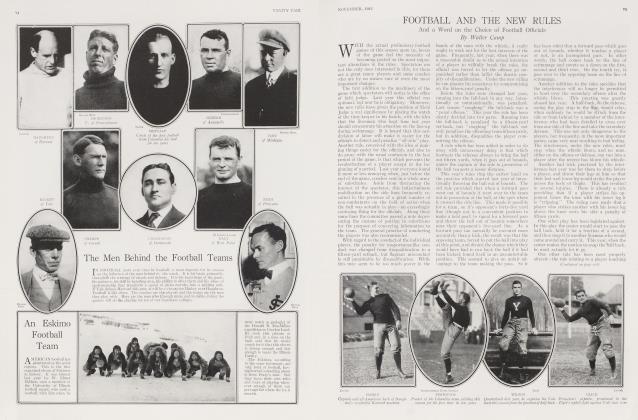
COACHES from the larger institutions in the East, where the game was first taken up, became at an early date in great demand in the West. They went, these Eastern coaches, from one institution to another, spreading the cult of American football from the Atlantic to the Pacific. Fielding H. Yost, for instance, who has made such a name at Michigan, is a Lafayette man; Stagg at Chicago, and Williams at Minnesota, are Yale men, as is Sharpe who is now at Cornell. Harvard, Yale, Princeton and Pennsylvania have their own graduates as coaches.
For three seasons now we have talked "open play" in football, but we have not had it. This year we are going to have the real thing. The early games have already demonstrated this. Open play does not mean simply a battery of forward passes and a team that can bring off three or four of them. It means the introduction of the passing game as a definite form of attack, not as a mere device to drive the defensive backs away from the support of the line so that the old running game can be effective. Yet it should be borne in mind by the enthusiast that the history of the game shows that whatever burden is put upon the defense, that defense after a time adjusts itself, either through added experience or (as in the case of good natural football players) through what seems an almost uncanny intuition, soon matches up with the attack. So it will be with the open game. What will fool the defense early in the season will be far less effective a month from now, unless the increased proficiency in handling the ball, and in masking the plays, shall in turn make them nearly doubly effective.
But all this will add materially to the interest and enjoyment of the spectators, and it is safe to say that the play this year will be more attractive to the crowd than in any previous season. The prowess of the individual will be displayed as never before, but success will be based even more largely upon team work and strategic variation of the plays. If the new game is developed, for another season or two, we shall see the very best points of all the schools united in a game that will combine, the team work of the old American style blended with the passing in Rugby as well as a generalship of a new and advanced type. And the season will have added interest in that the schedules have taken on a wider significance. There is a greater opportunity for testing sectional superiority. Pennsylvania has met Michigan for a number of years, but this year the Quakers will not be alone in taking on a team from the middle West, for Harvard is to play Michigan at Cambridge in what is admittedly a real test game for both elevens.
OF the teams as they stand to-day Harvard has carried over the greatest number of veterans, and that too of a championship team; so that October finds the Cambridge squad by far the strongest of any of the teams in the country. Their wonderful backfield of last year, Brickley, Mahan, Logan and Bradlee, is intact. There are only a few losses in the line, and those not especially serious. At Yale there is also a very strong backfield, and one that has already demonstrated its ability to play the new game and handle the ball well. But the line at New Haven was decimated by graduation and the candidates who possess championship material seem exceptionally scarce.
Princeton has an unusually promising lot of material and, with Boland as a forward passer, and an excellent defensive line, she is building her game around an open attack far more than she has in recent years.
Pennsylvania was hurt by graduations, as was also Michigan, and both these teams are behind in developing, owing to the necessity of preparing new material. Cornell started the season weakly with a defeat by Pittsburg, exactly as she did last year, but Sharpe, last season, proved his ability as a coach by bringing a team from this very mediocrity up to a winner, and he will surely be heard from on Thanksgiving Day.
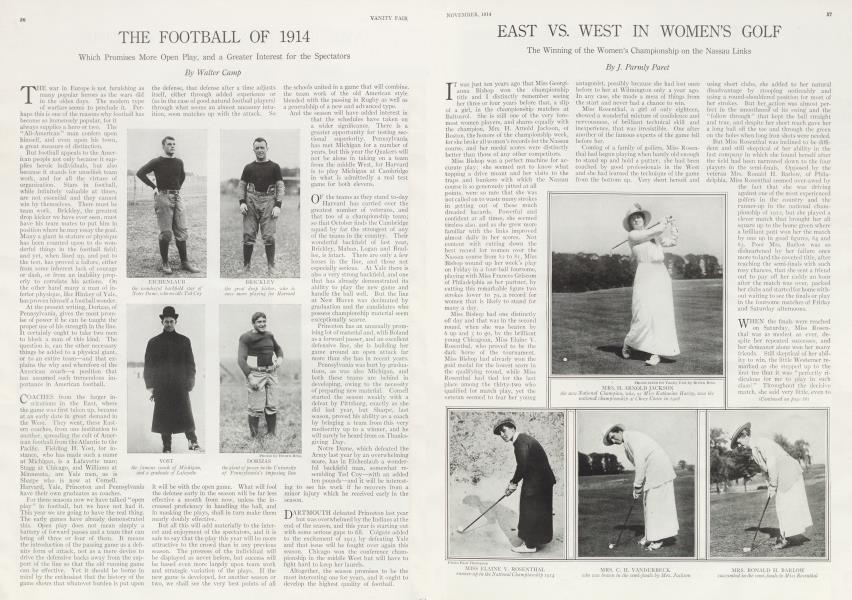
Notre Dame, which defeated the Army last year by an overwhelming score, has in Eichenlaub a wonderful backfield man, somewhat resembling Ted Coy—with an added ten pounds—and it will be interesting to see his work if he recovers from a minor injury which he received early in the season.
DARTMOUTH defeated Princeton last year but was overwhelmed by the Indians at the end of the season, and this year is starting out with some serious gaps to fill. Colgate added to the excitement of 1913 by defeating Yale and that issue will be fought over again this season. Chicago won the conference championship in the middle West but will have to fight hard to keep her laurels.
Altogether, the season promises to be the most interesting one for years, and it ought to develop the highest quality of football.
Subscribers have complete access to the archive.
Sign In Not a Subscriber?Join Now