Sign In to Your Account
Subscribers have complete access to the archive.
Sign In Not a Subscriber?Join NowA CASTLE OF EXCHANTMENT
Ernest Peixotto
The only Rhenish Stronghold which Escaped the Ravages of the French
WHOEVER has made the Rhine-journey, will remember near Coblentz, the point of land called the Deutche Eck, formed by the junction of the Moselle with the Rhine and now decorated with a colossal monument to Emperor William 1.
But a few miles up the first-mentioned river, close to the village of Mosel kern to be exact, there opens a narrow valley shut in by vineclad hillslopes and carpeted with matten — as quiet and secluded a vale as one could find. Through it glides a rivulet no wider than an arm's length with waters so limpid that Cyane or Galatea themselves might well delight to bathe their shapely limbs therein. Trout lie slily under alder branches in the deeper pools or dart like arrows from root to root as a shadow troubles the water's surface. Two mills are the only vestiges of human habitation in half an hour's walk. Then all trace of man is left behind, except a footpath leading up and down under oaks and beeches and the frilled leaves of the hornbeam. The whistle of a quail, the coo of a dove, the faint rustling of the leaves are the only sounds that break the morning stillness.
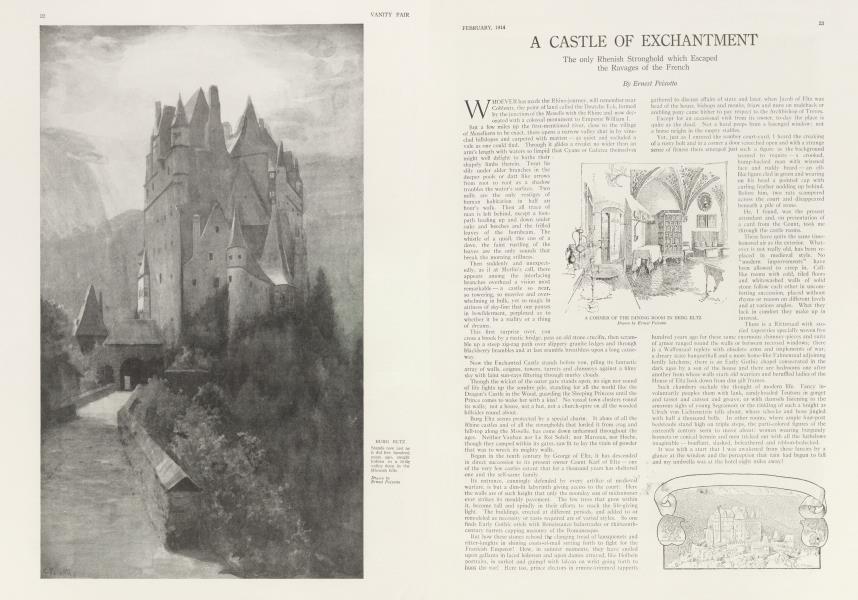
Then suddenly and unexpectedly, as if at Merlin's call, there appears among the interlacing branches overhead a vision most remarkable— a castle so near, so towering, so massive and overwhelming in bulk, yet so magic in airiness of sky-line that one pauses in bewilderment, perplexed as to whether it be a reality or a thing of dreams.
This first surprise over, you
cross a brook by a rustic bridge, pass an old stone crucifix, then scramble up a steep zig-zag path over slippery granite ledges and through blackberry brambles and at last stumble breathless upon a long causeway.
Now the Enchanted Castle stands before you, piling its fantastic array of walls, coignes, towers, turrets and chimneys against a filmy sky with faint sun-rays filtering through murky clouds.
Though the wicket of the outer gate stands open, no sign nor sound of life lights up the sombre pile, standing for all the world like the Dragon's Castle in the Wood, guarding the Sleeping Princess until the Prince comes to wake her with a kiss! No vassal town clusters round its walls; not a house, not a hut, not a church-spire on all the wooded hillsides round about.
Burg Eltz seems protected by a special charm. It alone of all the Rhine castles and of all the strongholds that lorded it from crag and hill-top along the Moselle, has come down unharmed throughout the ages. Neither Vauban nor Le Roi Soleil; nor Marceau, nor Hoche, though they camped within its gates, saw fit to lay the train of powder that was to wreck its mighty walls.
Begun in the tenth century by George of Eltz, it has descended in direct succession to its present owner Count Karl of Eltz — one of tho very few castles extant that for a thousand years has sheltered one and the self-same family.
Its entrance, cunningly defended by every artifice of medieval warfare, is but a dim-lit labyrinth giving access to the courtY Here the walls are of such height that only the noonday sun of midsummer -ever strikes its mouldy pavement. The few trees that grow within it, become tall and spindly in their efforts to reach the life-giving light. The buildings, erected at different periods, and added to or remodeled as necessity or taste required are of varied styles. So one finds Early Gothic oriels with Renaissance balustrades or thirteenthcentury turrets capping masonry of the Romanesque.
But how these stones echoed the clanging tread of lansquenets and ritter-knights in shining coats-of-mail setting forth to fight for the Frankish Emperor! How, in sunnier moments, they have smiled upon gallants in laced ledersen and upon dames arrayed, like Holbein portraits, in surkot and guimpf with falcon on wrist going forth to hunt the roe! Here too, prince electors in ermine-trimmed tapperts gathered to discuss affairs of state and later, when Jacob of Eltz was head of the house, bishops and monks, friars and nuns on muleback or ambling pony came hither to pay respect to the Archbishop of Treves.
Except for an occasional visit from its owner, to-day the place is quite as the dead. Not a head peeps from a lozenged window; not a horse neighs in the empty stables.
Yet, just as I entered the somber court-yard, I heard the creaking of a rusty bolt and in a corner a door screeched open and with a strange sense of fitness there emerged just such a figure as the background seemed to require — a crooked, hump-backed man with wizened face and ruddy beard — an elflike figure clad in green and wearing on his head a pointed cap with curling feather nodding up behind. Before him, two rats scampered across the court and disappeared beneath a pile of stone.
He, I found, was the present attendant and, on presentation of a card from the Count, took me through the castle rooms.
These have quite the same timehonored air as the exterior. Whatever is not really old, has been replaced in medieval style. No "modern improvements'' have been allowed to creep in. Celllike rooms with cold, tiled floors and whitewashed walls of solid stone follow each other in uncomforting succession, placed without rhyme or reason on different levels and at various angles. What they lack in comfort they make up in interest.
There is a Rittersaal with storied tapestries specially woven five hundred years ago for these same enormous chimney-pieces and suits of armor ranged round the walls or between recessed windows; there is a Waffensaal replete with obsolete arms and implements of war; a dreary state banquethall and a more home-like Fahnensaal adjoining lordly kitchens; there is an Early Gothic chapel consecrated in the dark ages by a son of the house and there are bedrooms one after another from whose walls stark old warriors and beruffled ladies of the House of Eltz look down from dim gilt frames.
Such chambers exclude the thought of modern life. Fancy involuntarily peoples them with lank, sandyheaded Teutons in gorget and tasset and cuissot and greave, or with damsels listening to the amorous sighs of young Segramors or the tinkling of such a knight as Ulrich von Lichtenstein tells about, whose schecke and hose jingled with half a thousand bells. In other rooms, where ample four-post bedsteads stand high on triple steps, the parti-colored figures of the sixteenth century seem to move about: women wearing burgundy bonnets or conical hennin and men tricked out with all the furbelows imaginable — bouffant, slashed, befcathered and ribbon-bedecked.
It was with a start that I was awakened from these fancies by a glance at the window and the perception that rain had begun to fall and my umbrella was at the hotel eight miles away!
Subscribers have complete access to the archive.
Sign In Not a Subscriber?Join Now
