Sign In to Your Account
Subscribers have complete access to the archive.
Sign In Not a Subscriber?Join NowTHE MODE DISPLAYS A DUAL PERSONALITY
French Reports Tell, on the One Hand, of the Ruffles and Puffs of 1830, and on the Other, of the Pocketed Skirt and Waistcoat of—Shall We Say, 1930?
What they Wear in Vanity Fairs
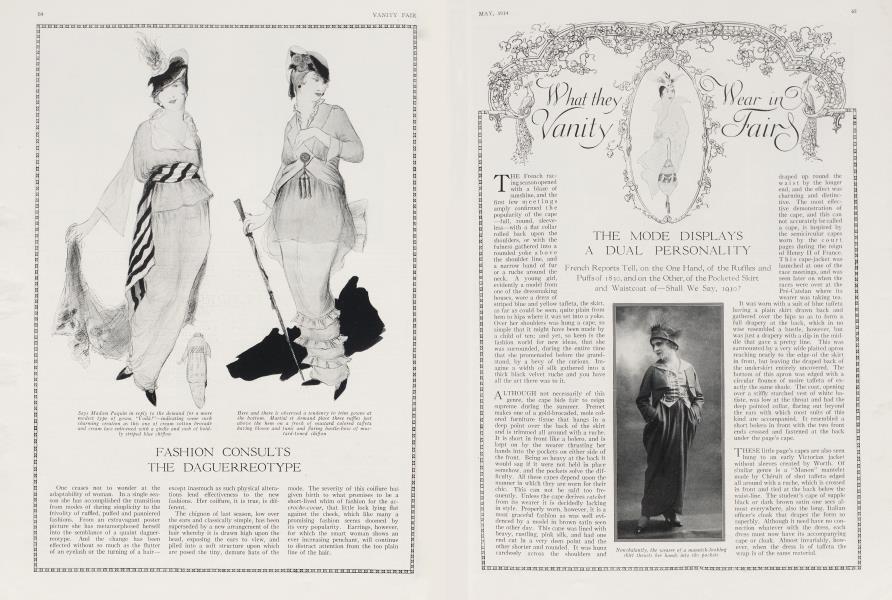
THE French racing season opened with a blaze of sunshine, and the first few meetings amply confirmed the popularity of the cape —full, round, sleeveless—with a flat collar rolled back upon the shoulders, or with the fulness gathered into a rounded yoke above the shoulder line, and a narrow band of fur or a ruche around the neck. A young .girl, evidently a model from one of the dressmaking houses, wore a dress of striped blue and yellow taffeta, the skirt, as far as could be seen, quite plain from hem to hips where it was set into a yoke. Over her shoulders was hung a cape, so simple that it might have been made by a child of ten; and yet, so keen is the fashion world for new ideas, that she was surrounded, during the entire time that she promenaded before the grandstand, by a bevy of the curious. Imagine a width of silk gathered into a thick black velvet ruche and you have all the art there was to it.
ALTHOUGH not necessarily of this genre, the cape bids fair to reign supreme during the summer. Premet makes one of a gold-brocaded, mole colored furniture tissue that hangs in a deep point over the back of the skirt and is trimmed all around with a ruche. It is short in front like a bolero, and is kept on by the wearer thrusting her hands into the pockets on either side of the front. Being so heavy at the back it would sag if it were not held in place somehow, and the pockets solve the difficulty. All these capes depend upon the manner in which they are worn for their chic. This can not be said too frequently. Unless the cape derives catchet from its wearer it is decidedly lacking in style. Properly worn, however, it is a most graceful fashion as was well evidenced by a model in brown satin seen the other day. This cape was lined with heavy, rustling, pink silk, and had one end cut in a very deep point and the other shorter and rounded. It was hung carelessly across the shoulders and draped up round the waist by the longer end, and the effect was charming and distinctive. The most effective demonstration of the cape, and this can not accurately be called a cape, is inspired by the semicircular capes worn by the court pages during the reign of Henry II of France. This cape-jacket was launched at one of the race meetings, and was seen later on when the races were over at the Pré-Catelan where its wearer was taking tea.
It was worn with a suit of blue taffeta having a plain skirt drawn back and gathered over the hips so as to form a full drapery at the back, which in no wise resembled a bustle, however, but was just a drapery with a dip in the middle that gave a pretty line. This was surmounted by a very wide plaited apron reaching nearly to the edge of the skirt in front, but leaving the draped back of the underskirt entirely uncovered. The bottom of this apron was edged with a circular flounce of moire taffeta of exactly the same shade. The coat, opening over a stiffly starched vest of white batiste, was low at the throat and had the deep pointed collar, flaring out beyond the ears with which most suits of this kind are accompanied. It resembled a short bolero in front with the two front ends crossed and fastened at the back under the page's cape.
THESE little page's capes are also seen hung to an early Victorian jacket without sleeves created by Worth. Of similar genre is a "Manon" mantelet made by Chéruit of shot taffeta edged all around with a ruche, which is crossed in front and tied at the back below the waist-line. The student's cape of supple black or dark brown satin one sees almost everywhere, also the long, Italian officer's cloak that drapes the form so superbly. Although it need have no connection whatever with the dress, each dress must now have its accompanying cape or cloak. Almost invariably, however, when the dress is of taffeta the wrap is of the same material.
An exaggeration in one detail of the mode is frequently corrected in another direction. These little garments were brought into being by the very transparent and much decollete bodices and blouses of the past few seasons. They give an added air of sloppiness to the figure which, according to taste, one finds either charming or untidy; and this sloppiness is causing a great deal of discussion at the present moment as to whether all this freedom is desirable.
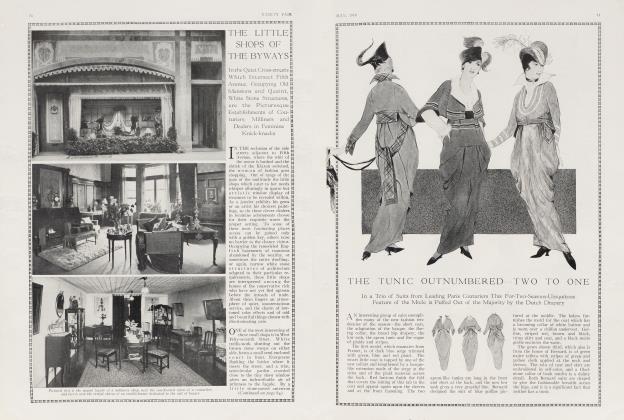
THE question of the corset is a burning one and is discussed by many of the great French writers of the day, who, as has before been pointed out in these pages, do not disdain to give the weight of their opinions to such a momentous question as La Mode. And already the effect may be noted. Drecoll, Paquin, and Bernard, are beginning, oh, ever so slightly and with extreme caution, as it were, to fit the figure. Drecoll shows a tailored gown of beige serge with skirt pulled very high at the back, but innocent of the bustle, which is accompanied by a basque-coat having the shaped underarm seam which we have not seen for many seasons.
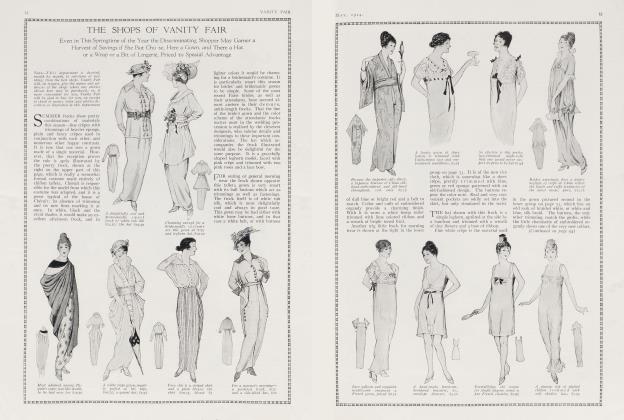
Boue, who has been responsible for so many pretty and charming new ideas, amongst them the "baby" bow at the back of the dress, goes a step further and boldly launches the fitted back in a model of which a sketch appears at the lower right corner of page 68. This is a new and almost unexpected move. Will it find favor in the eyes of those who, by their rank or by prestige of elegance, are recognized as leaders of the fashion?
If next-season's bodices are to be fitted, then inevitably the skirts will flare. This deduction is made by the law of contrasts which never fails to dominate all that appertains to clothes. But the flare can also fit, and the most noticeable method of obtaining this effect is the godet movement which is being introduced in wraps and skirts—witness the flounce at the bottom of the wrap shown in the middle at the top of this page. Drecoll and Poiret have achieved happy effects in this direction in a tunic flaring wide at the feet, which is cut on the plan of the basque so often seen on the coats and placed over a narrow plain skirt so that it falls in a cascade in front. Drecoll's model, of which a sketch is shown to the right of the middle in the lower group on page 68, is of red cloth with a bodice of chiffon in the same shade.
IT WOULD seem that women have decided that if they must have fussy dresses for afternoons and evenings at least they will have none of them before eleven a.m. Prior to this hour the ultrachic garb is a suit cut on mannish lines. Jeanne Lanvin shows two very smart models of this type, the one fashioned exactly like a man's cutaway and the other similar to a Prince Albert. Poiret, too, has achieved some of his very best efforts in this direction. Waistcoats which show no evidence of diminishing popularity are in accord with this masculine note, which is also reflected in some of the very small and very simple hats and in the flaring white collars which are worn on everything.
IF THERE had been any doubt about it, the races would have confirmed all the reports concerning the popularity of Scotch and other plaids. They are seen in all varieties, but those with huge stripes and squares which make it almost impossible to follow the design are what is captivating most the capricious fancy of the Parisian. Americans seem to have a predilection for a mixture of serge and silk woven in blue, green and yellow plaids, and these are the more effective because they lend themselves to so many wayward fancies. An American girl, tall, dark and beautiful, of the type that carries clothes so well, was seen wearing a fine blue serge gown with a bodice which looked like a bolero, but which was really in one piece with the dress. Around her slender waist was a wide, shapeless girdle of Scotch plaid. This gown is pictured at the lower left corner of this page.
The older woman who accompanied her wore a very smart Callot model of black charmeuse. Its chief charm lay in the sleeves. They were of white tulle over pale pink chiffon, so pale as to be almost white, and they had a double ruche at the wrist with a band of black velvet between the frills, and a touch of the same tulle over the bust. About the neck was a draped apache scarf of the charmeuse like the dress, loosely looped in front over the bust. It was attached to the dress at the back of the neck, where it lost all resemblance to the apache scarf and simulated a rolling Japanese collar.
IN SPITE of the persuasions and the inducements held out to them by the dressmakers, who include all the colors of the rainbow in their collection this spring, the smart women of Paris continue to wear black. The bright yellows, and the new bright green called chartreuse are reserved for the simple tailormade gowns that are seen in the Bois in the morning. Many of them are of a new silken material, very light and soft, but more often they are of serge or gabardine, or supple whipcord and the like, or of cote de cheval.
There is to be a veritable deluge of taffeta this summer—black taffeta with a pattern of pomegranates in gold thread; blue with a flowered pattern in green or mauve stamped upon it; pink with Louis XVI designs showing baskets of flowers worked in silk, and gold thread.
Subscribers have complete access to the archive.
Sign In Not a Subscriber?Join Now

