Sign In to Your Account
Subscribers have complete access to the archive.
Sign In Not a Subscriber?Join NowMR. DAVIS, OUR LITERARY JEUNE PREMIER
With Notes on Canon Hannay and a Few Other Novelists
Henry Brinsley
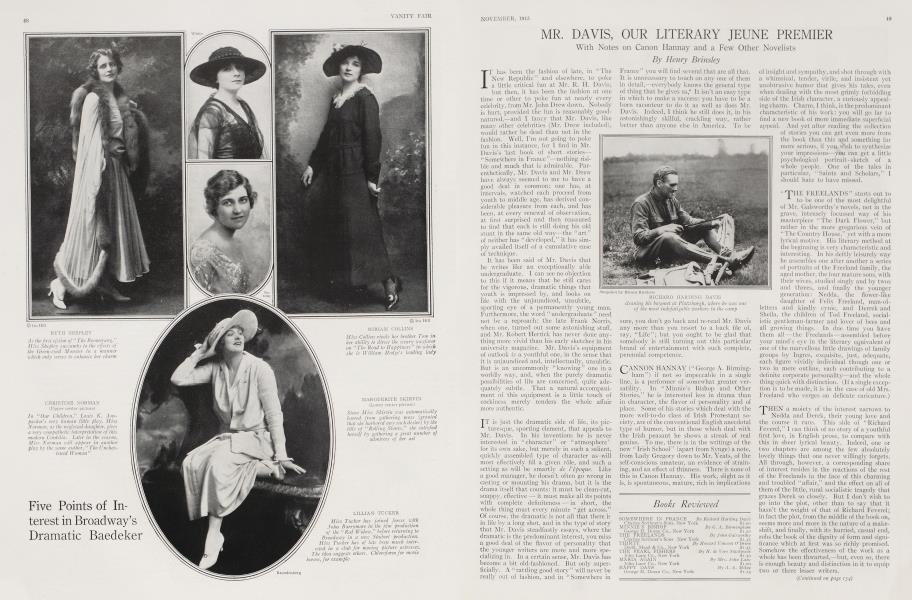
IT has been the fashion of late, in "The New Republic" and elsewhere, to poke a little critical fun at Mr. R. H. Davis; but then, it has been the fashion at one time or other to poke fun at nearly every celebrity, from Mr. John Drew down. Nobody is hurt, provided the fun is reasonably goodnatured,—and I fancy that Mr. Davis, like many other celebrities (Mr. Drew included), would rather be dead than not in the fashion. Well, I'm not going to poke fun in this instance, for I find in Mr. Davis's last book of short stories— "Somewhere in France"—nothing risible and much that is admirable. Parenthetically, Mr. Davis and Mr. Drew have always seemed to me to have a good deal in common: one has, at intervals, watched each proceed from youth to middle age, has derived considerable pleasure from each, and has been, at every renewal of observation, at first surprised and then reassured to find that each is still doing his old stunt in the same old way—the "art" of neither has "developed," it has simply availed itself of a cumulative ease of technique.
It has been said of Mr. Davis that he writes like an exceptionally able undergraduate. I can see no objection to this if it means that he still cares for the vigorous, dramatic things that youth is impressed by, and looks on life with the unjaundiced, unsubtle, sporting eye of a permanently young man. Furthermore, the word "undergraduate" need not be a reproach: the late Frank Norris, when one, turned out some astonishing stuff, and Mr. Robert Herrick has never done anything more vivid than his early sketches in his university magazine. Mr. Davis's equipment of outlook is a youthful one, in the sense that it is unjaundiced and, intellectually, unsubtle. But is an uncommonly "knowing" one in a worldly way, and, when the purely dramatic possibilities of life are concerned, quite adequately subtle. That a natural accompaniment of this equipment is a little touch of cockiness merely renders the whole affair more authentic.
IT is just the dramatic side of life, its picturesque, sporting element, that appeals to Mr. Davis. In his inventions he is never interested in "character" or "atmosphere' for its own sake, but merely in such a salient, quickly assembled type of character as will most effectively fill a given role, and such a setting as will be smartly de Vepoque. Like a good manager, he doesn't often go wrong in casting or mounting his drama, but it is the drama itself that counts: it must be clean-cut, snappy, effective — it must make all its points with complete definiteness — in short, the whole thing must every minute "get across." Of course, the dramatic is not all that there is in life by a long shot, and in the type of story that Mr. Davis steadfastly essays, where the dramatic is the predominant interest, you miss a good deal of the flavor of personality that the younger writers are more and more specializing in. In a certain sense, Mr. Davis has become a bit old-fashioned. But only superficially. A " rattling good story" will never be really out of fashion, and in "Somewhere in France you will find several that are all that. It is unnecessary to touch on any one of them in detail,—everybody knows the general type of thing that he gives us. It isn't an easy type in which to make a success: you have to be a born raconteur to do it as well as does Mr. Davis. Indeed, I think he still does it, in his astonishingly skilful, crackling way, rather better than anyone else in America. To be sure, you don't go back and re-read Mr. Davis any more than you resort to a back file of, say, "Life"; but you ought to be glad that somebody is still turning out this particular brand of entertainment with such complete, perennial competence.
QANNON HANNAY ("George A. Birmingham") if not so impeccable in a single line, is a performer of somewhat greater versatility. In "Minnie's Bishop and Other Stories," he is interested less in drama than in character, the flavor of personality and of place. Some of his stories which deal with the more well-to-do class of Irish Protestant society, are of the conventional English anecdotal type of humor, but in those which deal with the Irish peasant he shows a streak of real genius. To me, there is in the writings of the new "Irish School" (apart from Synge) a note, from Lady Gregory down to Mr. Yeats, of the self-conscious amateur, an evidence of straining, and an effect of thinness. There is none of this in Canon Hannay. His work, slight as it is, is spontaneous, mature, rich in implications of insight and sympathy, and shot through with a whimsical, tender, virile, and insistent yet unobtrusive humor that gives his tales, even when dealing with the most grimly forbidding side of the Irish character, a curiously appealing charm. Charm, I think, is the predominant characteristic of his work: you will go far to find a new book of more immediate superficial appeal. And yet after reading the collection of stories you can get even more from the book than this and something far more serious, if you wish to synthesize your impressions—you can get a little psychological portrait-sketch of a whole people. One of the tales in particular, "Saints and Scholars," I should hate to have missed.
Books Reviewed
SOMEWHERE IN FRANCE By Richard Harding Davis Charles Scribner's Sons, New York $1.00
MINNIE'S BISHOP By G. A. Birmingham
George H. Doran Co., New York I1.20
THE FREELANDS By John Galsworthy
Charles Scribner's Sons New York $1.35
THIRTY By Howard Vincent O'Brien
Dodd, Mead & Co., New York Si.35
THE PEARL FISHERS By H. de Vere Stackpoole
John Lane Co., New York S1.30
MARIA AGAIN By Mrs. John Lane
John Lane Co., New York S1.00
HAPPY DAYS By A. A. Milne
George H. Doran Co., New York $1.25
"THE FREELANDS" starts out to to be one of the most delightful of Mr. Galsworthy's novels, not in the grave, intensely focussed way of his masterpiece "The Dark Flower," but rather in the more gregarious vein of "The Country House," yet with a more lyrical motive. His literary method at the beginning is very characteristic and interesting. In his deftly leisurely way he assembles one after another a series of portraits of the Freeland family, the aged mother, the four mature sons, with their wives, studied singly and by twos and threes, and finally the younger generation: Nedda, the flower-like daughter of Felix Freeland, man-of-letters and kindly cynic, and Derrek and Sheila, the children of Tod Freeland, socialistic gentleman-farmer and lover of bees and all growing things. In due time you have them all — the Freelands—assembled before your mind's eye in the literary equivalent of one of the marvellous little drawings of family groups by Ingres, exquisite, just, adequate, each figure vividly individual though one or two in mere outline, each contributing to a definite corporate personality—and the whole thing quick with distinction. (If a single exception is to be made, it is in the case of old Mrs. Freeland who verges on delicate caricature.)
THEN a moiety of the interest narrows to Nedda and Derek, their young love and the course it runs. This side of "Richard Feverel," I can think of no story of a youthful first love, in English prose, to compare with this in sheer lyrical beauty. Indeed, one or two chapters are among the few absolutely lovely things that one never willingly forgets. All through, however, a corresponding share of interest resides in the reactions of the rest of the Freelands in the face of this charming and troubled "affair," and the effect on all of them of the little, rural socialistic tragedy that grazes Derek so closely. But I don't wish to go into the plot, other than to say that it hasn't the weight of that of Richard Feverel; in fact the plot, from the middle of the book on, seems more and more in the nature of a makeshift, and finally, with its hurried, casual end, robs the book of the dignity of form and significance which at first was so richly promised. Somehow the effectiveness of the work as a whole has been thwarted,—but, even so, there is enough beauty and distinction in it to equip two or three lesser writers.
(Continued on page 154)
(Continued from page 49)
"THIRTY," by Mr. Howard Vincent O'Brien, is "a newspaper story by a newspaper man." (I shall draw freely from the publisher's prospectus.) Brent Good, the socialistic hero, sets out to see,—as did the hero of Mr. Adams' "Clarion"—if a newspaper could "tell the truth frankly without fear of even the advertisers and win a success." He is, Messrs. Dodd, Mead and Company are convinced, "an outstanding character in the fiction of the season." And the heroine, "a beautiful, but thoughtless heiress, left alone with her equally undeveloped brother, is no less a real example of the fashionable 'smart set.'" Beside Brent, there is a fashionable rector who tries to influence the heroine. "Reminiscent of 'The Inside of the Cup,' 'Thirty' is a book that will make the reader think." Well, it has made one reader think that it has all been done before—by Mr. Adams, Mr. Churchill, and others: that Mr. O'Brien gives us a not wholly uninteresting but very much diluted version: and that he knows his newspaper people distinctly better than he does the others in his book.
In "The Pearl Fishers," Mr. Stackpoole uses again his own successful formula: two men and a woman are isolated in the South Seas; the right man and the woman combine, the wrong man intrigues; aborigines arrive and eventually, after good stand-up fights, are slain, and the villain is condignly rewarded. Sometimes a tale of adventure like this is a welcome mental rest. Mr. Stackpoole isn't an inspired genius but he writes clearly, with good movement and color, and his yarn is commendably free from slovenliness. You can with a clear conscience take his "Pearl Fishers," like his "Blue Lagoon," as reasonably agreeable padding for an empty hour. It is idle to think how wonderfully different the book would be if Mr. Conrad tackled it.
Two books of humor complete my list: "Maria Again," by Mrs. John Lane, and "Happy Days," by Mr. Milne of "Punch." Maria is a garrulous lady with a middle-class wit that combines with itself a certain amount of diverting, pedestrian philosophy. Her chief topics are chiffons and domestic difficulties. A little of the pleasant Maria goes a great way. You must take Mr. Milne, too, in small doses, for a slightly different reason—his delightfully whimsical, irresponsible, tangential wit has too delicate an edge to withstand the blunting effect of long handling.
Subscribers have complete access to the archive.
Sign In Not a Subscriber?Join Now
