


Sign In to Your Account
Subscribers have complete access to the archive.
Sign In Not a Subscriber?Join NowA ST. PAUL'S FOR AMERICAN HEROES
The Foundation-Stone of Which Has at Last Been Laid
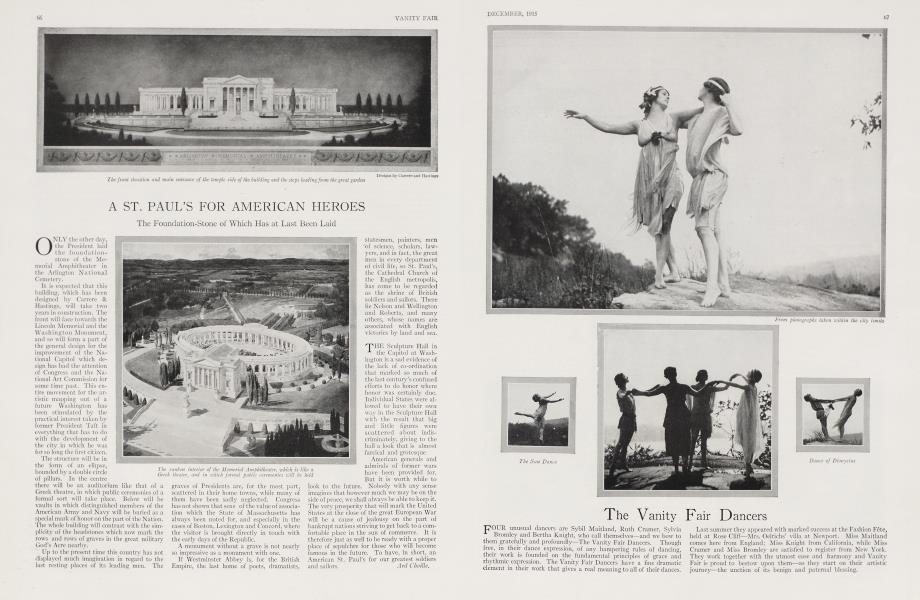
ONLY the other day, the President laid the foundationstone of the Memorial Amphitheater in the Arlington National Cemetery.
It is expected that this building, which has been designed by Carrere & Hastings, will take two years in construction. The front will face towards the Lincoln Memorial and the Washington Monument, and so will form a part of the general design for the improvement of the National Capitol which design has had the attention of Congress and the National Art Commission for some time past. This entire movement for the artistic mapping out of a future Washington has been stimulated by the practical interest taken by former President Taft in everything that has to do with the development of the city in which he was for so long the first citizen.
The structure will be in the form of an ellipse, bounded by a double circle of pillars. In the centre there will be an auditorium like that of a Greek theatre, in which public ceremonies of a formal sort will take place. Below will be vaults in which distinguished members of the American Army and Navy will be buried as a special mark of honor on the part of the Nation. The whole building will contrast with the simplicity of the headstones which now mark the rows and rows of graves in the great military God's Acre nearby.
Up to the present time this country has not displayed much imagination in regard to the last resting places of its leading men. The graves of Presidents are, for the most part, scattered in their home towns, while many of them have been sadly neglected. Congress has not shown that sens of the value of association which the State of Massachusetts has always been noted for, and especially in the cases of Boston, Lexington and Concord, where the visitor is brought directly in touch with the early days of the Republic.
A monument without a grave is not nearly so impressive as a monument with one.
If Westminster Abbey is, for the British Empire, the last home of poets, dramatists, statesmen, painters, men of science, scholars, lawyers, and in fact, the great men in every department of civil life, so St. Paul's, the Cathedral Church of the English metropolis, has come to be regarded as the shrine of British soldiers and sailors. There lie Nelson and Wellington and Roberts, and many others, whose names are associated with English victories by land and sea.
THE Sculpture Hall in the Capitol at Washington is a sad evidence of the lack of co-ordination that marked so much of the last century's confused efforts to do honor where honor was certainly due. Individual States were allowed to have their own way in the Sculpture Hall with the result that big and little figures were scattered about indiscriminately, giving to the hall a look that is almost farcical and grotesque.
American generals and admirals of former wars have been provided for. But it is worth while to look to the future. Nobody with any sense imagines that however much we may be on the side of peace, we shall always be able to keep it. The very prosperity that will mark the United States at the close of the great European War will be a cause of jealousy on the part of bankrupt nations striving to get back to a comfortable place in the sun of commerce. It is therefore just as well to be ready with a proper place of sepulchre for those who will become famous in the future. To have, in short, an American St. Paul's for our greatest soldiers and sailors.
Ard Choille
Subscribers have complete access to the archive.
Sign In Not a Subscriber?Join Now