Sign In to Your Account
Subscribers have complete access to the archive.
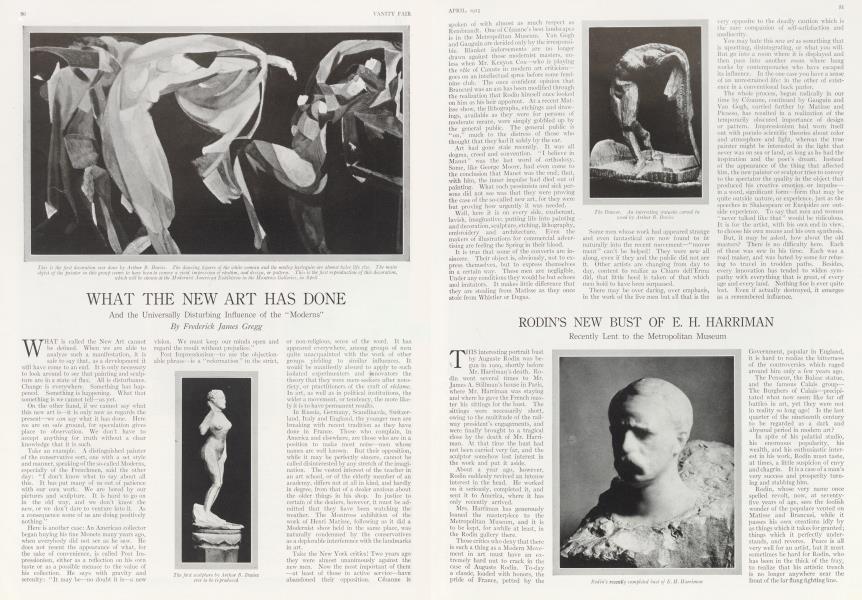
Sign In Not a Subscriber?Join NowWHAT THE NEW ART HAS DONE
And the Universally Disturbing Influence of the "Moderns"
Frederick James Gregg
WHAT is called the New Art cannot be defined. When we are able to analyze such a manifestation, it is safe to say that, as a development it will have come to an end. It is only necessary to look around to see that painting and sculpture are in a state of flux. All is disturbance. Change is everywhere. Something has happened. Something is happening. What that something is we cannot tell—as yet.
On the other hand, if we cannot say what this new art is—it is only new as regards the present—we can say what it has done. Here we are on safe ground, for speculation gives place to observation. We don't have to accept anything for truth without a clear knowledge that it is such.
Take an example. A distinguished painter of the conservative sort, one with a set style and manner, speaking of the so-called Moderns, especially of the Frenchmen, said the other day: "I don't know what to say about all this. It has put many of us out of patience with our own work. We are bored by our pictures and sculpture. It is hard to go on in the old way, and we don't know the new, or we don't dare to venture into it. As a consequence some of us are doing positively nothing."
Here is another case: An American collector began buying his fine Monets many years ago, when everybody did not see as he saw. He does not resent the appearance of what, for the sake of convenience, is called Post Impressionism, either as a reflection on his own taste or as a possible menace to the value of his collection. He says with gravity and serenity: "It may be—no doubt it is—a new vision. We must keep our minds open and regard the result without prejudice."
Post Impressionism—to use the objectionable phrase—is a "reformation" in the strict, or non-religious, sense of the word. It has appeared everywhere, among groups of men quite unacquainted with the work of other groups yielding to similar influences. It would be manifestly absurd to apply to such isolated experimenters and innovators the theory that they were mere seekers after notoriety, or practitioners of the craft of reclame. In art, as well as in political institutions, the wider a movement, or tendency, the more likely it is to have permanent results.
In Russia, Germany, Scandinavia, Switzerland, Italy and England, the younger men are breaking with recent tradition as they have done in France. Those who complain, in America and elsewhere, are those who are in a position to make most noise—men whose names are well known. But their opposition, while it may be perfectly sincere, cannot be called disinterested by any stretch of the imagination. The vested interest of the teacher in an art school, or of the elderly member of an academy, differs not at all in kind, and hardly in degree, from that of a dealer anxious about the older things in his shop. In justice to certain of the dealers, however, it must be admitted that they have been watching the weather. The Montross exhibition of the work of Henri Matisse, following as it did a Modernist show held in the same place, was naturally condemned by the conservatives as a deplorable interference with the landmarks in art.
Take the New York critics! Two years ago they were almost unanimously against the new men. Now the most important of them —at least of those in active sendee—have abandoned their opposition. Cezanne is spoken of with almost as much respect as Rembrandt. One of Cezanne's best landscapes is in the Metropolitan Museum. Van Gogh and Gauguin are derided only by the irresponsible. Blanket indorsements are no longer drawn against those modernist masters, unless when Mr. Kenyon Cox—who is playing the role of Canute in modern art criticismgoes on an intellectual spree before some feminine club. The once confident opinion that Brancusi was an ass has been modified through the realization that Rodin himself once looked on him as his heir apparent. At a recent Matisse show, the lithographs, etchings and drawings, available as they were for persons of moderate means, were simply gobbled up by the general public. The general public is "on," much to the distress of those who thought that they had it safely by the ear.
Art had gone stale recently. It was all dogma, creed and convention. I believe in Manet" was the last word of orthodoxy. Some, like George Moore, had even come to the conclusion that Manet was the end; that, with him, the inner impulse had died out of painting. What such pessimists and sick persons did not see was that they were proving the case of the so-called new art, for they were but proving how urgently it was needed.
Well, here it is on every side, exuberant, lavish, imaginative; putting life into painting and decoration, sculpture, etching, lithography, embroidery and architecture. Even the makers of illustrations for commercial advertising are feeling the Spring in their blood.
It is true that some of the converts are insincere. Their object is, obviously, not to express themselves, but to express themselves in a certain way. These men are negligible. Under any conditions they would be but echoes and imitators. It makes little difference that they are stealing from Matisse as they once stole from Whistler or Degas.
Some men whose work had appeared strange and even fantastical are now found to fit naturally into the recent movement—"move* ment" can't be helped! They were new all along, even if they and the public did not see it. Other artists are changing from day to day, content to realize as Chiaro dell'Erma did, that little heed is taken of that which men hold to have been surpassed.
There may be over daring, over emphasis, in the work of the live men but all that is the very opposite to the deadly caution which is the sure companion of self-satisfaction and mediocrity.
You may hate this new art as something that is upsetting, disintegrating, or what you will. But go into a room where it is displayed and then pass into another room where hang works by contemporaries who have escaped its influence. In the one case you have a sense of an unrestrained life: in the other of existence in a conventional back parlor.
The whole process, begun radically in our time by Cezanne, continued by Gauguin and Van Gogh, carried further by Matisse and Picasso, has resulted in a realization of the temporarily obscured importance of design or pattern. Impressionism had worn itself out with pseudo scientific theories about color and atmosphere and light, whereas the true painter might be interested in the light that never was on sea or land, as long as he had the inspiration and the poet's dream. Instead of the appearance of the thing that affected him, the new painter or sculptor tries to convey to the spectator the quality in the object that produced his creative emotion or impulse— in a word, significant form—form that may be quite outside nature, or experience, just as the speeches in Shakespeare or Euripides are outside experience. To say that men and women "never talked like that" would be ridiculous. It is for the artist, with his own end in view, to choose his own means and his own synthesis.
But, it may be asked, how about the old masters? There is no difficulty here. Each of these was new in his time. Each was a road maker, and was hated by some for refusing to travel in trodden paths. Besides, every innovation has tended to widen sympathy with everything that is great, of every age and every land. Nothing fine is ever quite lost. Even if actually destroyed, it emerges as a remembered influence.
Subscribers have complete access to the archive.
Sign In Not a Subscriber?Join Now
