Sign In to Your Account
Subscribers have complete access to the archive.
Sign In Not a Subscriber?Join NowSHOPPING FOR THE WELL-DRESSED MAN
A Few Remarks Concerning a Theory That Actually Behaves in Practise
Robert Lloyd Trevor
THERE is probably nothing in this mad world that is quite so delightful in the eyes of its possessor as a wellbehaved theory. By well-behaved, I mean, of course, a theory that actually works in practise. The reason for this is that really wellbehaved theories are scarce. In view of which statement I crave your indulgence, for I am going to assert unblushingly that I possess one —about men's clothes.
Before plunging into an exposition of it, I feel that I should publicly ask pardon of Mr. Thomas Wise and Mr. Vernon Castle for having taken the liberty of using them as illustrations. The former is assuredly too—must I say it?—Wise, to cherish any illusions as to his girth, and the latter must certainly be aware of the fact that he is not noticeably short and stout. And so, with the hope that all is now well on the Rialto, we will proceed with the theory:
Horizontal lines—especially if straight— and light colors accentuate shortness and stoutness; long, sweeping curves, subdued colors and vertical lines accentuate height and thinness. And the converse is true—that is to say, horizontal lines and light colors diminish the effect of height and thinness; long sweeping curves, subdued colors and vertical lines reduce the effect of shortness and stoutness. There you have it, in all its exquisite simplicity.
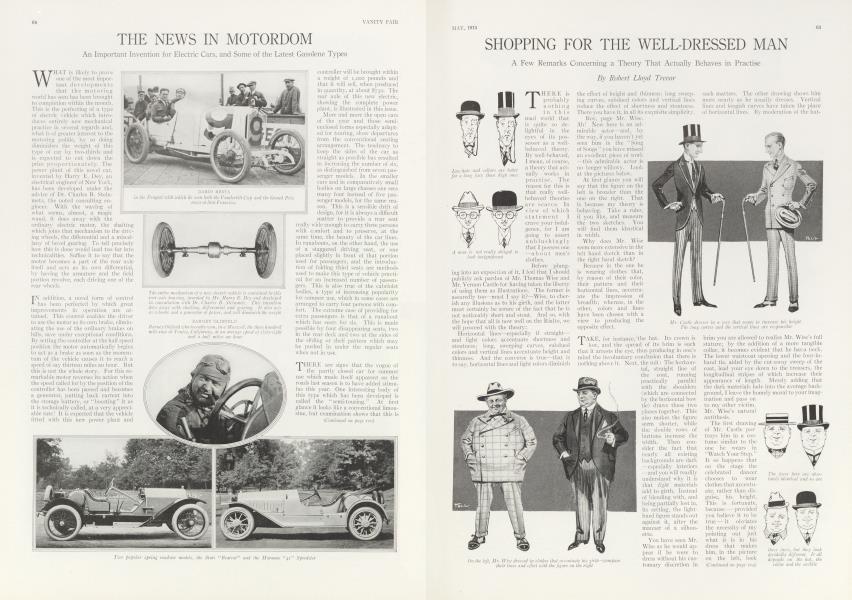
Boy, page Mr. Wise. Ah! Now here is an admirable actor—and, by the way, if you haven't yet seen him in the "Song of Songs" you have missed an excellent piece of work —this admirable actor is no longer willowy. Look at the pictures below.
At first glance you will say that the figure on the left is broader than the one on the right. That is because my theory is behaving. Take a ruler, if you like, and measure the two sketches. You will find them identical in width.
Why does Mr. Wise seem more extensive in the left hand sketch than in the right hand sketch?
Because in the one he is wearing clothes that, by reason of their color, their pattern and their horizontal lines, accentuate the impression of breadth; whereas, in the other, colors and lines have been chosen with a view to producing the opposite effect.
TAKE, for instance, the hat. Its crown is low, and the spread of its brim is such that it arrests the eye, thus producing in one's mind the involuntary conclusion that there is nothing above it. Next, the suit: The horizontal, straight line of the coat, running practically parallel with the shoulders (which are connected by the horizontal bow tie) draws these two planes together. This also makes the figure seem shorter, while the double rows of buttons increase the width. Then consider the fact that nearly all existing backgrounds are dark —especially interiors —and you will readily understand why it is that light materials add to girth. Instead of blending with, and being partially lost in, its setting, the lighthued figure stands out against it, after the manner of a silhouette.
You have seen Mr. Wise as he would appear if he were to dress without his customary discretion in such matters. The other drawing shows him more nearly as he usually dresses. Vertical lines and longish curves have taken the place of horizontal lines. Bv moderation of the hatbrim you are allowed to realize Mr. Wise's full stature; by the addition of a more tangible collar, it becomes evident that he has a neck. The lower waistcoat opening and the four-inhand tie, aided by the cut-away sweep of the coat, lead your eye down to the trousers, the longitudinal stripes of which increase their appearance of length. Merely adding that the dark materials fade into the average background, I leave the homely moral to your imagination and pass on to my other victim, Mr. Wise's natural antithesis.
The first drawing of Mr. Castle portrays him in a costume similar to the one he wears in "Watch Your Step." It so happens that on the stage the celebrated dancer chooses to wear clothes that accentuate, rather than disguise, his height. This is fortunate, because — provided you believe it to be true — it obviates the necessity of my pointing out just what it is in his dress that makes him, in the picture on the left, look taller and thinner than in the picture on the right.
(Continued on page 104)
(Continued from page 65)
Apply the theory yourself to the cut of the coat, and the waistcoat, the length of tie shown, and the height of the collar and hat. Remember, too, the effect of height produced on the legs of Mr. Wise by stripes, and observe how it produces the same effect in the left-hand drawing of Mr. Castle. You may even blot out the rounded corners of the coat, giving it a straight line at the bottom, on an exact level with the gray coat on the right, and the striped trousers will still seem longer than the checked ones.
THIS article and the illustrations are intended simply to emphasize points I have observed in my own experience. Chief of these is the proposition that any man may be well dressed provided he uses a slight allowance of common sense in suiting his figure with his clothes.
For a man to say that he can't be bothered to expend valuable thought on the subject is a little too absurd. It is not to be expected that he will sit down for hours to puzzle the thing out; nor is it necessary or desirable for him to do so. There is nothing on earth of less consequence than the person who devotes all his time—outside of meals—to a careful study of his personal appearance. On the other hand, however, man is required by law—man-made, as the suffragists will tell you—to wear adequate covering, and it is really no more trouble for him to procure the right kind of covering, while he is about it, than it is for him to accept any old thing that his tailor, or haberdasher—who is perhaps more to be pitied than censured—wants to be rid of. If he will simply think of his clothes while he is ordering them, he can afford to forget them at all other times.
A letter addressed to Vanity Fair will bring yon in return the addresses of any articles illustrated in these pages. Nexi month, this department will deal with the newest clothes and accessories for summer, fully illustrated and described
IN these days of vestpocket apartments, it is becoming increasingly difficult to know how to keep one's clothes and accessories and still have room in which to move around. Built-in wardrobes usually have no drawers or even shelves, and the ordinary dressing-table takes up a great deal of space without being particularly handy.
Here is an invention, known as a Closinette, which does away with numerous troubles. On seeing it first, in the room of a friend, I mistook it for a victrola, and idly opened it with a view to finding out about his taste in rag-time. Imagine my surprise, therefore, when I was confronted with a mirror instead of a green baize disk, and tiers of drawers instead of racks of records. Further examination of this remarkable piece of furniture disclosed the fact that it will hold everything, and hold it neatly and accessibly. There is a compartment for jewelry, studs, links, and so forth, and a disappearing shelf on which to stand things. There are drawers for shirts, collars, linen, and shoes. And on the inside of the door there are racks which can accommodate suits to the number of a dozen or so.
Subscribers have complete access to the archive.
Sign In Not a Subscriber?Join Now
