
Sign In to Your Account
Subscribers have complete access to the archive.
Sign In Not a Subscriber?Join NowHOW WOMEN CAN GROW OLD
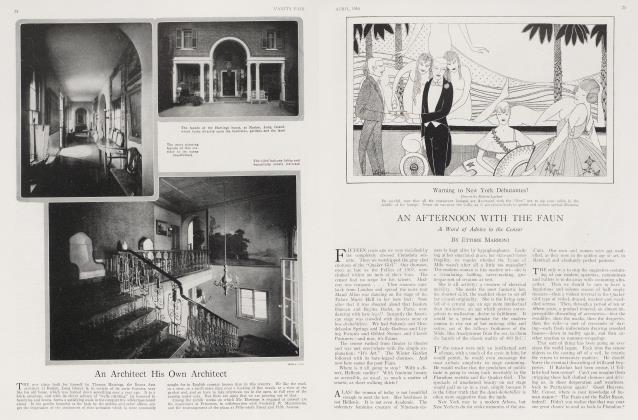
HOW many of the women we pass in the street could wear, with impunity, the styles one sees in the fashion magazines? The fashion designer creates his models for human bean stalks with wasp's waists, and ignores all the women who are not as graceful and lithe as gazelles, as beautiful as summer fruit, and as straight as antique columns. He fashions clothes for bodies that Phidias might have modeled or that Titian might have painted, divinely nude.
And what of the others? What of the fat women, the thin women, the women who are too tall or too small or simply too formless? Doesn't the capricious sprite, La Mode, realize that the ugly woman, or the mediocre woman, or the old woman is as feminine as her beautiful sister? No one has ever thought of designing fashions for her. And yet she is ninetenths of the feminine population of the world!
Of course if the women of to-day were as perfect as the women of ancient Greece, we would not have to overtax our ingenuity to create styles for them. But wouldn't we weary of a womanhood implacably moulded in one form? Wouldn't the very symmetry of those Grecian bodies, built according to a superior but always identical architectural plan—one just like the other—grow as tiresome as a row of suburban villas all made in one mould?
The fashion magazines are to the women of to-day what the Arcadian poetry was to the women of the eighteenth century. Phyllis and Daphne were always as rosy as the dawn, and their eyes were Cupid's darts or thunderbolts that struck the sighing suitor to his knees. And yet we see a good many of these same beauties in the portrait galleries, where they look very like wrinkled, blear-eyed septuagenarians.
When the woman of the Twentieth Century begins to show unmistakable signs of her matronly state, she has to squeeze herself into a sheath of stuff that was created for girls still in their teens. One sees serene, mild-faced mothers wearing saucy little hats designed for a bride on her honeymoon. The woman of forty usually has a daughter who must not be allowed to discover her mother's daily struggle with the passing years. She has a husband who must not be permitted to notice that every other woman is more attractive than his wife. So she goes to the fashion magazines for help, and they deprive her, wilfully and uncharitably, of all her autumnal charms. She is made pitiful and absurd. Fashion's greatest mistake is that it does not respect maturity.
The irreverence of the Parisian dressmakers and designers toward senility is only an indication of the Latin woman's inability to grow old gracefully. Cheque age a scs plaisirs, says an old French adage.
The American women age more charmingly because they age more slowly. In southern countries—perhaps because of the precocious flowering of Latin womanhood that at fourteen is already vivid and full-blown—old age comes swiftly and with devastating finality.
The American woman of seventy travels around the world for amusement. At that age Latin women do not leave their houses except to totter to Mass. The middle-aged American woman's cheeks are like rosy porcelain, her glance is as brilliant as a boy's.
To grow old does not mean to die little by little; to withdraw into oneself; to despoil oneself of every desire; to watch one's own fading with the sad voluptuousness of an anchorite betrothed to Death.
OLD age is not the negation of life; it is only a phase of life. Its thoughts, pleasures and desires arc as valuable and consistent as youth's. Why shouldn't old age be properly clothed, its dignity enhanced, its beauty protected? It is time that Fashion faced the Truth.
The small circle of a man's arm does not constitute the orbit of the world. When that circle is irrevocably closed, a woman should be as charming and graceful as she was at twenty, but in a new way. A man's whisper of love is not all the poetry and music of the universe.
ETTORF. MARRONI.
Subscribers have complete access to the archive.
Sign In Not a Subscriber?Join Now