Sign In to Your Account
Subscribers have complete access to the archive.
Sign In Not a Subscriber?Join NowLATEST NEWS FROM THE LITERARY TRENCHES
Henry Brinsley
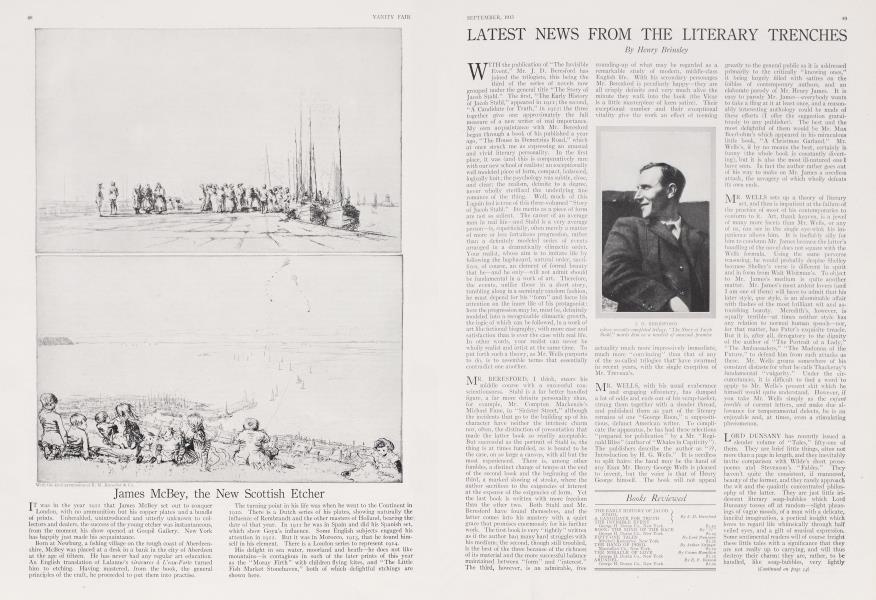
WITH the publication of "The Invisible Event," Mr. J. D. Beresford has joined the trilogists, this being the third of the series of novels now grouped under the general title "The Story of Jacob Stahl." The first, "The Early History of Jacob Stahl," appeared in 1911; the second, "A Candidate for Truth," in 1912: the three together give one approximately the full measure of a new writer of real importance. My own acquaintance with Mr. Beresford began through a book of his published a year ago, "The House in Demetrius Road," which at once struck me as expressing an unusual and vivid literary personality. In the first place, it was (and this is comparatively rare with our new school of realists) an exceptionally well modeled piece of form, compact, balanced, logically knit; the psychology was subtle, close, and clear; the realism, definite to a degree, never wholly sterilized the underlying fine romance of the thing. Well, much of this I again feel is true of this three-volumed " Story of Jacob Stahl." Its merits as a piece of form are not so salient. The career of an average man in real life—and Stahl is a very average person—is, superficially, often merely a matter of more or less fortuitous progression, rather than a definitely modeled series of events arranged in a dramatically climactic order. Your realist, whose aim is to imitate life by following the haphazard, natural order, sacrifices, of course, an element of formal beauty that he—and he only—will not admit should be fundamental in a work'of art. Therefore, the events, unlike those in a short story, tumbling along in a seemingly random fashion, he must depend for his "form" and focus his attention on the inner life of his protagonist: here the progression may be, must be, definitely modeled into a recognizable climactic growth, the logic of which can be followed, in a work of art like fictional biography, with more ease and satisfaction than is ever the case with real life. In other words, your realist can never be wholly realist and artist at the same time. To put forth such a theory, as Mr. Wells purports to do, is to assemble terms that essentially contradict one another.
MR. BERESFORD, I think, steers his middle course with a successful conscientiousness. Stahl is a far better handled figure, a far more definite personality than, for example, Mr. Compton Mackenzie's Michael Fane, in "Sinister Street," although the incidents that go to the building up of his character have neither the intrinsic charm nor, often, the distinction of presentation that made the latter book so readily acceptable. But successful as the portrait of Stahl is, the thing is at times fumbled, as is bound to be the case, on so large a canvas, with all but the most experienced. There is, among other fumbles, a distinct change of tempo at the end of the second book and the beginning of the third, a marked slowing of stroke, where the author sacrifices to the exigencies of interest at the expense of the exigencies of form. Yet the last book is written with more freedom than the other two. Both Stahl, and Mr. Beresford have found themselves, and the latter comes into his mastery with a quiet grace that promises enormously for his further work. The first book is very " tightly " written as if the author haa many hard struggles with his medium; the second, though still troubled, is the best of the three because of the richness of its material and the more successful balance maintained between "form" and "interest." The third, however, is an admirable, free rounding-up of what may be regarded as a remarkable study of modern, middle-class English life. With his secondary personages Mr. Beresford is peculiarly happy—they are all crisply definite and very much alive the minute they walk into the book (the Vicar is a little masterpiece of keen satire). Their exceptional number and their exceptional vitality give the work an effect of teeming actuality much more impressively immediate, much more "convincing" than that of any of the so-called trilogies that have swarmed in recent years, with the single exception of Mr. Trevena's.
MR. WELLS, with his usual exuberance and engaging effrontery, has dumped a lot of odds and ends out of his scrap-basket, strung them together with a slender thread, and published them as part of the literary remains of one "George Boon," a supposititious, defunct American writer. To complicate the apparatus, he has had these selections "prepared for publication" by a Mr. "Reginald Bliss" (authorof "Whales in Captivity"). The publishers describe the author as "??, Introduction by H. G. Wells." It is needless to split hairs: the hand may be the hand of any Esau Mr. Henry George Wells is pleased to invent, but the voice is that of Henry George himself. The book will not appeal greatly to the general public as it is addressed primarily to the critically "knowing ones," it being largely filled with satires on the foibles of contemporary authors, and an elaborate parody of Mr. Henry James. It is easy to parody Mr. James—everybody wants to take a fling at it at least once, and a reasonably interesting anthology could be made of these efforts (I offer the suggestion gratuitously to any publisher). The best and the most delightful of them would be Mr. Max Beerbohm's which appeared in his miraculous little book, "A Christmas Garland." Mr. Wells's, if by no means the best, certainly is funny (the whole book .is constantly diverting), but it is also the most ill-natured one I have seen. Iu fact the author rather goes out of his way to make on Mr. Jame9 a needless attack, the savagery of which wholly defeats ifs own ends.
Books Reviewed
THE EARLY HISTORY OF JACOB STAHL A CANDIDATE FOR TRUTH THE INVISIBLE. EVENT
}By J. D. Beresford
George H. Doran Co.. New York S2.50 BOON: THE MIND OF THE RACEBy "??" George H. Doran Co., New York $1.25 FIFTY-ONE TALESBy Lord Dunsany Mitchell Kennerlev. New. York $1.25 THE HAND OF PERILBy Arthur Stringer Macmillan Co.. New York $1.25 THE MIRACLE OF LOVEBy Cosmo Hamilton George H. Doran Co., New York $1.25 ARUNDELBy E. F. Benson George-H. Doran Co., New York - $1.25
MR. WELLS sets up a theory of literary art, and then is impatient at the failure of the practice of most of his contemporaries to conform to it. Art, thank heaven, is a jewel of many more facets than Mr. Wells, or any of us, can see in the single eye-wink his impatience allows him. It is ineffably silly for him to condemn Mr. James because the latter's handling of the novel does not square with the Wells formula. Using the same perverse reasoning, he would probably despise Shelley because Shelley's verse is different in spirit and in form from Walt Whitman's. To object to Mr. James's medium is quite another matter. Mr. James's most ardent lovers (and I am one of them) will have to admit that his later style, qua style, is an abominable affair with flashes of the most brilliant wit and astonishing beauty. Meredith's, however, is equally terrible—at times neither style has any relation to normal human speech—nor, for that matter, has Pater's exquisite treacle. But it is, after all, derogatory to the dignity of the author of "The Portrait of a Lady," "The Ambassadors," "The Madonna of the Future," to defend him from such attacks as these. Mr. Wells groans somewhere of his constant distaste for what he calls Thackeray's fundamental "vulgarity." Under the circumstances, it is difficult to find a word to apply to Mr. Wells's present skit which he himself would quite understand. However, if you take Mr. Wells simply as the enfant terrible of current letters, and make due allowance for temperamental defects, he is an enjoyable and, at times, even a stimulating phenomenon.
LORD DUNSANY has recently issued a slender volume of "Tales," fifty-one of them. They are brief little things, often not more than a page in length, and they inevitably invite comparison with Wilde's short prosepoems and Stevenson's "Fables." They haven't quite the consistent, if mannered, beauty of the former, and they rarely approach the wit and the quaintly concentrated philosophy of the latter. They are just little iridescent literary soap-bubbles which Lord Dunsany tosses off at random—slight phrasings of vague moods, of a man with a delicate, fanciful imagination, a poetical insight which loves to regard life whimsically through half veiled eyes, and a gift of musical expression. Some sentimental readers will of course freight these liftle tales with a significance that they are not really up to carrying, and will thus destroy their charm: they are, rather, to be handled, like soap-bubbles, very lightly indeed. They gleam with faint colors for a moment and then break, leaving sometimes a speck of froth behind, sometimes nothing at all. Lord Dunsany blows them with much charm.
Continued on page 94
Continued, from page 49
"The Hand of Peril" is subtitled by its author, Mr. Arthur Stringer, "a novel of adventure," whereas I should label it a six-cylinder detective story. I have a particular fondness for detective stories (I wish fervidly that Mr. Zangwill—if he's still alive—would write another one), but this example leaves me a bit cold, because it is so mechanical. The hero spreads his net for a gang of counterfeiters in Paris and has them all encompassed, when a mesh breaks, and— presto—they arc in Palermo. He patiently performs the same operation in Palermo, again a mesh breaks, and—zip—they are in New York. So it goes through six acts structurally the same. It's as if you were buying sausages: the obliging purveyor takes down a string, and there is nothing organic about the structure of the string as a whole that predetermines whether he shall cut off one, two, six, or a dozen. It depends, perhaps, on how many you can carry. The author finds that six will comfortably fill his book, so six it is. Incidentally the ligament that holds these six morsels together is, of course, a "love-interest" between the detective and the chief criminal's putative daughter and assistant. I shouldn't mind all this so much if each sausage were a particularly fascinating or novel bonne bouche, but such, unfortunately this time with Mr. Stringer, is not the case.
MR. COSMO HAMILTON'S publishers write about him with a high lyricism as follows: "For charming scenes of society, smart country houses and great town houses, and dukes who sound like dukes, and also for love scenes that satisfy the reader, Cosmo Hamilton is widely known, and these characteristics are at their best in his new novel." This leaves me mildly gasping. I can only say that after reading "The Miracle of Love," I have been wondering about the author's literary paternity, or maternity. There's a little streak of Hall Caine in him and a big one of the late lamented Mrs. Hungerford. As for dukes, he can treat them with a colloquial freedom that might well cause Mr. Hugh Walpole to blush—and when it comes to sentimentality (oh, but of the most moral, "heart-throbbing" kind) he has the excellent Mrs. Florence Barclay simply lashed to the mast. A course in novel-reading like this would refine and humanize the most fractious of housemaids. I am delighted to have discovered Mr. Hamilton for myself.
Mr. E. F. Benson's new novel, "Arundel," is, I am sorry to say, distinctly below his own mark.
Subscribers have complete access to the archive.
Sign In Not a Subscriber?Join Now
