Sign In to Your Account
Subscribers have complete access to the archive.
Sign In Not a Subscriber?Join NowWHEN A PLAY IS NOT A PLAY
Some Reflections Upon the Illusion of the First Time and the Disillusion of Doing It Correctly
William Gillette
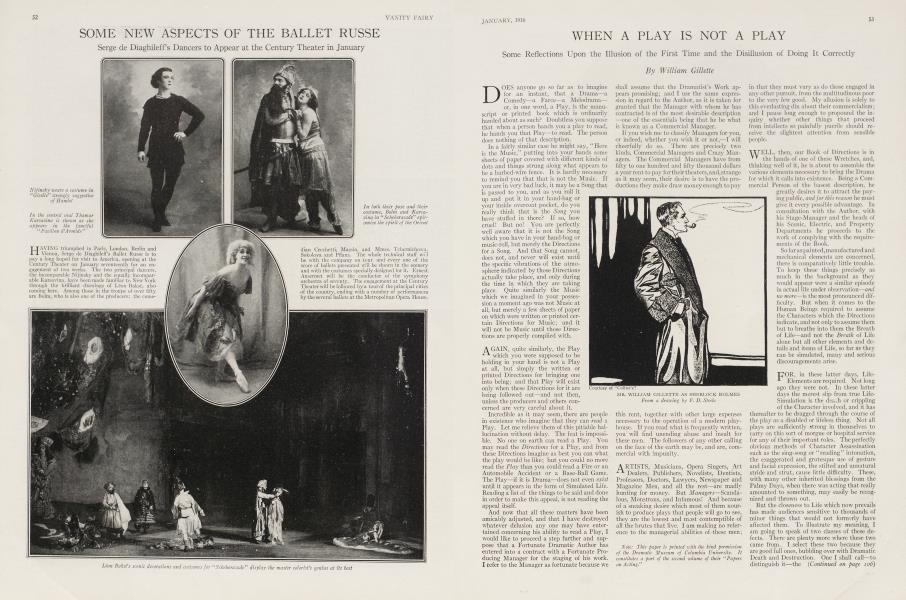
DOES anyone go so far as to imagine for an instant, that a Drama—a Comedy—a Farce—a Melodrama— or, in one word, a Play, is the manuscript or printed book which is ordinarily handed about as such? Doubtless you suppose that when a person hands you a play to read, he hands you that Play—to read. The person does nothing of that description.
In a fairly similar case he might say, "Here is the Music," putting into your hands some sheets of paper covered with different kinds of dots and things strung along what appears to be a barbed-wire fence. It is hardly necessary to remind you that that is not the Music. If you are in very bad luck, it may be a Song that is passed to you, and as you roll it up and put it in your hand-bag or your inside overcoat pocket, do you really think that is the Song you have stuffed in there? If so, how cruel! But no! You are perfectly well aware that it is not the Song which you have in your hand-bag or music-roll, but merely the Directions for a Song. And that Song cannot, does not, and never will exist until the specific vibrations of the atmosphere indicated by those Directions actually take place, and only during the time in which they are taking place. Quite similarly the Music which we imagined in your possession a moment ago was not Music at all, but merely a few sheets of paper on which were written or printed certain Directions for Music; and it will not be Music until those Directions are properly complied with.
A GAIN, quite similarly, the Play which you were supposed to be holding in your hand is not a Play at all, but simply the written or printed Directions for bringing one into being; and that Play will exist
only when these Directions for it are Courtesy of being followed out—and not then, unless the producers and others concerned are very careful about it.
Incredible as it may seem, there are people in existence who imagine that they can read a Play. Let me relieve them of this pitiable hallucination without delay. The feat is impossible. No one on earth can read a Play. You may read the Directions for a Play, and from these Directions imagine as best you can what the play would be like; but you could no more read the Play than you could read a Fire or an Automobile Accident or a Base-Ball Game. The Play—if it is Drama—does not even exist unt;il it appears in the form of Simulated Life. Reading a list of the things to be said and done in order to make this appeal, is not reading the appeal itself.
And now that all these matters have been amicably adjusted, and that I have destroyed whatever delusion any one may have entertained concerning his ability to read a Play, I would like to proceed a step further and suppose that a Fortunate Dramatic Author has entered into a contract with a Fortunate Producing Manager for the staging of his work.
I refer to the Manager as fortunate because we shall assume that the Dramatist's Work appears promising; and I use the same expression in regard to the Author, as it is taken for granted that the Manager with whom he has contracted is of the most desirable description —one of the essentials being that he be what is known as a Commercial Manager.
If you wish me to classify Managers for you, or indeed, whether you wish it or not,—I will cheerfully do so. There are precisely two kinds, Commercial Managers and Crazy Managers. The Commercial Managers have from fifty to one hundred and fifty thousand dollars a year rent to pay for their theaters, and, strange as it may seem, their desire is to have the productions they make draw money enough to pay this rent, together with other large expenses necessary to the operation of a modem playhouse. If you read what is frequently written, you will find unending abuse and insult for these men. The followers of any other calling on the face of the earth may be, and are, commercial with impunity.
ARTISTS, Musicians, Opera Singers, Art Dealers, Publishers, Novelists, Dentists, Professors, Doctors, Lawyers, Newspaper and Magazine Men, and all the rest—are madly hunting for money. But Managers—Scandalous, Monstrous, and Infamous! And because of a sneaking desire which most of them nourish to produce plays that people will go to see, they are the lowest and most contemptible of all the brutes that live. I am making no reference to the managerial abilities of-these men;
Note: This paper is printed with the kind permission of the Dramatic Museum of Columbia University. It constitutes a part of the second volume of their " Papers on Acting." in that they must vary as do those engaged in any other pursuit, from the multitudinous poor to the very few good. My allusion is solely to this everlasting din about their commercialism; and I pause long enough to propound the inquiry whether other things that proceed from intellects so painfully puerile should receive the slightest attention from sensible people.
WELL, then, our Book of Directions is in the hands of one of these Wretches, and, thinking well of it, he is about to assemble the various elements necessary to bring the Drama for which it calls into existence. Being a Commercial Person of the basest description, he greatly desires it to attract the paying public, and for this reason he must give it every possible advantage. In consultation with the Author, with his Stage-Manager and the heads of his Scenic, Electric, and Property Departments he proceeds to the work of complying with the requirements of the Book.
So far as painted, manufactured and mechanical elements are concerned, there is comparatively little trouble. To keep these things precisely as much in the background as they would appear were a similar episode in actual life under observation—and no more—is the most pronounced difficulty. But when it comes to the Human Beings required to assume the Characters which the Directions indicate, and not only to assume them but to breathe into them the Breath of Life—and not the Breath of Life alone but all other elements and details and items of Life, so far as they can be simulated, many and serious discouragements arise.
FOR, in these latter days, LifeElements are required. Not long ago they were not. In these latter days the merest slip from true LifeSimulation is the death or crippling of the Character involved, and it has thereafter to be dragged through the course of the play as a disabled or lifeless thing. Not all plays are sufficiently strong in themselves to carry on this sort of morgue or hospital service for any of their important roles. The perfectly obvious methods of Character Assassination such as the sing-song or "reading" intonation, the exaggerated and grotesque use of gesture and facial expression, the stilted and unnatural stride and strut, cause little difficulty. These, with many other inherited blessings from the Palmy Days, when there was acting that really amounted to something, may easily be recognized and thrown out.
But the closeness to Life which now prevails has made audiences sensitive to thousands of minor things that would not formerly have affected them. To illustrate my meaning, I am going to speak of two classes of these defects. There are plenty more where these two came from. I select these two because they are good full ones, bubbling over with Dramatic Death and Destruction. One I shall call—to distinguish it—the "Neglect of the Illusion of the First Time"; the other, the "Disillusion of Doing It Correctly."
(Continued on page 106)
(Continued from page 53)
Unfortunately for an actor (to save time I mean all known sexes by that), he knows, or is supposed to know, his part. He is fully aware—especially after several performances—of what he is going to say. The Character he is representing, however, does not know whathe is going to say, but, if he isa human being, various thoughts occur to him one by one, and he puts such of those thoughts as he decides to, into such speech as he happens to be able to command at the time. Now it is a very difficult thing—and even now rather an uncommon thing—for an actor who knows exactly what he is going to say to behave exactly as if he didn't; to let his thoughts (apparently) occur to him as he goes along, even though they are there in his mind already; and (apparently) to search for and find the words by which to express those thoughts, even though these words are at his tongue's very end. That's the terrible thing—at his tongue's very end! Living and breathing creatures do not carry their words in that part of their systems; they have to find them and send them there— with more or less rapidity according to their facility in that respect—as occasion arises.
This menace of Death from Neglect of the Illusion of the First Time is not confined to matters and methods of speech and mentality, but extends to every part of the presentation. Take the simple matter of entering a room to which, according to the plot or story, the Character coming in is supposed to be a stranger. Unless there is vigilance the actor will waft himself blithely across the threshold, conveying the impression that he has at least been born in the house— finding it quite unnecessary to look where he is going and not in the least worth while to watch out for thoughtless pieces of furniture that may, in their ignorance of his approach, have established themselves in his path. And the different scenes with the different people; and the behavior resulting from their behavior; and the love-scenes as they are called—these have a little tragedy all their own for the performers involved; for, if an actor plays his part in one of these with the gentle awkwardness and natural embarrassment of one in love for the first time—as the plot supposes him to be—he will have the delight of reading the most withering and caustic ridicule of himself in the next day's pai>ers, indicating in no polite terms that he is an awkward amateur who does not know his business. Whereas, if he behaves with the careless ease and grace and fluency of the Palmy Day Actor, softly breathing airy and poetic love-messages down the back of the lady's neck as he feelingly stands behind her so that they can both face to the front at the same time, the audience will be perfectly certain that the young man has had at least fifty-seven varieties of love-affairs l>efore and that the plot has been shamelessly lying about him.
The dangers to dramatic life and limb from the "Disillusion of Doing It Correctly" are scarcely less than those in the First Time class, but not so difficult to detect and eliminate. Speaking, breathing, walking, sitting, rising, standing, gesturing—in short behaving correctly, when the character under representation would not naturally or customarily do so, will either kill that character outright or make it very sick indeed. Drama can make its appeal only in the form of Simulated Life as it is Lived—not as various authorities on Grammar, Pronunciation, Etiquette, and Elocution happen to announce that it ought to be lived.
But we find it well to go much further than the keeping of studied and unusual correctness out, and to put common and to-be-expected errors in, when they may lie employed appiopriately and unobtrusively. To use every possible means and device for giving Drama that which makes it Drama—that is to say, Life-Simulation—must be the aim of the modern Play-Constructor and Producer.
The foregoing are a few only of the numberless parts or items in Drama-Presentation which must conform to the Illusion of the First Time. But this is one of the rather unusual cases in which the sum of all the parts does not equal the whole. For although every single item, from the most important to the least important, be successfully safeguarded, there yet remains the Spirit of the Presentation as a Whole. Each successive audience before which the Play is given must feel—not think or reason about, but fed—that it is witnessing, not one of a thousand weary repetitions, but a Life Episode that is being lived just across the magic barrier of the footlights. That is to say, the Whole must have that indescribable Life-Spirit or Effect which produces the Illusion of Happening for the First Time.
Subscribers have complete access to the archive.
Sign In Not a Subscriber?Join Now
