Sign In to Your Account
Subscribers have complete access to the archive.
Sign In Not a Subscriber?Join NowDOGS FOR THE COUNTRY HOME
And Some Suggestions for Purchasing Pastoral Puppies
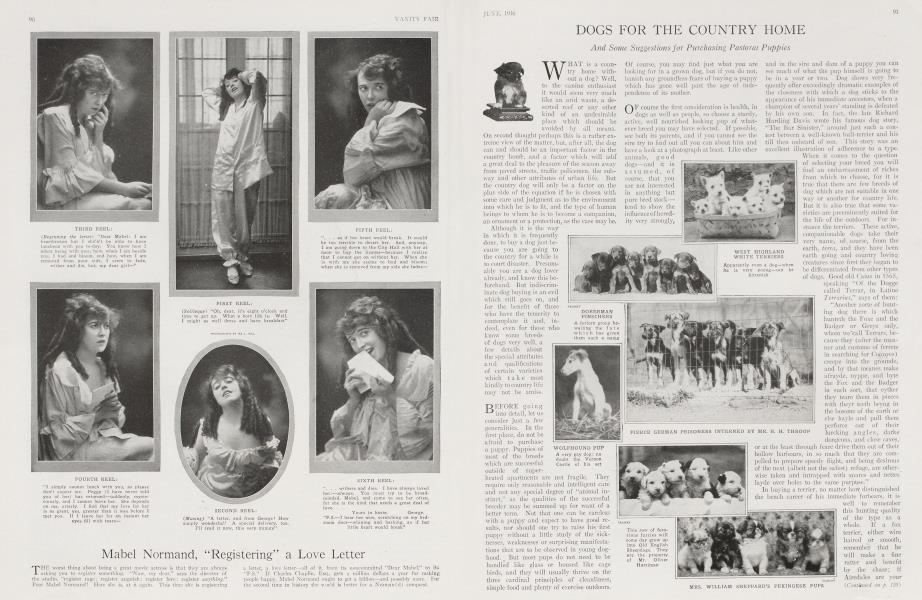
WHAT is a country home without a dog? Well, to the canine enthusiast it would seem very much like an arid waste, a deserted reef or any other kind of an undesirable place which should be avoided by all means. On second thought perhaps this is a rather extreme view of the matter, but, after all, the dog can and should be an important factor in the country home, and a factor which will add a great deal to the pleasure of the season away from paved streets, traffic policemen, the subway and other attributes of urban life. But the country dog will only be a factor on the plus side of the equation if he is chosen with some care and judgment as to the environment into which he is to fit, and the type of human beings to whom he is to become a companion, an ornament or a protection, as the case may be.
Although it is the way in which it is frequently done, to buy a dog just because you are going to the country for a while is to court disaster. Presunmably you are a dog lover already, and know this beforehand. But indiscriminate dog buying is an evil which still goes on, and for the benefit of those who have the temerity to contemplate it and, indeed, even for those who know some breeds of dogs very well, a few details about the special attributes and qualifications of certain varieties which take most kindly to country life may not be amiss.
BEFORE going into detail, let us consider just a few generalities. In the first place, do not be afraid to purchase a puppy. Puppies of most of the breeds which are successful outside of superheated apartments are not fragile. They require only reasonable and intelligent care and not any special degree of "animal instinct," as the qualities of the successful breeder may be summed up for want of a better term. Not that one can be careless with a puppy and expect to have good results, nor should one try to raise his first puppy without a little study of the sicknesses, weaknesses or surprising manifestations that are to be observed in young doghood. But most pups do not need to be handled like glass or housed like cage birds, and they will usually thrive on the three cardinal principles of cleanliness, simple food and plenty of exercise outdoors. Of course, you may find just what you are looking for in a grown dog, but if you do not, banish any groundless fears of buying a puppy which has gone well past the age of independence of its mother.
OF course the first consideration is health, in dogs as well as people, so choose a sturdy, active, well nourished looking pup of whatever breed you may have selected. If possible, see both its parents, and if you cannot see the sire try to find out all you can about him and have a look at a photograph at least. Like other animals, good dogs—and it is assumed, of course, that you are not interested in anything but pure bred stock— tend to show the influence of heredity very strongly, and in the sire and dam of a puppy you can see much of what the pup himself is going to be in a year or two. Dog shows very frequently offer exceedingly dramatic examples of the closeness with which a dog sticks to the appearance of his immediate ancestors, when a champion of several years' standing is defeated by his own son. In fact, the late Richard Harding Davis wrote his famous dog story, "The Bar Sinister," around just such a contest between a well-known bull-terrier and his till then unheard of son. This story was an excellent illustration of adherence to a type. When it comes to the question of selecting your breed you will find an embarrassment of riches from which to choose, for it is true that there are few breeds of dog which arc not suitable in one way or another for country life. But it is also true that some varieties are preeminently suited for the life of the outdoors. For instance the terriers. These active, companionable dogs take their very name, of course, from the earth, terra, and they have been earth going and country loving creatures since first they began to be differentiated from other types of dogs. Good old Caius in 1565, speaking "Of the Dogge called Terrar, in Latine Terrarms," says of them:
"Another sorte of hunting dog there is which hunteth the Foxe and the Badger or Greye only, whom we'call Terrars, because they (after the manner and custome of ferrets in searching for Connyes) creepe into the grounde, and by that meanes make afrayde, nyppe, and byte the Fox and the Badger in such sort, that eyther they teare them in pieces with theyr teeth beyng in the bosome of the earth or else hayle and pull them perforce out of their lurcking angles, darke dongeons, and close caves, or at the least through feare drive them out of their hollow harbours, in so much that they are compelled to prepare speedy flight, and being desirous of the next (albeit not the safest) refuge, are otherwise taken and intrapped with snares and nettes layde over holes to the same purpose."
In buying a terrier, no matter how distinguished the bench career of his immediate forbears, it is well to remember this hunting quality of the type as a whole. If a fox terrier, either wire haired or smooth, remember that he will make a fine ratter and benefit by the chase; if Airedales are your choice do not fail to bear in mind that, as a matter of fact, they also have their natural reminiscences of the chase, in this case the elusive otter of the valley of theAire. Many an Irish terrier has run with one of the famous foxhound packs on the hard riding Emerald Isle, to be on hand when the quarry went to earth. The Sealyhams are held by some authorities to derive their very name from the "seal" or track of the otter. And so on down the whole list of the terrier clan; Bull terrier, Welsh terrier, Scottish and West Highland white terrier, Dandie Dinmont, Manchester, Cairn and all the rest. They are active, hardy, alert and courageous dogs by nature, usually game to the core and for this reason just the thing for the outdoor ramble in any weather, to beat about the hedgerows with telegraphically active nose and tail. They have the heart and aggressiveness of a man's dog but many of their varieties have been brought to a sufficient degree of perfection of type to be very decorative as well and just the thing for the twentieth century woman who likes to tramp and poke about the farm a bit on her own account.
(Continued on p. 120)
(Continued, from page 91)
A SPLENDID breed for the large and parklike country estate is the Old English Sheepdog, tousled and enormous of coat, with his elephantine feet, entire disregard of climate and generally fine disposition. On such a place the majestic St. Bernard and no less regal Great Dane are also very much in keeping. These breeds really need large spaces to be at their best; they do not fit in happily with country property on the front yard basis. In spite of their size, they make splendid companions for children, and may well be chosen to grow up with a young family. Of course, the proper setting for the Russian wolfhound, whose native heath is the broad steppes, is spaciousness, and a dog of this breed will be found a delightful companion where the owner has a chance to do much riding. These aristocratic dogs love to follow and lead a horse.
TO go with you out into the spring woods and keep themselves delightfully busy beating through the coverts, or to lie on the porch and let the children pull their ears, Spaniels, either cocker or field, are well worth your attention. This fine old breed is distinguished for its excellent disposition and also for the characteristic fawning after chastisement, a trait by no means repellent in a dog as it would undoubtedly be in the human species. Of the virtues of the German Sheperd Dog and the Chow these pages have already had much to say. Suffice it to add here that each is a true country dog, especially the former, and a fine companion for nearly anything one may wish to do outdoors. Among the toy dogs a breed which does well in the country is the Pekingese. He is a true toy to be sure and should be kept so, but this does not mean that he is fragile. On the contrary, he is a sturdy little chap, and if properly housed will make himself quite at home many miles from Broadway.
the time this issue reaches its readers one of the important shows of the spring season will have come and gone; that of the French Bulldog Club of America at the Hotel McAlpin. There was an unusual degree of interest in the benching this year, largely due to the fact that Samuel L. Goldenburg was selected as judge.
At the show of the Ladies' Kennel Association of America, which is to be held as usual at Mineola this year on June fifth and sixth, there will be two English judges, a custom which this fixture has followed with some frequency. The experts who are coming over this year are W. J. Nichols, who will judge the poodle, bulldog, West Highland white terrier, Pekingese and miscellaneous classes, and R. T. Haines, who will have in hand the destinies of the fox, Scottish, Cairn and Welsh terriers, Pomeranians, pugs, toy poodles, Yorkshire, Maltese, toy bull and toy black and tan terriers and Brussels griffons.
IN a recent issue of Vanity Fair it was erroneously stated that Wire Boy of Paignton, George W. Quintard's famous wire haired fox terrier, had been defeated in the breed classes at the Garden by Conejo Wycollar Boy, his son. This was a mistake as the two dogs did riot meet in competition. Mr. Quintard had another triumph in Washington recently, winning with Champion Raby Dazzler for the best fox terrier in the show of the Washington Kennel Club.
ONCE again a team of Siberian wolfdogs, seventeen in number, has won the 412 mile All Alaska Sweepstakes for dog teams. Driven by Leonard Seppala, dogs and man came through the gruelling run in good condition. The time was eighty hours and twenty-seven minutes. Fay Delzene's team of fourteen Alaska-bred malemutes w,as second and Fred Ayer's team of foxhounds third. The purse was of $2,000.
Subscribers have complete access to the archive.
Sign In Not a Subscriber?Join Now
